Samuel Beckett (1906–1989) was an Irish novelist, playwright, and theatre director who spent much of his adult life in Paris and wrote in both English and French. A central figure in the Theatre of the Absurd, his works, including Waiting for Godot and Endgame, explore human existence, linguistic breakdown, and existential isolation with bleak, tragicomic humor.
In the years leading up to my conversion, I gradually became fascinated by Thomas á Kempis’s devotional text, The Imitation of Christ. I encountered it first in the letters of the young Samuel Beckett, and next in the interviews of Estonian composer Arvo Pärt, and then in all kinds of other unexpected places. Among them, this 1877 letter from Vincent Van Gogh to his beloved brother, Theo:
Emilie Morin’s recent book sheds light on Beckett’s engagement with cultural and political issues
Emilie Morin, Beckett’s Political Imagination (Cambridge University Press, 2017)
Could you tell me a little bit about yourself and your research interests?
My research revolves around modernism and post-1945 literature, and the essays and books that I have published on Beckett’s work explore its relation to politics, its historical dimensions, and its Irish and European influences. I have been working in the Department of English at the University of York for over ten years.
How did you first encounter Samuel Beckett’s writing?
I must have been about fifteen, I think, when I first heard about Beckett. A friend of mine told me about a play that she had seen in which two actors were trapped in rubbish bins, and I was intrigued! Soon after I came across copies of the early absurdist plays, in the lovely Editions de Minuit versions. I was particularly struck by Oh les beaux jours, with its memorable cover featuring Madeleine Renaud stoically holding her umbrella.
It seemed to me remarkable that a whole play could be made to unfold from that situation, from that image. The author was of no concern to me then, but from that first reading I recall being convinced that the work dealt with colonialism and with colonial wars, and I remember seeing a very literal political dimension within it. The French texts have a peculiar texture; they refract much of what is unsaid about colonial history, and much of what is culturally unsayable about historical injustice, and I was sensitive to that. These were powerful impressions, which stayed with me thereafter. When I began to study Beckett’s work properly, many years later, I did so in light of its Irish literary and historical contexts, and my first monograph was a reappraisal of Beckett’s relation to Ireland. For me, the work is never abstract: it is inseparable from war memory and from the long colonial histories that it invokes. In a sense, this new book was a return to my first impressions: when I started researching, I worked on what is now the final chapter on Beckett and the Algerian War of Independence. (more…)
As The Story Was Told (1996), a two-part documentary featuring interviews with authorised biographer James Knowlson, publishers John Calder and Barney Rosset, actress Billie Whitelaw, nephew Edward Beckett, and others. The documentary is notable, in part, for its glimpses of Beckett’s home in Paris and his country retreat in Ussy-sur-Marne.
The letters allow readers to glimpse over the shoulder of one of twentieth-century drama’s most distinguished playwrights as he corresponds with actors, directors, and loved ones
A philosopher in the ancient Greek city of Miletus posed a question. If somebody adds one grain of sand to another, and repeats the process, at what point do the grains of sand become a heap? The conundrum, known as the Sorites paradox, opens Samuel Beckett’s Endgame as part of Clov’s speech to the auditorium: ‘Finished, it’s finished, nearly finished, it must be nearly finished. [Pause] Grain upon grain, one by one, and one day suddenly, there’s a heap, a little heap, the impossible heap’. The paradox asks us to confront the ambiguities of rational thinking and empirical observation, and in Endgame it frames the ‘impossible’ problem of being in the world, of what constitutes a life lived.
I was reminded of the Sorites paradox in 2016, when Cambridge University Press published the fourth and final volume of Samuel Beckett’s correspondence. On the instruction of Beckett himself, Martha Dow Fehsenfeld led an editorial team to assemble, transcribe and translate thousands of letters, telegrams, and postcards held in archives and private collections around the world. These traces of Beckett’s personal and artistic life have been ordered chronologically, and fully annotated with cultural and historical notes that are accessible to the scholar and layman alike. Surmounting this seemingly impossible task, The Letters of Samuel Beckett brings these documents together in one place for the first time to form a masterwork of academic scholarship and rigour — allowing readers to glimpse over the shoulder of one of twentieth-century drama’s most distinguished playwrights as he corresponds with actors, directors, and loved ones.
This is an excerpt from a review of The Letters of Samuel Beckett: Volume 4, 1966-1989, edited by George Craig et al., (Cambridge University Press, 2016), published in Studies in Theatre and Performance(July, 2017).
Angela Moorjani on co-editing a new collection which recounts Samuel Beckett’s meetings with scholars, translators, and theatre practitioners
To begin, could you say a little bit about Samuel Beckett Today/Aujourd’hui?
SBT/A is a refereed academic journal that publishes essays in English and French on Samuel Beckett’s oeuvre.
When first launched in 1992 by the late Marius Buning and the present coeditor in chief Sjef Houppermans, it took the form of a bilingual annual review publishing selections from international meetings or solicited essays on special topics, but also featuring a section of submitted articles. By 2016, the year SBT/A morphed into a semiannual journal under a different academic publisher (Brill), twenty-seven handsome hardcover volumes had appeared under the Rodopi imprint. My association with SBT/A goes back twenty years with an essay in the “Crossroads and Borderlines” volume of 1997, further intensifying with my coediting the volume based on the “Beckett in Berlin 2000” symposium, after which I was invited to join the editorial board. I served as coeditor in chief from 2008 to 2016. (more…)
Anthony Uhlmann on co-editing a new essay collection exploring Coetzee’s recent novel, The Childhood of Jesus
How did you first encounter J.M. Coetzee’s writing?
In 2002 I was working on the preparation for a major conference on Samuel Beckett that was to take place in Sydney in 2003 and I was looking for keynotes. There was a major public lecture at the Sydney Town Hall which is a reasonably grand space. We invited a number of people including Herbert Blau and Luce Irigaray (via videolink). Someone suggested I ask J. M. Coetzee who was on the board of one of the research groups related to Samuel Beckett. I then went and read a few of his novels, including Disgrace, Waiting for the Barbarians, and The Master of Petersburg and was blown away by the quality of the works. I told him when I finally met him that he had renewed my faith in contemporary fiction. He agreed to act as a keynote and read the ‘At The Gate’ Lesson from Elizabeth Costello which had not yet been published when he read it January 2003. He spoke briefly of having mostly gained an understanding of rhythm, and the structure of sentences, from reading and studying Beckett. After that I read all of his novels and have been working towards writing about him. (more…)
David Lloyd talks about Beckett’s friendships with twentieth-century painters and his enduring interest in the visual arts
David Lloyd, Beckett’s Thing: Painting and Theatre (Edinburgh University Press, 2016)
What draws you to the work of Samuel Beckett?
I’ve been reading Beckett’s work since I was a teenager and writing on him since my undergraduate days at Cambridge in the 70s. I dare say part of my initial attraction to Beckett lay in the kinds of philosophical conundra his work posed, in its hilarious comedy and in its ascetic reductionism. In a letter to Georges Duthuit, in which he comments on his desire for “a theatre reduced to its own means”, he goes on: “That is Protestantism if you like, we are what we are.” It may be that there was also something about the South Dublin Protestant background that I shared with Beckett that felt like grounds for affinity: certainly there was something familiar as much in the ethos as in the local landscapes secreted in the works. But above all, it was the uncompromising aesthetic ethic, the commitment to a work determined to “reduce itself to its own means”, that corresponded to the refusal of extraneous resources like the resonances of identity or signifiers of cultural belonging. That offered a quite different set of possibilities, intellectually and aesthetically, than Irish culture at the time generally made available. (more…)


 It seemed to me remarkable that a whole play could be made to unfold from that situation, from that image. The author was of no concern to me then, but from that first reading I recall being convinced that the work dealt with colonialism and with colonial wars, and I remember seeing a very literal political dimension within it. The French texts have a peculiar texture; they refract much of what is unsaid about colonial history, and much of what is culturally unsayable about historical injustice, and I was sensitive to that. These were powerful impressions, which stayed with me thereafter. When I began to study Beckett’s work properly, many years later, I did so in light of its Irish literary and historical contexts, and my first monograph was a reappraisal of Beckett’s relation to Ireland. For me, the work is never abstract: it is inseparable from war memory and from the long colonial histories that it invokes. In a sense, this new book was a return to my first impressions: when I started researching, I worked on what is now the final chapter on Beckett and the Algerian War of Independence.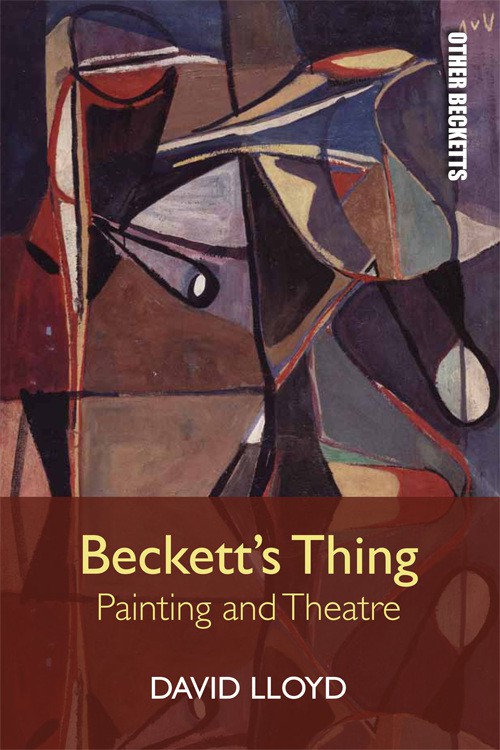
 RhysTranter.com