

This extract is from my review of Jean-Michel Rabaté’s Think, Pig! Beckett at the Limit of the Human, published in the Times Literary Supplement, 14 October 2016.
This extract is from my review of Jean-Michel Rabaté’s Think, Pig! Beckett at the Limit of the Human, published in the Times Literary Supplement, 14 October 2016.

Samuel Beckett is on Twitter, and perhaps we should not be surprised. As a playwright, he was what we would now call an “early adopter” of modern technology. His 1958 play Krapp’s Last Tape made revolutionary use of the reel-to-reel tape recorder the same year RCA manufactured full-size cassettes for home use. His works for radio and television—including All That Fall, which is being presented as part of the 2016 White Light Festival—stretched each medium to their technical limits, producing sights and sounds that had never before been broadcast. And it’s not just his engagement with technology that makes Beckett a natural candidate for Twitter: his compact observations and incisive remarks are perfectly trimmed for our social media age.
Beckett always had a talent for pithy observations about birth, death, and all the pesky stuff that happens in between. In 1984, when The Times (London) asked him about his New Year’s resolutions, he replied: “resolutions colon zero stop period hopes colon zero stop beckett.” His short, sharp telegram cuts to the quick, but also makes us smile at our own obsession with self-improvement. This is the kind of wit and economy that became his signature in plays like Waiting for Godot, Endgame, and Happy Days. (more…)

Today’s artistic landscape can often feel like a busy marketplace, where voices compete for attention and creative validation. And, as a result, some voices do not get heard. Since its launch in 2012, Music & Literature has been a torchbearer for writers and artists that are often neglected by the mainstream: its first issue was notable for its discussion of avant-garde composer Arvo Pärt, offering an unprecedented glimpse into his life, work, and motivations. Scott Esposito points out that the journal offers ‘the kind of thing that’s unavailable anywhere else’, and he’s right. Music & Literature is a fascinating read for enthusiasts, and a valuable cultural resource for scholars.
Now publishing its seventh volume, Music & Literature is celebrating the work of Welsh-born writer, critic, and accomplished librettist Paul Griffiths. His first novel, Myself and Marco Polo: A Novel of Changes (1989), is a work of speculative fiction that reimagines the life of the world traveller through his memoirs. More recently, Griffiths translated eleven Japanese noh plays, published as The Tilted Cup: Noh Stories (2014) in a beautifully illustrated volume. Paul Griffiths has written five librettos, and is an insightful commentator on modern classic music; he is the author of a number of critical works on topics ranging from electronic music to the history of the string quartet, and was a music critic for both The New Yorker (1992-96) and The New York Times (1997-2005). As if that wasn’t enough, Griffiths is also the biographer of a number of modern composers, from György Ligeti and Bela Bartók to John Cage and Igor Stravinsky. (more…)
You previously collaborated on a book of essays about the German electronic group Kraftwerk. What made you decide to put together a book about Eno?
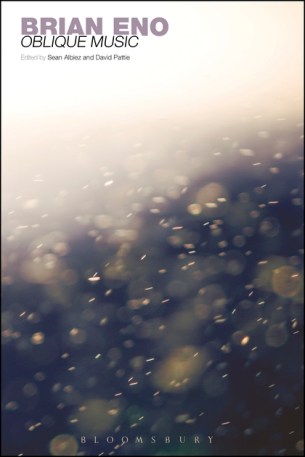
Sean Albiez: In the final stages of the editing and writing process of Kraftwerk: Music Non Stop we started to discuss further book projects as, though we had never met before starting the book, we found that we enjoyed our collaborative process and had many similar musical interests. It think it was David who initially suggested looking at Brian Eno. Eno has been a major figure in music since the 1970s and yet little academic attention had been paid to his work. Any attention that had been given seemed to repeat and replay the same ideas and stories. So we felt that undertaking detailed research on Eno’s diverse activities over several decades from a range of academic perspectives would produce new ways of thinking about his work.
“As Eno says, he’s very interested in the idea of music as landscape; and it’s a landscape that I’m quite happy to inhabit.”
David: As Sean said, we’d enjoyed working together on the Kraftwerk book; and when we were discussing other projects Eno seemed to be the obvious next option. He’s amassed quite a reputation as popular music’s resident intellectual, but, aside from one book in the 1990s, his work hadn’t been given the kind of in-depth analysis it deserves. On a more personal level, I’ve been listening to Eno’s solo work for over three decades, and I find it endlessly fascinating. As Eno says, he’s very interested in the idea of music as landscape; and it’s a landscape that I’m quite happy to inhabit. (more…)


“I want to be a force for real good. In other words. I know that there are bad forces, forces that bring suffering to others and misery to the world, but I want to be the opposite force. I want to be the force which is truly for good”
— John Coltrane

The Beckett Digital Library (BDL) is a digital reconstruction of Samuel Beckett’s personal library, based on the volumes preserved at his apartment in Paris, in archives (Beckett International Foundation) and private collections (James and Elizabeth Knowlson Collection, Anne Atik, Noga Arikha, Terrence Killeen,…). It currently houses 757 extant volumes, as well as 248 virtual entries for which no physical copy has been retrieved.
The BDL module is a part of the Beckett Digital Manuscript Project and contains scans of book covers, title pages, all pages with reading traces, flyleaves, colophons, tables of contents, indexes and inserts of various kinds. In addition to facsimiles, the BDL also offers transcriptions of readings traces and links to Beckett’s manuscripts.
The BDL is accompanied by a monograph (Dirk Van Hulle and Mark Nixon, Samuel Beckett’s Library, Cambridge UP, 2013)
What follows is an exclusive preview of the Beckett Digital Library (BDL), with quotations excerpted from Van Hulle’s and Nixon’s companion book. Each image presents an actual edition owned by the writer himself. (more…)
 RhysTranter.com