Michael Richardson discusses how literature can help shed new light on our understanding of torture, trauma, and affect
Michael Richardson, Gestures of Testimony (Bloomsbury, 2016)
How did you come to write Gestures of Testimony?
One of Barack Obama’s first acts as President was to declassify the Torture Memos of the Bush Administration. Suddenly, the architecture of American torture was visible to an extent that it had never been before. At the time, I was working as a speechwriter in Canada for Jack Layton, who was then the leader of the New Democratic Party, and watching very closely what was happening across the border. I became obsessed with how torture was articulated and authorised, and even more so with the effect it had on both survivors and perpetrators. I’ve always understood the world through writing and literature, so I wanted to understand torture in that context too. That led me to a PhD on torture, literature and politics, and from there to writing Gestures of Testimony. (more…)
British artist Tom Harman discusses how critical theory led him to return to painting
Tom Harman installs abstract paintings at Little Man Coffee Co., Cardiff. Photograph: Rhys Tranter.
When did you start painting?
Drawing and painting, for me, was what I always did and was always good at. Throughout school I only ever wanted to paint and couldn’t wait to leave at 16 and begin a BTECH in Art and Design at my local FE college. This was a great experience, at last getting to create visual material all day, every day. I was particularly interested in painting that had some form of social commentary and was influenced by the New Glasgow Boys, painters from the Glasgow School of Art such as Steven Campbell, Peter Howson and Ken Currie, as well as the big names in British painting such as Frank Auerbach, Leon Kossoff, Francis Bacon and Lucian Freud. (more…)
Aimee Pozorski discusses the complex ways we engage with art and writing in the wake of the September 11th attacks
We are conducting this interview fifteen years after the September 11th terrorist attacks took place. What motivated you to write Falling After 9/11? How did the project begin?
Aimee Pozorski, Falling After 9/11: Crisis in American Art and Literature (Bloomsbury, 2016)
The project began with the installation of Graydon Parrish’s 9/11 mural, Cycle of Terror and Tragedy, which was commissioned in 2002 by the New Britain Museum of American Art in my hometown of New Britain, CT. It took Parrish four years to complete the work, and when it was finally revealed, some critics savaged it for its commitments to Classical Realism. After being outraged that reviewers could be so callous, my training in trauma theory kicked in. As a trauma theorist who studies literature, I frequently consider ways in which a text’s moments of so-called failure can actually succeed in telling us something not only about the nature of representation but also about traumatic history itself. What does it mean that so many representations of 9/11 seemed inadequate? I asked myself. And does that have more do to with the nature of trauma and our reception of art and literature than it does with the singular talents or contributions of individual artists themselves? (more…)
Bethany Rose Lamont on a print journal that discusses mental health issues through art and literature
Doll Hospital, Issue 2. Founder and Editor: Bethany Rose Lamont
Doll Hospital, Issue 3. Founder and Editor: Bethany Rose Lamont
What inspired you to start Doll Hospital?
I started Doll Hospital in 2014 when I was 23 and a suicidal master’s student at Oxford. I’m 25 now and a suicidal PhD student at Central Saint Martins, so, like, ‘inspiring’ may not be the best word but hey, in two and half years we’ve put out three 150 page plus full colour issues which is cool. My reason for starting it wasn’t particularly worthy. I was literally just told by my friends to stop tweeting about killing myself as it was freaking everyone out so I was like ‘screw you guys I’ll find another space to make people uncomfortable!’—which is a hilarious backstory in my humble opinion.
Could you tell me how you chose the provocative title?
I came across the phrase ‘doll hospital’ in the 2012 Spring/Summer edition of Another Magazine, the author Joe Dunthorne had curated a photo series, pairing quotes with interesting images. One of the quotes read something along the lines of ‘this is the doll hospital, they come to me broken and I bring them new life’. I just became totally taken in by that line! I had also recently read The Bluest Eye, and the notion of deconstructing white supremacy via the imagery of the doll, of Shirley Temple, was so powerful to me. From then on all my social media was under the handle ‘doll hospital’. I just thought it was the best combination of words, so inevitably when it came to choosing a title for the journal I went with Doll Hospital too! (more…)
Victor Brombert discusses how literature reflects changing ideas about life, death, and the condition of mortality
Victor Brombert, Musings on Mortality: From Tolstoy to Primo Levi (University of Chicago Press, 2016)
What motivated you to write the book?
Probably it was an early childhood and adolescent awareness of our mortal condition, of human vulnerability in general: the death in infancy of my younger sister (I was seven years old), the assault on human life and dignity by totalitarian regimes that forced families like mine into multiple exiles, and later the experience of war and the Nazi occupation of France, our escape to the United States on an overcrowded freighter zigzagging for six weeks across the Atlantic to elude German U-boats, my joining the American army and surviving the Omaha Beach landing and the Battle of the Bulge — perhaps above all the growing belief that all valuable human achievements, especially in literature and the arts, were a defiance of death.
Your subtitle traces a history between Leo Tolstoy and Primo Levi. What is significant about these two writers?
It is a long trajectory between Tolstoy and Primo Levi. The distance and the contrast tell a story. Whereas Tolstoy in The Death of Ivan Ilych is concerned with an exemplary individual, his morally and spiritually empty life, and his ultimate salvational epiphany at the hour of death, Primo Levi by contrast is dealing with a collective moral and political context in which private salvation is no longer thinkable. The trajectory as well as the authors along the way tell the story of the 20th century as that of a growing awareness of a collective tragedy. (more…)
I am delighted to announce that RhysTranter.com was recently selected as an Editors’ Pick on WordPress.com’s Discover. The site aims to curate ‘the best content on WordPress, collected for you by humans who love to read’.
The selected piece was a recent interview with Carolyn Cocca for her new book, Superwomen: Gender, Power, and Representation (Bloomsbury, 2016). Carolyn Cocca discussed how women superheroes are changing the we way think about contemporary femininity. You can read the full interview here.
A big thank you to the editorial team of WordPress Discover for featuring the site.
Will Brooker reflects on our continuing fascination with Gotham City’s caped crusader
Will Brooker, Batman Unmasked: Analyzing a Cultural Icon
What inspired you to write Batman Unmasked?
Batman Unmasked was originally my PhD thesis, One Life, Many Faces, and I began it over 20 years ago, so you can understand it is a fairly distant memory. My PhD plans began around 1994 as a study of masculinity in the mainstream cinema of the 1990s, and Batman was a small aspect of one proposed chapter, about the Gothic Masculine (Tim Burton’s films). I realised gradually that the idea of writing about Batman was what I was really looking forward to – at the time, the very concept was audacious in academic work – and the project evolved until that small part of one chapter expanded into the entire PhD. Of course, Batman is an interesting topic per se, but I felt personally invested in the character, and wanted to write about something I was really enthusiastic about, as a fan. That enthusiasm was important, as by the end of the three years full time of my doctorate, I hated Batman, PhDs and academia in general. (Those feelings passed). (more…)





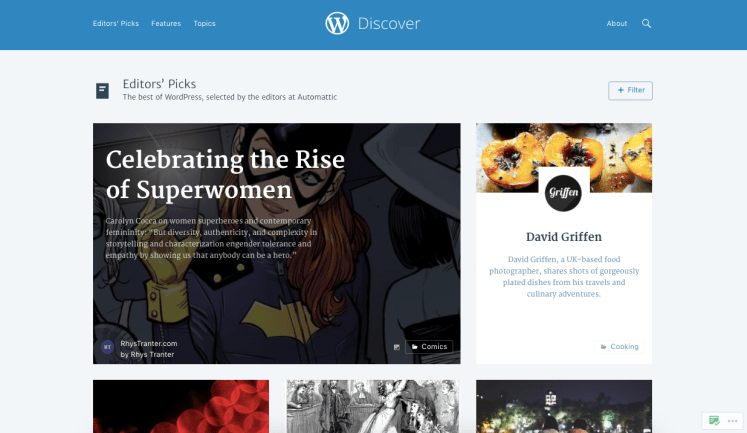
 I am delighted to announce that RhysTranter.com was recently selected as an
 RhysTranter.com