Recent interview selected as an Editors’ Pick
rhystranterdotcom-carolyncocca-riseofthesuperwomen-wordpressdiscover3
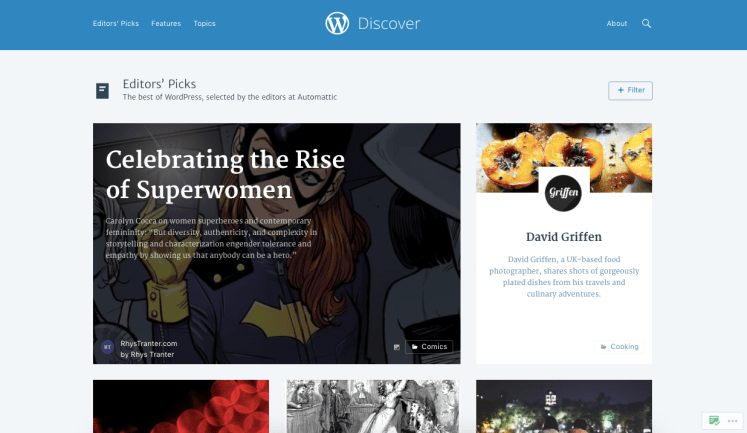
Screenshot of discover.wordpress.com

discover-badge-circle-rhystranter-comI am delighted to announce that RhysTranter.com was recently selected as an Editors’ Pick on WordPress.com’s Discover. The site aims to curate ‘the best content on WordPress, collected for you by humans who love to read’.

The selected piece was a recent interview with Carolyn Cocca for her new book, Superwomen: Gender, Power, and Representation (Bloomsbury, 2016). Carolyn Cocca discussed how women superheroes are changing the we way think about contemporary femininity. You can read the full interview here.

A big thank you to the editorial team of WordPress Discover for featuring the site.

Find out more about WordPress Discover.

Will Brooker reflects on our continuing fascination with Gotham City’s caped crusader
Will Brooker, Batman Unmasked: Analyzing a Cultural Icon

What inspired you to write Batman Unmasked?

Batman Unmasked was originally my PhD thesis, One Life, Many Faces, and I began it over 20 years ago, so you can understand it is a fairly distant memory. My PhD plans began around 1994 as a study of masculinity in the mainstream cinema of the 1990s, and Batman was a small aspect of one proposed chapter, about the Gothic Masculine (Tim Burton’s films). I realised gradually that the idea of writing about Batman was what I was really looking forward to – at the time, the very concept was audacious in academic work – and the project evolved until that small part of one chapter expanded into the entire PhD. Of course, Batman is an interesting topic per se, but I felt personally invested in the character, and wanted to write about something I was really enthusiastic about, as a fan. That enthusiasm was important, as by the end of the three years full time of my doctorate, I hated Batman, PhDs and academia in general. (Those feelings passed). (more…)

Rosalind E. Krauss talks about the life and work of the American abstract expressionist painter
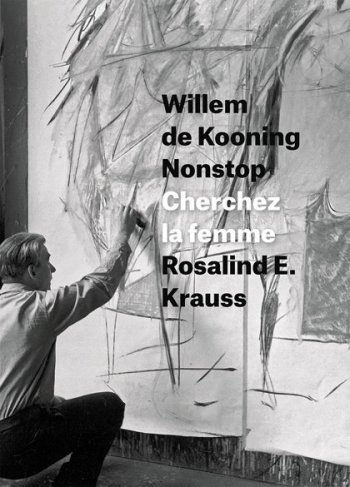
Rosalind E. Krauss, Willem de Kooning Nonstop: Cherchez la femme (Columbia University Press, 2016)
Rosalind E. Krauss, Willem de Kooning Nonstop: Cherchez la femme (University of Chicago Press, 2016)

How did you first encounter Willem de Kooning’s paintings? What is it about his work that appeals to you?

The Phillips Collection in Washington D. C. has a particularly beautiful de Kooning: Asheville, 1948. I was always fascinated by it but frustrated that I couldn’t articulate its effect on me. It made me want to look for other de Koonings and to read the literature on his work—initially that in Art News, such as Tom Hess’s “De Kooning Paints a Picture.”  I was disappointed by this literature which I found merely effusive rather than analytical.

What motivated you to write a book about his work?

I had written my senior thesis on de Kooning at Wellesley College; then, when I saw the 2011 MoMA retrospective, curated by John Elderfield, I felt I had things to say about the paintings that no one had expressed before. (more…)

A new historical novel watches the rise of Nazism through the eyes of Sigmund Freud and a boy from the country
Robert Seethaler, The Tobacconist

Can you imagine getting dating advice from Freud? This is one of the conceits of Robert Seethaler’s The Tobacconist, recently published by Picador in a translation by Charlotte Collins. The novel is a coming-of-age story about Franz, a seventeen-year-old boy who leaves his rural town to become a tobacconist’s apprentice in Vienna in the 1930s. As the naïve young Franz is dazzled by the lights and stimulations of the modern city, Dr Freud appears as a customer in the small tobacco shop where he works. They strike up cigars and conversation, and speculate on love, life, and a rapidly-changing world.

Seethaler rose to prominence with A Whole Life (2014), a novel shortlisted for the Man Booker International Prize. Praised by Margaret Atwood and Ian McEwan, the text explored the influence of modernity and the Second World War on traditional ways of life. Seethaler’s interest in this theme persists in The Tobacconist, where what begins as a whimsical tale shifts gear into a novel exploring the rise of fascism in Austria. The forces of history push Franz towards maturity, and he transitions from a wide-eyed witness to tragic commentator on antisemitism, political violence, and populist rhetoric. (more…)

Calum Gardner talks about editing a special edition of Barthes Studies exploring the writer’s relationship to poetry
roland-barthes
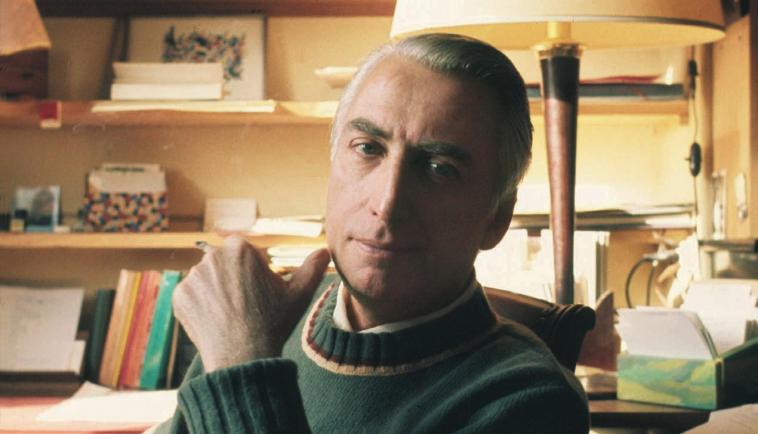
Roland Barthes

What kind of academic journal is Barthes Studies?

Barthes Studies is an open-access online journal dedicated to the work of influential French literary and cultural theorist and critic Roland Barthes. It’s the only such journal in English (although there is an older French equivalent, the Revue Roland Barthes), and it was founded by Neil Badmington in 2015 with an issue that marked the centenary of Barthes’ birth. It’s interdisciplinary, has published articles by those working in French studies, English studies, literary theory, and cultural theory, and is open to those working in any area that has to do with Barthes. Because of the breadth and variety of his interests and writings, this is a very wide remit indeed!

What inspired you to oversee an issue devoted to the subject of poetry?

I think a few years ago, many people who are interested in Barthes, particularly in the UK, were seeing that there was a gap: it was commonly assumed that Barthes had something to say that was of relevance to poetry, and perhaps experimental poetry in particular, but why had so little been written about Barthes and poetry? I looked at a lot of books about poetry and found that in the index they would have one or two references to Barthes, but that these would lead to passing references to his most famous ‘The Death of the Author’ – an essay we assumed all the poets and poetry critics were familiar with, but nobody wanted to seem to talk about why, or how they got that way. When I started my PhD at Cardiff’ in 2013, I was hoping to fill this gap. (more…)

A new fully-illustrated volume offers a fascinating portrait of Austria’s most significant post-war writer
Thomas Bernhard, 3 Days: From the Film By Ferry Radax (Blast Books, 2016)

In the summer of 1970, experimental filmmaker Ferry Radax arranged to meet with the Austrian writer Thomas Bernhard. Over the course of three days, Radax recorded the writer amid the pleasant surroundings of a park in Hamburg. For readers familiar with Bernhard’s work, the setting was incongruous: his novels Frost (1963), Gargoyles (1967) and The Lime Works (1970) portray dark, grotesque landscapes of murder, ignorance, and obsession. As Bernhard himself admits, ‘I am hardly a cheery author’. And yet, in such bright and affable settings, Radax manages to capture a revealing portrait of the writer George Steiner called ‘the foremost craftsmen of German prose after Kafka and Musil.’

Blast Books, an independent publisher in New York, has taken a great deal of care to adapt Radax’s film, entitled 3 Days, into a book. The beautifully presented hardback volume includes Thomas Bernhard’s own reflections on Radax’s film, and a fully-illustrated record of the documentary translated from the German by Laura Lindgren. Also included is a critical afterword by film scholar Georg Vogt, and a fully-illustrated appendix of Radax’s notes for the filmmaking. The book makes considered use of space, word, and image to capture the spirit of Radax’s documentary, and the rhythms and emphasis of Bernhard’s monologues. (more…)

How Stephen King’s second novel cemented his reputation as America’s foremost horror writer
Stephen King, Salem's Lot
Stephen King, ‘Salem’s Lot

Stephen King first found his way onto the international stage with 1974’s bestseller, Carrie. But it was his next published novel, ‘Salem’s Lot, that cemented his reputation as America’s foremost writer of horror fiction. King, who had been working in obscurity until his newfound success, had two unpublished manuscripts. In his 2005 introduction to ‘Salem’s Lot, King recalls a conversation with his editor Bill Thompson, who was enthusiastic about one of the two manuscripts, calling it ‘Peyton Place with vampires’. It had bestselling potential, Thompson had said, but there was one problem: the decision would forever type him as a horror writer. King was relieved: ‘I don’t care what they call me as long as the checks don’t bounce’.

The cheques didn’t bounce. In the four decades since ‘Salem Lot’s publication in 1975, Stephen King has become one of the world’s bestselling living authors. And, while his work ranges a broad range of styles and genres, including thrillers, fantasy, and nonfiction, his reputation as the ‘King of Horror’ persists. It seems Thompson had been right on both counts. (more…)