Rhys Tranter is a writer and teacher based in Cardiff, Wales, UK. He is the author of Beckett's Late Stage (2018), and his work has appeared in the Times Literary Supplement, the San Francisco Chronicle, and a number of books and periodicals. He holds a BA, MA, and a PhD in English Literature.
British artist Tom Harman discusses how critical theory led him to return to painting
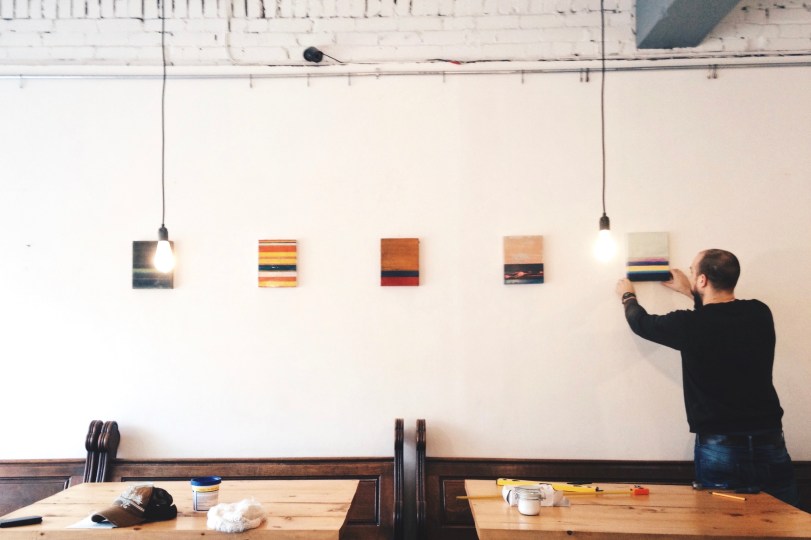
Tom Harman installs abstract paintings at Little Man Coffee Co., Cardiff. Photograph: Rhys Tranter.
When did you start painting?
Drawing and painting, for me, was what I always did and was always good at. Throughout school I only ever wanted to paint and couldn’t wait to leave at 16 and begin a BTECH in Art and Design at my local FE college. This was a great experience, at last getting to create visual material all day, every day. I was particularly interested in painting that had some form of social commentary and was influenced by the New Glasgow Boys, painters from the Glasgow School of Art such as Steven Campbell, Peter Howson and Ken Currie, as well as the big names in British painting such as Frank Auerbach, Leon Kossoff, Francis Bacon and Lucian Freud. (more…)
Aimee Pozorski discusses the complex ways we engage with art and writing in the wake of the September 11th attacks
We are conducting this interview fifteen years after the September 11th terrorist attacks took place. What motivated you to write Falling After 9/11? How did the project begin?
Aimee Pozorski, Falling After 9/11: Crisis in American Art and Literature (Bloomsbury, 2016)
The project began with the installation of Graydon Parrish’s 9/11 mural, Cycle of Terror and Tragedy, which was commissioned in 2002 by the New Britain Museum of American Art in my hometown of New Britain, CT. It took Parrish four years to complete the work, and when it was finally revealed, some critics savaged it for its commitments to Classical Realism. After being outraged that reviewers could be so callous, my training in trauma theory kicked in. As a trauma theorist who studies literature, I frequently consider ways in which a text’s moments of so-called failure can actually succeed in telling us something not only about the nature of representation but also about traumatic history itself. What does it mean that so many representations of 9/11 seemed inadequate? I asked myself. And does that have more do to with the nature of trauma and our reception of art and literature than it does with the singular talents or contributions of individual artists themselves? (more…)
The avant-garde reedist’s iconic outing for Blue Note Records was recorded on this day in 1964
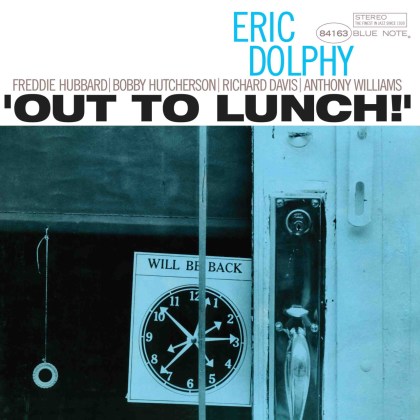
Eric Dolphy, Out to Lunch! (Blue Note, 1964)
On this day in 1964, Eric Dolphy entered Rudy Van Gelder’s studio in Englewood Cliffs, New Jersey, to record one of Blue Note Records’ most distinctive and iconic records. Joined by Freddie Hubbard (trumpet), Bobby Hutchinson (vibraphone), Richard Davis (bass) and an eighteen-year-old Anthony Williams (drums), Dolphy brought along his alto saxophone, bass clarinet, and flute for the date.
Out to Lunch! is the culmination of asequence of recordings that explored the possibilities of avant-garde jazz in the early 1960s, from Dolphy’s first album as leader, Outward Bound (New Jazz, 1960), to Out There (New Jazz, 1960), to his 1961 recordings at the Five Spot and 1962’s Far Cry (New Jazz). Across these works we can hear the artistic development of Dolphy as a restless and inventive talent. Out to Lunch! nods a debt to bebop in its tribute to pianist Thelonious Monk (‘Hat and Beard’), and acknowledges the classical flautist Severino Gazzelloni (‘Gazzelloni’), but while the album negotiates the legacy of bebop and post-bop music it simultaneously reaches towards freer musical forms. (more…)
I’m currently teaching a literature module at Cardiff University entitled Utopia: Suffrage to Cyberpunk, which traces the development of utopian/dystopian writing in the twentieth-century. Yesterday’s lecture included something of a surprise, when Margaret Atwood took time to share a few words the group via Twitter. We spent a few minutes at the end of the lecture following her sage advice, collectively acquainting ourselves with the wonders of Thug Notes.
A new study explores the potential for agency and flight in post-war working-class writing
“I’m not working-class: I come from the criminal classes.” These words by the actor Peter O’Toole play on a broader prejudice that aligns working-class identity with marginality and transgression. Roberto del Valle Alcalá explores these thematic links in British Working-Class Fiction, which traces an alternative literary history of the British Isles, spanning from 1950 to the economic collapse of 2008. Alcalá documents life on the hard shoulder of modern capitalist progress, offering an analysis of working-class experience through detailed theoretical readings of Alan Sillitoe, Pat Barker, Irvine Welsh, Monica Ali and others. [Read More]
This extract is from my review of Roberto del Valle Alcalá’s British Working-Class Fiction: Narratives of Refusal and the Struggle Against Work, published in the Times Literary Supplement, 24 February 2017.
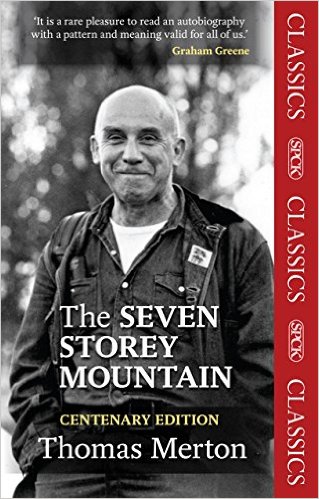
Spent yesterday evening reading Thomas Merton‘s autobiography, The Seven Storey Mountain. Still a young man, he has lost his mother and his father to illness. With no fixed home, he moved from his birthplace in France to America, then back to France, then to England, and now to America. His attention to detail is wonderful, whether describing middle-class English life or American cinemagoers enjoying Charlie Chaplin‘s Modern Times. He is becoming increasingly disillusioned with his literary career, and there are early signs that he will consider monastic life. I’m looking forward to returning to the book as soon as I can: rich in everyday details, it’s a remarkable document of early-twentieth-century life.
I am becoming increasingly fascinated with life writing for its potential to blend historical record, philosophical observation, and literary style. I’m thinking here not only of Merton, but figures like St Augustine, Henri Amiel, and one of my all-time favourites, Jules Renard. Samuel Beckett‘s poignant and dryly humorous letters have a similar quality.
In a recent interview with Neil Badmington, I was reminded of the profound power and solace that that life writing can provide. Badmington reveals that ‘The Mourning Diary is the posthumous text by Barthes to which I return more than any other. Every time I revisit it, I’m struck by the desperate, impossible tension in its brief sighs of sorrow’.
Neil Badmington discusses his fascination with the work of Barthes, the continuing relevance of critical theory, and his own approach to academic style
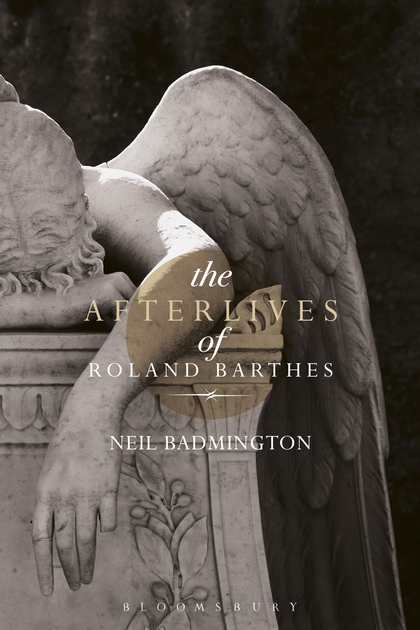
Neil Badmington, The Afterlives of Roland Barthes (Bloomsbury, 2016)
What led you to write The Afterlives of Roland Barthes?
‘Who’ rather than ‘What’, really. It’s all the fault of my good friend Jürgen Pieters, who has repeatedly led me, with our conversations over the years, in new directions. In 2006 Jürgen and Kris Pint (who was Jürgen’s PhD student at the time) organised a conference at their home institution of Ghent University on Barthes’s lecture courses at the Collège de France, which had recently appeared in print for the first time. I’m not sure why I was invited to participate: the other speakers were people with formidable reputations in the field of Barthes studies (Andy Stafford and Claude Coste, for instance), while I’d never written extensively about Barthes. His work had often informed mine up until that point — he’s there in Alien Chic and even the Posthumanism anthology, for instance — but he’d not been the primary object of analysis: I’d written with Barthes, not on Barthes. And the Barthes with whom I’d written had been the familiar Barthes, the ‘classic’ Barthes — the Barthes of S/Z and Mythologies, for example. But the unexpected invitation from Jürgen and Kris led me to look closely at the various volumes bearing Barthes’s name which had been published long after his death, and I was struck by how a different Barthes, another Barthes, was emerging gradually into print — not just the Barthes of the Collège years, but the Barthes of Travels in China, the Barthes of the seminars at the École pratique des hautes études, and the Barthes of Journal de deuil (or Mourning Diary, to give it its English title). It was the appearance of the latter in French in 2009 which really convinced me that The Afterlives of Roland Barthes needed to be written, in fact. I remember reading it at the time and realising as I turned the pages that it was altering my established perspective on Camera Lucida. This ‘new’ Barthes was reshaping the ‘old’ Barthes. In short, then, I wrote Afterlives to take stock of some of the posthumous publications which have appeared in recent years, and to ask how they might lead us to reconsider our understanding of the well-known publications which appeared during Barthes’s lifetime. (more…)