Bethany Rose Lamont on a print journal that discusses mental health issues through art and literature

What inspired you to start Doll Hospital?

I started Doll Hospital in 2014 when I was 23 and a suicidal master’s student at Oxford. I’m 25 now and a suicidal PhD student at Central Saint Martins, so, like, ‘inspiring’ may not be the best word but hey, in two and half years we’ve put out three 150 page plus full colour issues which is cool. My reason for starting it wasn’t particularly worthy. I was literally just told by my friends to stop tweeting about killing myself as it was freaking everyone out so I was like ‘screw you guys I’ll find another space to make people uncomfortable!’—which is a hilarious backstory in my humble opinion.

Could you tell me how you chose the provocative title?

I came across the phrase ‘doll hospital’ in the 2012 Spring/Summer edition of Another Magazine, the author Joe Dunthorne had curated a photo series, pairing quotes with interesting images. One of the quotes read something along the lines of ‘this is the doll hospital, they come to me broken and I bring them new life’. I just became totally taken in by that line! I had also recently read The Bluest Eye, and the notion of deconstructing white supremacy via the imagery of the doll, of Shirley Temple, was so powerful to me. From then on all my social media was under the handle ‘doll hospital’. I just thought it was the best combination of words, so inevitably when it came to choosing a title for the journal I went with Doll Hospital too! (more…)

Sarah Hammerschlag discusses how the work of Levinas and Derrida can help us to rethink the relationship between religion, literature, and philosophy

What motivated you to write the book?

Sarah Hammerschlag, Broken Tablets: Levines, Derrida, and the Literary Afterlife of Religion (Columbia University Press, 2016)
Sarah Hammerschlag, Broken Tablets: Levinas, Derrida, and the Literary Afterlife of Religion (Columbia University Press, 2016)

This project developed organically out of my first book The Figural Jew, which focuses on the revalorization of the figure of the Jew in post-World War II French literature and philosophy. At the center of that project there was already a nascent argument for introducing literary modes of speech into the political sphere to capitalize on the ways in which irony and plurivocity complicate the politics of identity. The last couple of chapters of that book argue that Blanchot and Derrida develop a literary concept of the Jew and Judaism through a reading of Levinas. But I was still concerned to represent the differences between Derrida and Levinas on the question of how to think about the cultural relevance of Judaism in the post-WWII context and to consider the very important political implications of their respective choices. Broken Tablets  gave me the opportunity to track the implications of those differences and to conceive of them in terms of how each philosopher negotiated his relationship to religion and literature as competing discourses to philosophy. (more…)

Michael Lackey on the popularity of the biographical novel, and what it can tell us about the relationship between literature, history and truth
Michael Lackey, The American Biographical Novel (Bloomsbury, 2016)

What motivated you to write The American Biographical Novel

Through my reading of biographical novels, I noticed a shift in the nature of literary truth.  In Heart of Darkness, Joseph Conrad illuminates the colonial mentality that enabled Europeans to plunder Africa and to abuse Africans with impunity.  Conrad represents that mentality through Kurtz, and as the narrator says, “all Europe contributed to the making of Kurtz.”  In essence, if we want to understand the European mentality that justified colonization and its horrific outcomes, we can look to Kurtz for some answers.  But with the rise of postmodernism, there has been growing skepticism about the traditional literary symbol.

Put simply, postmodernists question the value of an overarching truth claim, because they realize that someone constructed that truth for an ideological or political reason.  This approach to truth impacted the traditional literary symbol, so a postmodernist could easily say: “Look, Joe, you constructed the character of Kurtz in order to promote your own ideological agenda.  Therefore, I don’t see any reason why I should consider a character like Kurtz as symbolic of the European mind.”It is my contention that biographical novelists were becoming increasingly aware of the problems with the traditional literary symbol, but they also did not want to get rid of the literary symbol, because they realized that it could be effectively used to expose the structures and conditions of oppression.  (more…)

Victor Brombert discusses how literature reflects changing ideas about life, death, and the condition of mortality
Victor Brombert, Musings on Mortality: From Tolstoy to Primo Levi (University of Chicago Press, 2016)

What motivated you to write the book?

Probably it was an early childhood and adolescent awareness of our mortal condition, of human vulnerability in general: the death in infancy of my younger sister (I was seven years old), the assault on human life and dignity by totalitarian regimes that forced families like mine into multiple exiles, and later the experience of war and the Nazi occupation of France, our escape to the United States on an overcrowded freighter zigzagging for six weeks across the Atlantic to elude German U-boats, my joining the American army and surviving the Omaha Beach landing and the Battle of the Bulge — perhaps above all the growing belief that all valuable human achievements, especially in literature and the arts, were a defiance of death.

Your subtitle traces a history between Leo Tolstoy and Primo Levi. What is significant about these two writers?

It is a long trajectory between Tolstoy and Primo Levi. The distance and the contrast tell a story. Whereas Tolstoy in The Death of Ivan Ilych is concerned with an exemplary individual, his morally and spiritually empty life, and his ultimate salvational epiphany at the hour of death, Primo Levi by contrast is dealing with a collective moral and political context in which private salvation is no longer thinkable. The trajectory as well as the authors along the way tell the story of the 20th century as that of a growing awareness of a collective tragedy. (more…)

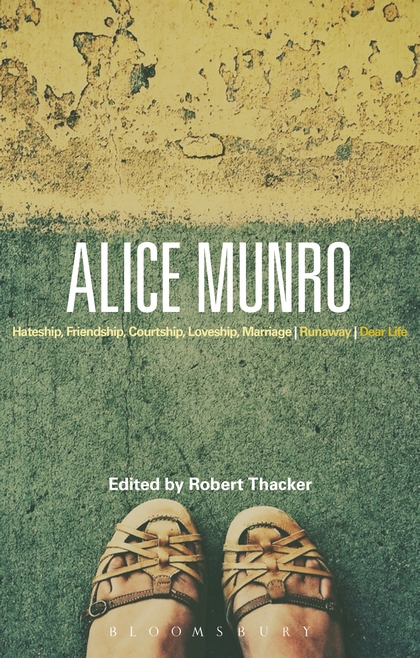
Robert Thacker discusses the life and work of the Canadian Nobel laureate

alicemunro-robertthacker-hateshipfriendshipcourtshiploveshipmarriage-runaway-dearlife-bloomsbury.jpgHow did you first come to encounter the work of Alice Munro?
I discovered Munro’s writing at a propitious moment in my own life and also, as it turned out, in hers. In 1973 I had just completed a B. A. at a university in my native Ohio, had decided to take a year off to explore graduate-school possibilities in Canada, and so had begun reading Canadian literature. At the suggestion of one of my mentors, I took out a subscription to the Tamarack Review, a quarterly focused on contemporary Canadian writing. The first story in the first issue I received—November 1973—was Munro’s “Material.” I read it, was struck hard by it, and became enraptured by her work right then—it is still among my favourite Munro stories. The next August I enrolled in an M.A. program at the University of Waterloo (Ontario) and, after coursework, presented a thesis on Munro’s narrative techniques in her uncollected stories and first book, Dance of the Happy Shades (1968). It was among the earliest critical studies of her stories, and I have been reading and analysing them ever since. (more…)

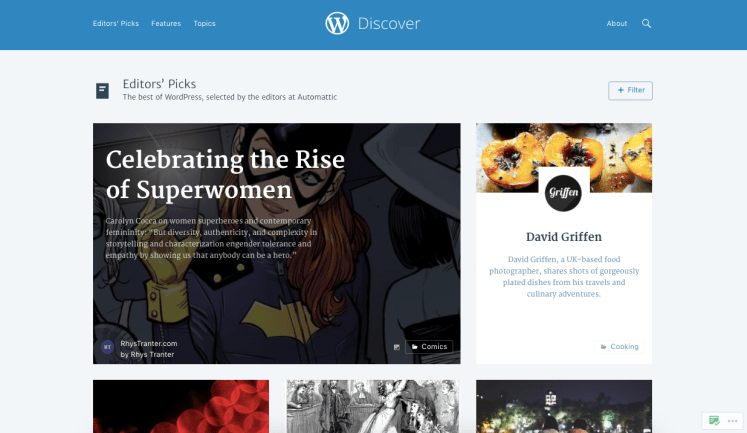
Recent interview selected as an Editors’ Pick
rhystranterdotcom-carolyncocca-riseofthesuperwomen-wordpressdiscover3
Screenshot of discover.wordpress.com

discover-badge-circle-rhystranter-comI am delighted to announce that RhysTranter.com was recently selected as an Editors’ Pick on WordPress.com’s Discover. The site aims to curate ‘the best content on WordPress, collected for you by humans who love to read’.

The selected piece was a recent interview with Carolyn Cocca for her new book, Superwomen: Gender, Power, and Representation (Bloomsbury, 2016). Carolyn Cocca discussed how women superheroes are changing the we way think about contemporary femininity. You can read the full interview here.

A big thank you to the editorial team of WordPress Discover for featuring the site.

Find out more about WordPress Discover.

Will Brooker reflects on our continuing fascination with Gotham City’s caped crusader
Will Brooker, Batman Unmasked: Analyzing a Cultural Icon

What inspired you to write Batman Unmasked?

Batman Unmasked was originally my PhD thesis, One Life, Many Faces, and I began it over 20 years ago, so you can understand it is a fairly distant memory. My PhD plans began around 1994 as a study of masculinity in the mainstream cinema of the 1990s, and Batman was a small aspect of one proposed chapter, about the Gothic Masculine (Tim Burton’s films). I realised gradually that the idea of writing about Batman was what I was really looking forward to – at the time, the very concept was audacious in academic work – and the project evolved until that small part of one chapter expanded into the entire PhD. Of course, Batman is an interesting topic per se, but I felt personally invested in the character, and wanted to write about something I was really enthusiastic about, as a fan. That enthusiasm was important, as by the end of the three years full time of my doctorate, I hated Batman, PhDs and academia in general. (Those feelings passed). (more…)