
Michelle Boulous Walker on the difficulty of practicing philosophy in modern institutions, and an alternative approach that might encourage a more careful and attentive relation with the world

Could you tell me a little bit about yourself, and what inspired you to write Slow Philosophy?

I’m a philosopher who works in the European tradition. I have a background in political theory and an ongoing commitment to feminist politics. I’ve been teaching for some years now, and this has provided me with the opportunity to re-read key texts with my students.

For example, I’ve read Plato’s Symposium and Phaedrus countless times with both undergraduate and graduate students. The joy of re-reading is what first alerted me to the power of slow reading because for me slow philosophy is partly about the quality of attention that comes through repeated engagements with a work or text. Each time I’d return to Plato’s dialogues I’d uncover new possibilities – new meanings that were possible partly because of the new frames I was bringing to his work. (more…)
On pursuing a vocation in art, writing, and simple living

The reasons for my decision

Back in June, I attended a cardiology appointment that had a profound impact on me. My meeting with the cardiologist was routine and I did not receive any alarming news, but I became aware of the fragility of my own body in a new way. As an infant I was diagnosed with a congenital heart condition, and my life had been saved by the UK’s National Health Service and the surgeons at Great Ormond Street Hospital in London. I have always felt grateful for the life-saving help that I received, and could talk superficially about my condition with friends and loved ones, but now I see that I was also prone to a form of denial. Throughout my adolescence and early adulthood I placed my heart condition to one side as I tried to establish an identity for myself. My routine appointments continued from year to year, but in my conscious mind and my behaviour I aimed to suppress what they represented with denial and distraction. This year marks the first time that I am fully and consciously aware that I have a congenital heart condition. And while there is no reason why I cannot live a full and happy life, I am now awake to the fact that I nearly didn’t survive infancy.

(more…)

John Corbett on a new pocket-sized field guide to free and spontaneous music

What led you to write A Listener’s Guide to Free Improvisation?

I’ve been involved with improvised music from several different standpoints over the last 35 years, as a listener, as a critic, as a teacher, as a presenter, and as a producer.  In the process of moving around in the music’s netherworlds, I noticed that many potential listeners were curious about it but just had no way to enter, no accessible points of reference.  It’s sometimes seen as “difficult” or “complex,” and it can be both, but approaching free music is very different from listening to music composed using mathematical algorithms or with elaborate preconceived harmonic inventions.  To listen to it you basically need to be attentive.  That’s it.  But that’s also not easy.  Having some historical framework can help, and the more experience you have as a listener the better.  But it’s really open to new listeners, and I wanted to find a way, in as down to earth a way as possible, to suggest that openness.  To invite new listeners from other walks of music and to give a few tips on listening, things that might help get over the initial hump.    (more…)

Jeffrey R. Di Leo on a new essay collection that explores the legacy of critical theory since the deaths of some of its leading figures

How did you come to put together Dead Theory?

I was writing a review of Vincent Leitch’s Living with Theory (2008) several years ago and could not help thinking that the opposite might also be the case, namely, that we are “dying with theory.”  At the time, it was nothing more than a passing thought, but one that stuck in my head.  A few years later, when I was reading about “critical climate change” and the proposal that the time scale and size of climate change calls for an entirely new critical language the thought came back.

It was a volume edited by Tom Cohen on the topic of critical climate change published by Open Humanities Press (Telemorphosis: Theory in the Area of Climate Change, Vol. 1, 2012).  I wrote an essay for symplokē on the subject entitled “Can Theory Save the Planet” (2013).  The subject of whether the work of philosophers like Derrida, who were now deceased, could have any bearing on current discussions in critical climate change intrigued me.  As I started to discuss this issue with some of my colleagues as well as the topic of “dying with theory,” the idea of a collection of essays on dead theory began to take shape. (more…)

Angela Moorjani on co-editing a new collection which recounts Samuel Beckett’s meetings with scholars, translators, and theatre practitioners

To begin, could you say a little bit about Samuel Beckett Today/Aujourd’hui?

SBT/A is a refereed academic journal that publishes essays in English and French on Samuel Beckett’s oeuvre.

When first launched in 1992 by the late Marius Buning and the present coeditor in chief Sjef Houppermans, it took the form of a bilingual annual review publishing selections from international meetings or solicited essays on special topics, but also featuring a section of submitted articles. By 2016, the year SBT/A morphed into a semiannual journal under a different academic publisher (Brill), twenty-seven handsome hardcover volumes had appeared under the Rodopi imprint. My association with SBT/A goes back twenty years with an essay in the “Crossroads and Borderlines” volume of 1997, further intensifying with my coediting the volume based on the “Beckett in Berlin 2000” symposium, after which I was invited to join the editorial board. I served as coeditor in chief from 2008 to 2016. (more…)

Anthony Uhlmann on co-editing a new essay collection exploring Coetzee’s recent novel, The Childhood of Jesus

How did you first encounter J.M. Coetzee’s writing?

In 2002 I was working on the preparation for a major conference on Samuel Beckett that was to take place in Sydney in 2003 and I was looking for keynotes. There was a major public lecture at the Sydney Town Hall which is a reasonably grand space. We invited a number of people including Herbert Blau and Luce Irigaray (via videolink). Someone suggested I ask J. M. Coetzee who was on the board of one of the research groups related to Samuel Beckett. I then went and read a few of his novels, including Disgrace, Waiting for the Barbarians, and The Master of Petersburg and was blown away by the quality of the works. I told him when I finally met him that he had renewed my faith in contemporary fiction. He agreed to act as a keynote and read the ‘At The Gate’ Lesson from Elizabeth Costello which had not yet been published when he read it January 2003. He spoke briefly of having mostly gained an understanding of rhythm, and the structure of sentences, from reading and studying Beckett. After that I read all of his novels and have been working towards writing about him. (more…)

Robert Cohen on co-editing a new anthology where established writers discuss their practice and vocation

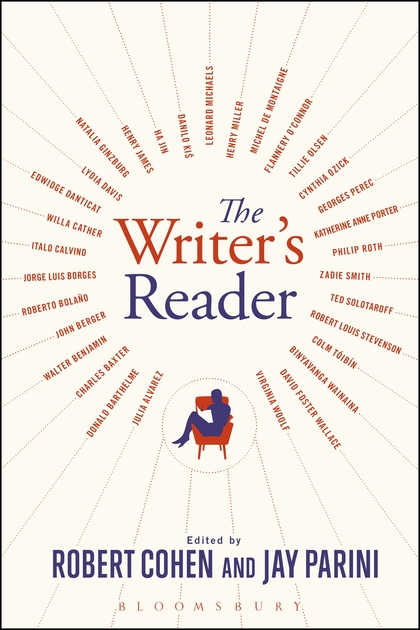
The Writer's Reader: Vocation, Preparation, Creation, eds. Robert Cohen and Jay Parini (Bloomsbury, 2017).
The Writer’s Reader: Vocation, Preparation, Creation, eds. Robert Cohen and Jay Parini (Bloomsbury, 2017).

How did you come to put together The Writer’s Reader?

[Jay Parini, my co-editor, and I] both taught workshops for emerging writers — here at Middlebury, at the Bread Loaf Writers Conference, at Iowa and Harvard and elsewhere — for more years than we care to think about, and all that time we’ve been Xeroxing certain essays we love, essays that seem particularly well-suited to providing consolation, instruction, and the muscle of inspiration, not just to the small-w aspect of the practice but to the larger, more long-term, capital-W sense as well. At a certain point it became almost physically painful, not having these essays between covers (especially the ones out of print), not being able to share them in an easy, accessible way. It just seemed somehow stupid and wrong that there was no way to introduce a new generation of writers to Natalia Ginzburg’s piece, say, or Tillie Olsen’s, or Ted Solotaroff’s, or Danilo Kis’ — to name just three of the wiser, more over-arching essays about the writer’s life you’re ever likely to find. (more…)