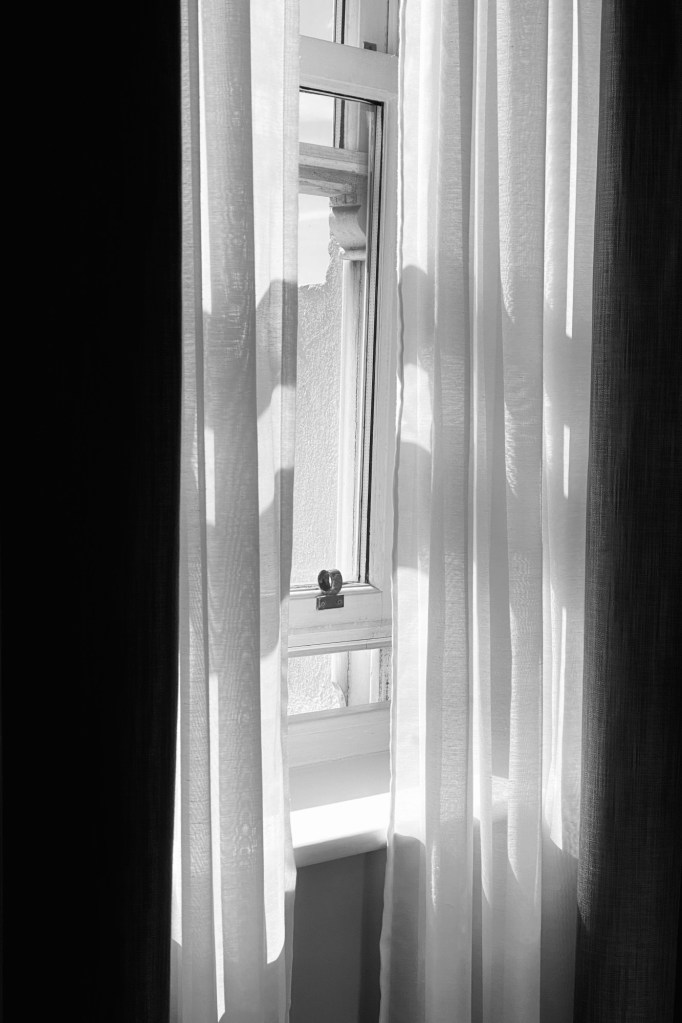
Thomas Merton’s hermitage at the Abbey of Gethsemani

A beautiful day. We rise early. I head out into the rain and collect coffee and pastries.

Later, as the sun comes out, we go walking until late into the afternoon.

After Mass, we listen to the sounds of birds and traffic, and settle down for a quiet evening. I read this in Thomas Merton’s journals:

(more…)

Saturday afternoon. Revisiting Merton, Newman, and this from Madeleine Delbrêl:

“We are not lacking silence. We already have it. / If we lack silence, it is because we have not learned how to keep it. / All the noises that surround us make much less din than we ourselves do. / The real noise is the echo that things have in us. / It is not speaking that necessarily breaks the silence. / Silence is the place of the word of God, and if we confine ourselves to repeating this word, then we can speak without ceasing to be silent.”

— The Dazzling Light of God, trans. Mary Dudro Gordon

I recently finished re-reading Merton’s The Seven Storey Mountain, one of my favourite books. Now, I am dipping into the multi-volume edition of his letters. All of the books are secondhand copies, and I am sure that some of them have their own stories to tell. My copy of the first volume once sat on the shelves of a branch of The New York Public Library at 455 Fifth Avenue in Mid-Manhattan.

The letters are collected according to theme. There’s a volume of correspondence covering Merton‘s close friendships; there’s one devoted to poetry, literature, and the vocation of writing; and yet another two that deal with religious experience. The fifth and final volume collects together his letters on “Times of Crisis”. I think I might start with that one.

cropped-Thomas-Mertons-desk-facing-east-from-the-living-room-of-his-hermitage-frank-geiser.jpg

“There is a pervasive form of contemporary violence to which the idealist most easily succumbs: activism and overwork. The rush and pressure of modern life are a form, perhaps the most common form, of its innate violence. To allow oneself to be carried away by a multitude of conflicting concerns, to surrender to too many demands, to commit oneself to too many projects, to want to help everyone in everything, is to succumb to violence. The frenzy of our activism neutralizes our work for peace. It destroys our own inner capacity for peace. It destroys the fruitfulness of our own work, because it kills the root of inner wisdom which makes work fruitful.”

— Thomas Merton, Conjectures of a Guilty Bystander

Rose early. Cool and clear morning. Went running around East Bute Dock (one lap). Reading Thomas a Kempis, Flannery O’Connor (her first published short story, ‘The Geranium’), and the diaries of Thomas Merton (describing his meeting with Zen scholar and practitioner D. T. Suzuki).

“I need to set myself to the study of non-violence, with thoroughness. The complete, integral practice of it in community life.”

—Thomas Merton, Journal, 21 August 1962

Autumn. It has been almost four months since I made a decision to change the way that I live, and I feel happier now than at any other time in my life. I rise earlier in the morning (around 6 o’clock) to read and watch the sunrise. I go cycling or running almost every day, rain or shine. I have also become a regular visitor to my local library, which has a wonderful selection of books on every conceivable topic. At the moment, I am spending my days writing, looking for part-time work, and nourishing myself with healthy and delicious food.

I continue to find international news events troubling. I was saddened to hear about the most recent American mass shooting in Las Vegas, which took the lives of over fifty people and injured over five hundred. Someone who attended my wedding was at the event, and while she managed to escape she knew people who were shot. Other family members also know friends and colleagues who were in attendance that day, including some who were killed.

The shooting occurred on the first day of October. The next day, I spent an hour or more watching footage and witness accounts broadcast on various channels. I then picked up my coat and went walking. The second of October is traditionally known as the International Day of Non-Violence, a day inaugurated by the United Nations General Assembly ten years ago (June 2007). The second of October is significant since it marks the birthday of non-violence advocate and political activist Mahatma Gandhi. As I passed along Lloyd George Avenue, I saw that a new statue of the civil rights leader was being unveiled. The likeness struck me as a potent and inspiring reminder of human potential in the face of inestimable odds, and, moreover, a testament to the importance of kindness and compassion in these troubled times.

I went home and spent some time reading Thomas Merton.