“What I really need is to get clear about what I must do, not what I must know, except insofar as knowledge must precede every act. What matters is to find a purpose, to see what it really is that God wills that I shall do; the crucial thing is to find a truth which is truth for me, to find the idea for which I am willing to live and die.”
Lorraine Sim discusses how the women of modernism allow us to reimagine the ordinary and the everyday
Lorraine Sim, Ordinary Matters: Modernist Women’s Literature and Photography (Bloomsbury, 2016)
What inspired you to write Ordinary Matters?
The idea developed from my first book, Virginia Woolf: the Patterns of Ordinary Experience. Towards the end of that project I realised there was much more that I wanted to explore, both in terms of the concept of the everyday and its applications to modernism and cultural histories of early twentieth-century modernity. I remember reading H.D.’s fascinating wartime memoir, The Gift, while I was working on my book on Woolf, and seeing some of Lee Miller’s photographs of London during the Blitz around the same time, and I felt I needed to extend my exploration of the ordinary to a broader range of women writers, artists and contexts. The final chapter of Virginia Woolf looked at what I termed the ‘ethics of the ordinary’ in her oeuvre. This idea, of the ways in which the ordinary functions as a site of value (be it personal, social, moral or political), really fascinated me, and I wanted to explore it in a more comprehensive way. Also, many canonical and contemporary theories on the topic view the everyday negatively, or as requiring radical transformation, and I felt that this was a critical habit or commonplace that itself required interrogation. (more…)
Robert Doran examines how critical theory has always been a form of ethical practice
Robert Doran, The Ethics of Theory: Philosophy, History, Literature (Bloomsbury, 2016)
What led you to write The Ethics of Theory?
The impetus for this project was a feeling that the tectonic shift of Theory–from a hermetic-textualist to a culturally-focused and politically-driven discourse–had not really been examined. This shift (circa 1987) was simply accepted, celebrated, or lamented without any real thinking about how we got from here to there or from there to here. Thus, I wanted to reflect on how this transformation happened and what it means for us now.
What do you think is the biggest misconception people have about critical theory?
That it is definable in terms of some general consensus, that there is some general agreement about what it is and what role it should play, when in fact it embodies many competing and at times mutually exclusive paradigms and assumptions. Nevertheless, I think that what binds everyone (or most everyone) together under the Theory banner is the sense that Nietzsche’s challenge to philosophy (continued and amplified by Heidegger) represented a fundamental break in the intellectual history of the West. On the one side, Nietzsche contested the hegemony of scientific inquiry, which, in the late nineteenth century, had attained great cultural prestige, displacing philosophy’s traditional role as the arbiter of knowledge. On the other side, Nietzsche held that human beings make their own truth–or decide what counts as truth–and that all knowledge is therefore contingent on human projects. The concept of objective, value-neutral knowledge is thereby torn asunder, giving way to the idea that seemingly “objective” knowledge is permeated with social, ethical, and political considerations that can never be completely expunged. The role of Theory or Critical Theory is to keep pointing this out. (more…)
A new study explores the potential for agency and flight in post-war working-class writing
“I’m not working-class: I come from the criminal classes.” These words by the actor Peter O’Toole play on a broader prejudice that aligns working-class identity with marginality and transgression. Roberto del Valle Alcalá explores these thematic links in British Working-Class Fiction, which traces an alternative literary history of the British Isles, spanning from 1950 to the economic collapse of 2008. Alcalá documents life on the hard shoulder of modern capitalist progress, offering an analysis of working-class experience through detailed theoretical readings of Alan Sillitoe, Pat Barker, Irvine Welsh, Monica Ali and others. [Read More]
This extract is from my review of Roberto del Valle Alcalá’s British Working-Class Fiction: Narratives of Refusal and the Struggle Against Work, published in the Times Literary Supplement, 24 February 2017.
Neil Badmington discusses his fascination with the work of Barthes, the continuing relevance of critical theory, and his own approach to academic style
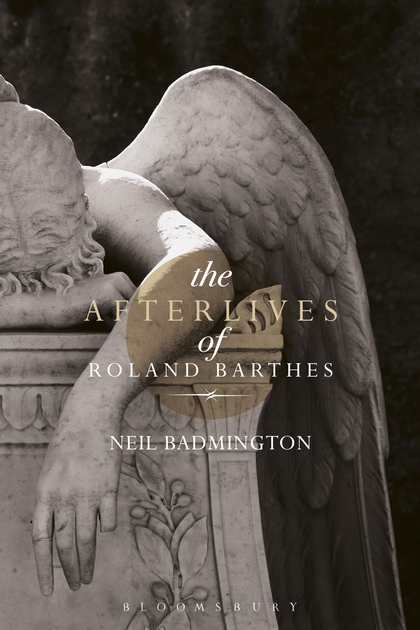
Neil Badmington, The Afterlives of Roland Barthes (Bloomsbury, 2016)
What led you to write The Afterlives of Roland Barthes?
‘Who’ rather than ‘What’, really. It’s all the fault of my good friend Jürgen Pieters, who has repeatedly led me, with our conversations over the years, in new directions. In 2006 Jürgen and Kris Pint (who was Jürgen’s PhD student at the time) organised a conference at their home institution of Ghent University on Barthes’s lecture courses at the Collège de France, which had recently appeared in print for the first time. I’m not sure why I was invited to participate: the other speakers were people with formidable reputations in the field of Barthes studies (Andy Stafford and Claude Coste, for instance), while I’d never written extensively about Barthes. His work had often informed mine up until that point — he’s there in Alien Chic and even the Posthumanism anthology, for instance — but he’d not been the primary object of analysis: I’d written with Barthes, not on Barthes. And the Barthes with whom I’d written had been the familiar Barthes, the ‘classic’ Barthes — the Barthes of S/Z and Mythologies, for example. But the unexpected invitation from Jürgen and Kris led me to look closely at the various volumes bearing Barthes’s name which had been published long after his death, and I was struck by how a different Barthes, another Barthes, was emerging gradually into print — not just the Barthes of the Collège years, but the Barthes of Travels in China, the Barthes of the seminars at the École pratique des hautes études, and the Barthes of Journal de deuil (or Mourning Diary, to give it its English title). It was the appearance of the latter in French in 2009 which really convinced me that The Afterlives of Roland Barthes needed to be written, in fact. I remember reading it at the time and realising as I turned the pages that it was altering my established perspective on Camera Lucida. This ‘new’ Barthes was reshaping the ‘old’ Barthes. In short, then, I wrote Afterlives to take stock of some of the posthumous publications which have appeared in recent years, and to ask how they might lead us to reconsider our understanding of the well-known publications which appeared during Barthes’s lifetime. (more…)
Alice Kaplan shares how Albert Camus wrote one of the twentieth century’s most iconic novels
Alice Kaplan, Looking for The Stranger: Albert Camus and the Life of a Literary Classic (University of Chicago Press, 2016). National Book Award Finalist.
What inspired you to write Looking for The Stranger?
The Stranger is the first novel I ever read in French, and the first novel I ever taught. I’ve always been struck by the fact that during all the years I spent studying it, word by word and scene by scene, I learned almost nothing at all about its Algerian setting. My trips to Algeria, my visits to the places Camus lived when he worked on the book were deeply inspiring. Twenty years ago, there was no way to travel to Algeria and I feel very lucky to have been able to explore Camus’s life there.
Your titledraws attention to the elusiveness of Camus’ novel. What kinds of challenges did you face during your research?
That’s a question every researcher loves to answer! Whatever papers Camus used to write the novel are lost. One theory has it that he left all his stuff in the Madison Hotel on the Boulevard Saint Germain when he evacuated to Clermont-Ferrand during the German invasion. The Germans eventually requisitioned the hotel, and by the time he went to collect his belongings there was nothing left. So I had to imagine what inspired him, through hints in his letters, his diaries, and in the novel itself: James M. Cain’s novel, The Postman Always Rings Twice; the Fernandel comedy, Le Schpountz; trials he covered for the newspaper Alger-Républicain. Then there are the manuscripts. If you set out to write the life story of a novel, the various manuscript versions are bound to tell a compelling story about how the writing evolved. In the case of The Stranger, there is only one available manuscript, which seems to be cobbled together from several versions. Part of it is hand written and part typed. The most interesting thing about that manuscript is that “Meursault” is spelled without an e, “Mersault.” When did he add that “u”, which put death (meur) right in his narrator’s name? (more…)
Sarah Hammerschlag discusses how the work of Levinas and Derrida can help us to rethink the relationship between religion, literature, and philosophy
What motivated you to write the book?
Sarah Hammerschlag, Broken Tablets: Levinas, Derrida, and the Literary Afterlife of Religion (Columbia University Press, 2016)
This project developed organically out of my first book The Figural Jew, which focuses on the revalorization of the figure of the Jew in post-World War II French literature and philosophy. At the center of that project there was already a nascent argument for introducing literary modes of speech into the political sphere to capitalize on the ways in which irony and plurivocity complicate the politics of identity. The last couple of chapters of that book argue that Blanchot and Derrida develop a literary concept of the Jew and Judaism through a reading of Levinas. But I was still concerned to represent the differences between Derrida and Levinas on the question of how to think about the cultural relevance of Judaism in the post-WWII context and to consider the very important political implications of their respective choices. Broken Tablets gave me the opportunity to track the implications of those differences and to conceive of them in terms of how each philosopher negotiated his relationship to religion and literature as competing discourses to philosophy. (more…)