Roger Luckhurst offers a critical and entertaining survey of Kubrick’s horror masterpiece
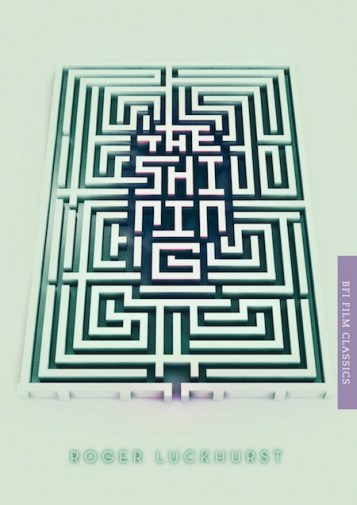
Roger Luckhurst, The Shining (Palgrave, 2013).

In the thirty-seven years since its premiere, Stanley Kubrick’s The Shining (1980) has been the subject of heated debate. Based on a bestselling novel by Stephen King, the adaptation was dismissed by the author as ‘maddening, perverse, and disappointing’. His judgement was not unique. Critics and audiences alike found the film bewildering and strange, not knowing whether to take it as an art film or a low-brow horror shocker. Yet, as Roger Luckhurst points out in his excellent book, The Shining (BFI Classics, 2013), despite its chilly opening reception the film is now regarded as ‘one of the most admired horror films in cinema history’.

Luckhurst’s take on The Shining manages to pierce the lid on thirty years of critical discussion, and to yield a fresh perspective on one of cinema’s most discussed and perplexing films. The book addresses Stanley Kubrick’s status as a distinctive auteur filmmaker, but dismisses the tendency of critics to see deliberate intention in every move and gesture. Instead, Luckhurst reads The Shining within the broader cultural and historical context of late 1970s-early 1980s American culture. Insightful connections are made to films like The Amityville Horror (1979), The Omen (1976), Poltergeist and The Evil Dead (both released in 1982). Through its representation of prescient children, telepathy, and horror, Luckhurst reveals how The Shining expresses widely-held anxieties about traditional gender roles, the nuclear family, and histories of repressed trauma and violence. (more…)


Peter J. Beck discusses the history of H.G. Wells’ iconic sci-fi novel, and how it continues to resonate in popular culture
Peter J. Beck, The War of the Worlds: From H. G. Wells to Orson Welles, Jeff Wayne, Steven Spielberg & Beyond (Bloomsbury, 2016)

What inspired you to write the book?

I have lived in Woking since 1971. Over time I became increasingly aware of the town’s links with H.G. Wells’ The War of the Worlds. Woking is the place where he researched, wrote and set the book. My house is located within one mile or so of both Horsell Common, where Wells’ Martians landed, and 141 Maybury Road, the house where Wells wrote the story.  Apart from walking the trail of the story and reading his books, during the late 1980s I began researching Wells’ correspondence, most notably that held by archives at the University of Illinois at Urbana-Champaign, the Harry Ransom Center at the University of Texas at Austin, and Yale University Library. This research was basically undertaken out of personal interest rather than with a view to publication, since as a professor of history my principal areas of research and publication were the history of British foreign policy and international organisation. RAE pressures – my membership of the RAE History panel for the 1992 and 1996 RAEs made me acutely aware of these – left no time for other research topics. However, I taught a course at Kingston University on ‘Literature, Art and War 1860-1920’, and introduced The War of the Worlds as one of the war scare set texts alongside The Battle of Dorking. I began to write up my research about Wells’ The War of the Worlds only in 2012 after finishing two contracted books: Using history, making British policy: the Treasury and the Foreign Office, 1950-76 (2006) and Presenting History: Past and Present (2012). A further source of inspiration was my membership of a Woking Task Group set up in 2013 to organise a programme of events celebrating Wells’ links with Woking in 2016, a year marking the 150th anniversary of his birth and the 70th anniversary of his death. I represented the H.G. Wells Society on this task group. (more…)

Recent interview selected as an Editors’ Pick
rhystranterdotcom-carolyncocca-riseofthesuperwomen-wordpressdiscover3
Screenshot of discover.wordpress.com

discover-badge-circle-rhystranter-comI am delighted to announce that RhysTranter.com was recently selected as an Editors’ Pick on WordPress.com’s Discover. The site aims to curate ‘the best content on WordPress, collected for you by humans who love to read’.

The selected piece was a recent interview with Carolyn Cocca for her new book, Superwomen: Gender, Power, and Representation (Bloomsbury, 2016). Carolyn Cocca discussed how women superheroes are changing the we way think about contemporary femininity. You can read the full interview here.

A big thank you to the editorial team of WordPress Discover for featuring the site.

Find out more about WordPress Discover.

Will Brooker reflects on our continuing fascination with Gotham City’s caped crusader
Will Brooker, Batman Unmasked: Analyzing a Cultural Icon

What inspired you to write Batman Unmasked?

Batman Unmasked was originally my PhD thesis, One Life, Many Faces, and I began it over 20 years ago, so you can understand it is a fairly distant memory. My PhD plans began around 1994 as a study of masculinity in the mainstream cinema of the 1990s, and Batman was a small aspect of one proposed chapter, about the Gothic Masculine (Tim Burton’s films). I realised gradually that the idea of writing about Batman was what I was really looking forward to – at the time, the very concept was audacious in academic work – and the project evolved until that small part of one chapter expanded into the entire PhD. Of course, Batman is an interesting topic per se, but I felt personally invested in the character, and wanted to write about something I was really enthusiastic about, as a fan. That enthusiasm was important, as by the end of the three years full time of my doctorate, I hated Batman, PhDs and academia in general. (Those feelings passed). (more…)

A new fully-illustrated volume offers a fascinating portrait of Austria’s most significant post-war writer
Thomas Bernhard, 3 Days: From the Film By Ferry Radax (Blast Books, 2016)

In the summer of 1970, experimental filmmaker Ferry Radax arranged to meet with the Austrian writer Thomas Bernhard. Over the course of three days, Radax recorded the writer amid the pleasant surroundings of a park in Hamburg. For readers familiar with Bernhard’s work, the setting was incongruous: his novels Frost (1963), Gargoyles (1967) and The Lime Works (1970) portray dark, grotesque landscapes of murder, ignorance, and obsession. As Bernhard himself admits, ‘I am hardly a cheery author’. And yet, in such bright and affable settings, Radax manages to capture a revealing portrait of the writer George Steiner called ‘the foremost craftsmen of German prose after Kafka and Musil.’

Blast Books, an independent publisher in New York, has taken a great deal of care to adapt Radax’s film, entitled 3 Days, into a book. The beautifully presented hardback volume includes Thomas Bernhard’s own reflections on Radax’s film, and a fully-illustrated record of the documentary translated from the German by Laura Lindgren. Also included is a critical afterword by film scholar Georg Vogt, and a fully-illustrated appendix of Radax’s notes for the filmmaking. The book makes considered use of space, word, and image to capture the spirit of Radax’s documentary, and the rhythms and emphasis of Bernhard’s monologues. (more…)

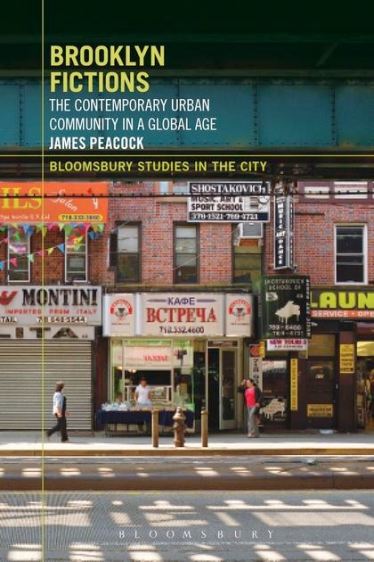
James Peacock discusses how cultural and literary criticism can help us to unpack Brooklyn’s complex cultural history

How did you come to write Brooklyn Fictions?

James Peacock, Brooklyn Fictions: The Contemporary Urban Community in a Global Age (Bloomsbury, 2016).

There are two strands to this answer – three, if I’m being really honest. First, it evolved quite organically from my previous research on Paul Auster and Jonathan Lethem – both contemporary writers strongly associated with the borough. Having written articles and monographs on them which explored, at least in part, their representations of Brooklyn neighbourhoods, it made sense to embark on a multi-author project which dug more deeply into these representations. Looking at my research as a whole, I realise that the importance of place and the relationship between the individual and the community have been connecting themes. The second inspiration for the project was more personal. While I was studying for my Ph.D., my wife and I lived in Leith. Once a separate town, now part of Edinburgh, Leith retains a fiercely independent streak and a sense of identity in opposition to the fancier city up the road. Even though it has been undergoing gentrification for many years, and despite the fact that it has Michelin-starred restaurants and some very expensive new apartments, Leith still values a down-home, honest authenticity many of its residents feel the centre does not have. When I began to understand that the relationship between Brooklyn and Manhattan was very similar, I saw some wider potential in writing about these ideological constructions, with Brooklyn as a suitable case study. Thirdly – and here’s the confessional moment – I visited New York City for the first time in 2005 and (though it’s not very original to say this) fell in love with it. I cannot deny that a research project which might take me there a few times was an attractive prospect. (more…)

Carolyn Cocca discusses how women superheroes are changing the we way think about contemporary femininity

What motivated you to write Superwomen?

carolyn-cocca-superwomen-gender-power-representation
Carolyn Cocca, Superwomen: Gender, Power, and Representation (Bloomsbury, 2016)

As a kid, my three male neighbors and I would play “superheroes.” I was always “the girl,” whether that was Wonder Woman, or Princess Leia, or whoever, while the guys got to choose from among many characters. As I got older it still seemed that female characters were much less numerous than the male characters and were more sexualized than the male characters, and usually have weaker powers and less interesting stories. So I decided to formally apply my political science and gender studies training to this issue and found that what I felt growing up is true not only about superheroes but also about the way women are portrayed across fiction–they are portrayed much less often, with much less nuance, and with much less power. There has been some change over time, but not very much. So Superwomen investigates how and why this is the case. (more…)