
Adam Weiner discusses how a Russian socialist novel from the nineteenth-century influenced the work of Ayn Rand and subsequent economic deregulation in the United States

What motivated you to write How Bad Writing Destroyed the World?
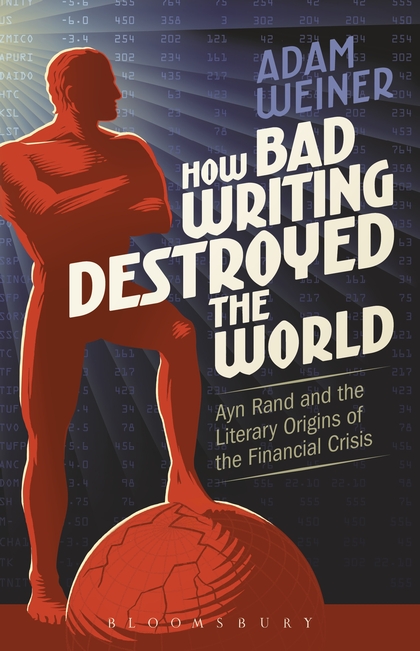
Adam Weiner, How Bad Writing Destroyed the World: Ayn Rand and the Literary Origins of the Financial Crisis (Bloomsbury, 2016)

The idea evolved over time. While I was attending university I kept hearing about what an incredible, life-transforming experience it was to read Ayn Rand’s novels. Eventually I became curious enough to read The Fountainhead. The awfulness of the writing dumbfounded me, and I began to wonder what people could possibly be finding in there—it couldn’t be pleasures of an artistic order, so something else. As a graduate student I had to read Nikolai Chernyshevsky’s history-making but horribly written novel What Is to Be Done? and I became immediately aware that its badness was akin to what I had found in Ayn Rand. I mean not merely the clunky prose style and android heroes, but the dictatorial, sermonizing tone, and the sense that questionable ideological values were being hawked practically for free. When I began to teach literature at Wellesley College some of my students kept naming Ayn Rand and Nabokov as their favourite writers, and I was dismayed that the two names were being spoken in the same breath. So I read Atlas Shrugged. Only then did I get it: Ayn Rand, while officially despising socialism, had found her most immediate literary inspiration in Russia’s homegrown socialist, Chernyshevsky. All of the same ideas, devices, images: the same rational egoism; the same utopian scheming, right down to weird details, like perpetual motion machines. Humankind would discover miraculous new metals, motors and professional relations that would allow them to re-shape the world in their own image. Do god’s work. Become the master of your destiny. Etc., etc. I knew that all of this nonsense had been a direct inspiration to Lenin, who had destroyed the Russian Empire under its heady influence. Suddenly I saw that Ayn Rand had done much the same thing in the US by programming Alan Greenspan with objectivism and unleashing him into our economy, where he deregulated everything to the point of disaster and beyond. That’s when the book took shape in my mind. (more…)

Peter J. Beck discusses the history of H.G. Wells’ iconic sci-fi novel, and how it continues to resonate in popular culture
Peter J. Beck, The War of the Worlds: From H. G. Wells to Orson Welles, Jeff Wayne, Steven Spielberg & Beyond (Bloomsbury, 2016)

What inspired you to write the book?

I have lived in Woking since 1971. Over time I became increasingly aware of the town’s links with H.G. Wells’ The War of the Worlds. Woking is the place where he researched, wrote and set the book. My house is located within one mile or so of both Horsell Common, where Wells’ Martians landed, and 141 Maybury Road, the house where Wells wrote the story.  Apart from walking the trail of the story and reading his books, during the late 1980s I began researching Wells’ correspondence, most notably that held by archives at the University of Illinois at Urbana-Champaign, the Harry Ransom Center at the University of Texas at Austin, and Yale University Library. This research was basically undertaken out of personal interest rather than with a view to publication, since as a professor of history my principal areas of research and publication were the history of British foreign policy and international organisation. RAE pressures – my membership of the RAE History panel for the 1992 and 1996 RAEs made me acutely aware of these – left no time for other research topics. However, I taught a course at Kingston University on ‘Literature, Art and War 1860-1920’, and introduced The War of the Worlds as one of the war scare set texts alongside The Battle of Dorking. I began to write up my research about Wells’ The War of the Worlds only in 2012 after finishing two contracted books: Using history, making British policy: the Treasury and the Foreign Office, 1950-76 (2006) and Presenting History: Past and Present (2012). A further source of inspiration was my membership of a Woking Task Group set up in 2013 to organise a programme of events celebrating Wells’ links with Woking in 2016, a year marking the 150th anniversary of his birth and the 70th anniversary of his death. I represented the H.G. Wells Society on this task group. (more…)

Alice Kaplan shares how Albert Camus wrote one of the twentieth century’s most iconic novels
Alice Kaplan, Looking for The Stranger: Albert Camus and the Life of a Literary Classic (University of Chicago Press, 2016). National Book Award Finalist.

What inspired you to write Looking for The Stranger?

The Stranger is the first novel I ever read in French, and the first novel I ever taught. I’ve always been struck by the fact that during all the years I spent studying it, word by word and scene by scene, I learned almost nothing at all about its Algerian setting. My trips to Algeria, my visits to the places Camus lived when he worked on the book were deeply inspiring. Twenty years ago, there was no way to travel to Algeria and I feel very lucky to have been able to explore Camus’s life there.

Your title draws attention to the elusiveness of Camus’ novel. What kinds of challenges did you face during your research?

That’s a question every researcher loves to answer! Whatever papers Camus used to write the novel are lost. One theory has it that he left all his stuff in the Madison Hotel on the Boulevard Saint Germain when he evacuated to Clermont-Ferrand during the German invasion. The Germans eventually requisitioned the hotel, and by the time he went to collect his belongings there was nothing left. So I had to imagine what inspired him, through hints in his letters, his diaries, and in the novel itself: James M. Cain’s novel, The Postman Always Rings Twice; the Fernandel comedy, Le Schpountz; trials he covered for the newspaper Alger-Républicain. Then there are the manuscripts. If you set out to write the life story of a novel, the various manuscript versions are bound to tell a compelling story about how the writing evolved. In the case of The Stranger, there is only one available manuscript, which seems to be cobbled together from several versions. Part of it is hand written and part typed. The most interesting thing about that manuscript is that “Meursault” is spelled without an e, “Mersault.” When did he add that “u”, which put death (meur) right in his narrator’s name? (more…)

Bethany Rose Lamont on a print journal that discusses mental health issues through art and literature

What inspired you to start Doll Hospital?

I started Doll Hospital in 2014 when I was 23 and a suicidal master’s student at Oxford. I’m 25 now and a suicidal PhD student at Central Saint Martins, so, like, ‘inspiring’ may not be the best word but hey, in two and half years we’ve put out three 150 page plus full colour issues which is cool. My reason for starting it wasn’t particularly worthy. I was literally just told by my friends to stop tweeting about killing myself as it was freaking everyone out so I was like ‘screw you guys I’ll find another space to make people uncomfortable!’—which is a hilarious backstory in my humble opinion.

Could you tell me how you chose the provocative title?

I came across the phrase ‘doll hospital’ in the 2012 Spring/Summer edition of Another Magazine, the author Joe Dunthorne had curated a photo series, pairing quotes with interesting images. One of the quotes read something along the lines of ‘this is the doll hospital, they come to me broken and I bring them new life’. I just became totally taken in by that line! I had also recently read The Bluest Eye, and the notion of deconstructing white supremacy via the imagery of the doll, of Shirley Temple, was so powerful to me. From then on all my social media was under the handle ‘doll hospital’. I just thought it was the best combination of words, so inevitably when it came to choosing a title for the journal I went with Doll Hospital too! (more…)

Sarah Hammerschlag discusses how the work of Levinas and Derrida can help us to rethink the relationship between religion, literature, and philosophy

What motivated you to write the book?

Sarah Hammerschlag, Broken Tablets: Levines, Derrida, and the Literary Afterlife of Religion (Columbia University Press, 2016)
Sarah Hammerschlag, Broken Tablets: Levinas, Derrida, and the Literary Afterlife of Religion (Columbia University Press, 2016)

This project developed organically out of my first book The Figural Jew, which focuses on the revalorization of the figure of the Jew in post-World War II French literature and philosophy. At the center of that project there was already a nascent argument for introducing literary modes of speech into the political sphere to capitalize on the ways in which irony and plurivocity complicate the politics of identity. The last couple of chapters of that book argue that Blanchot and Derrida develop a literary concept of the Jew and Judaism through a reading of Levinas. But I was still concerned to represent the differences between Derrida and Levinas on the question of how to think about the cultural relevance of Judaism in the post-WWII context and to consider the very important political implications of their respective choices. Broken Tablets  gave me the opportunity to track the implications of those differences and to conceive of them in terms of how each philosopher negotiated his relationship to religion and literature as competing discourses to philosophy. (more…)

Michael Lackey on the popularity of the biographical novel, and what it can tell us about the relationship between literature, history and truth
Michael Lackey, The American Biographical Novel (Bloomsbury, 2016)

What motivated you to write The American Biographical Novel

Through my reading of biographical novels, I noticed a shift in the nature of literary truth.  In Heart of Darkness, Joseph Conrad illuminates the colonial mentality that enabled Europeans to plunder Africa and to abuse Africans with impunity.  Conrad represents that mentality through Kurtz, and as the narrator says, “all Europe contributed to the making of Kurtz.”  In essence, if we want to understand the European mentality that justified colonization and its horrific outcomes, we can look to Kurtz for some answers.  But with the rise of postmodernism, there has been growing skepticism about the traditional literary symbol.

Put simply, postmodernists question the value of an overarching truth claim, because they realize that someone constructed that truth for an ideological or political reason.  This approach to truth impacted the traditional literary symbol, so a postmodernist could easily say: “Look, Joe, you constructed the character of Kurtz in order to promote your own ideological agenda.  Therefore, I don’t see any reason why I should consider a character like Kurtz as symbolic of the European mind.”It is my contention that biographical novelists were becoming increasingly aware of the problems with the traditional literary symbol, but they also did not want to get rid of the literary symbol, because they realized that it could be effectively used to expose the structures and conditions of oppression.  (more…)

Victor Brombert discusses how literature reflects changing ideas about life, death, and the condition of mortality
Victor Brombert, Musings on Mortality: From Tolstoy to Primo Levi (University of Chicago Press, 2016)

What motivated you to write the book?

Probably it was an early childhood and adolescent awareness of our mortal condition, of human vulnerability in general: the death in infancy of my younger sister (I was seven years old), the assault on human life and dignity by totalitarian regimes that forced families like mine into multiple exiles, and later the experience of war and the Nazi occupation of France, our escape to the United States on an overcrowded freighter zigzagging for six weeks across the Atlantic to elude German U-boats, my joining the American army and surviving the Omaha Beach landing and the Battle of the Bulge — perhaps above all the growing belief that all valuable human achievements, especially in literature and the arts, were a defiance of death.

Your subtitle traces a history between Leo Tolstoy and Primo Levi. What is significant about these two writers?

It is a long trajectory between Tolstoy and Primo Levi. The distance and the contrast tell a story. Whereas Tolstoy in The Death of Ivan Ilych is concerned with an exemplary individual, his morally and spiritually empty life, and his ultimate salvational epiphany at the hour of death, Primo Levi by contrast is dealing with a collective moral and political context in which private salvation is no longer thinkable. The trajectory as well as the authors along the way tell the story of the 20th century as that of a growing awareness of a collective tragedy. (more…)