Six months ago today, I decided to change my life. I wanted to find a sense of peace and happiness in myself, and to live by my conviction that to enact social, cultural, and political change, it is essential that I change myself. I started following a healthy and balanced diet, stopped drinking alcohol, and began exercising regularly; I began to pursue my vocation as a writer; and I committed myself to getting more involved in my local community. Since that decision, I have attained a healthy bodyweight (having shed fifty-three pounds), am volunteering with local organisations, and write for my own enjoyment. I accept that meaningful change requires ongoing action and sacrifice, and I continue to be humbled by an awareness of my weaknesses and limitations. I am grateful for the understanding of my family and friends, and for their continued enthusiasm and support. I feel that I have found my peace, and I am happier than I have ever been.
Tuning in to the State of the Theory Podcast
What is the State of the Theory podcast?
Hannah Fitzpatrick: Like most podcasts, State of the Theory is a manifestation of our narcissism. It began as an optimistic hope (albeit with few expectations) that our casual conversations might be of interest to, and spark debate among, our friends and colleagues. We used to commute together a few times a week, and the car became a sort of impromptu seminar venue, but without the audience. After the last research auditing exercise undertaken by the UK government in 2014, Impact and Public Engagement became quantifiable entities that might be used for or against us later in our careers, so the podcast is a sort of compromise, a way for us to demonstrate that our thoughts have value beyond the walls of the Vauxhall Astra, while still doing it on our own terms. A way of selling out without entirely selling out, if you will. Also, we missed the long drive, where all we could do was chat, and we could have these long, multi-stage conversations over the course of a week or two, so the podcast was a way for us to recreate that time. (more…)

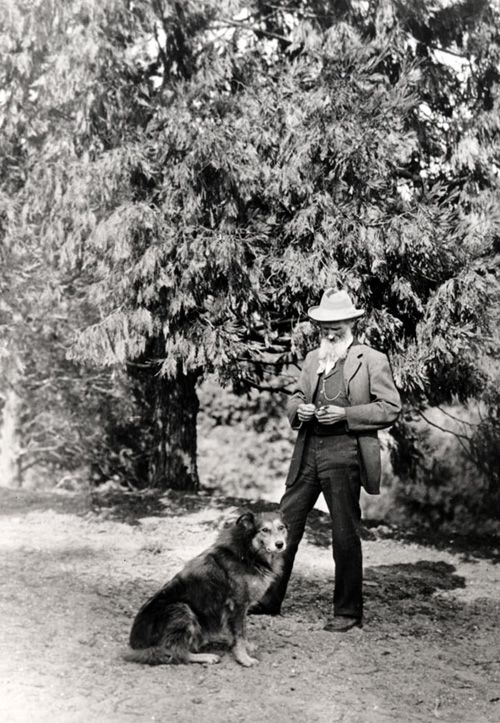
John Muir: “I am degenerating into a machine for making money”

“I am losing precious days. I am degenerating into a machine for making money. I am learning nothing in this trivial world of men. I must break away and get out into the mountains to learn the news.”
— John Muir
Hermann Hesse on Life’s Difficulties
“That life is difficult, I have often bitterly realized. I now had further cause for serious reflection. Right up to the present I have never lost the feeling of contradiction that lies behind all knowledge. My life has been miserable and difficult, and yet to others, and sometimes to myself, it has seemed rich and wonderful. Man’s life seems to me like a long, weary night that would be intolerable if there were not occasionally flashes of light, the sudden brightness of which is so comforting and wonderful, that the moments of their appearance cancel out and justify the years of darkness.”
— Hermann Hesse, Gertrude (trans. Hilda Rosner)
The Signature Hard Bop Tune that was Recorded On This Day in 1958
Art Blakey and the Jazz Messengers recorded Moanin’ for Blue Note Records on October 30, 1958, fifty-nine years ago today. The bandleader, depicted on the record’s front sleeve, was born in Pittsburgh in October 1919; Blakey left school early to work in a coal mine, and then a steel mill, before putting together his first band. In interviews he described himself as an orphan who taught himself everything he needed to know, from how to play piano (without reading music) to the drums.
In 1943, Blakey made his way to New York where he found a place as a drummer with the Fletcher Henderson Orchestra, and made his debut recording with Billy Eckstine‘s band. After establishing a career throughout the 1940s and ’50s as an accomplished player, including dates with Miles Davis, Thelonious Monk, and Coleman Hawkins, Blakey joined Horace Silver and the Jazz Messengers. (more…)
23 October 2017
I rise at 6am, and spend the early hours writing, reading, and drinking hot tea.
I am reading Primo Levi’s The Truce, an account of his long journey home after the liberation of Auschwitz in 1945. The chemist has a close eye for detail, and describes people’s actions with clarity and economy. His work is relevant for its account (and analysis) of historical injustice, but feels more so during these times.
Experimenting with black and white photography, and pleased with the results. Since I capture images using a phone camera, quality can be a concern in poor weather or dim lighting. But I find that in black and white photography these conditions are not a hindrance, but work to one’s advantage. The results are always interesting and sometimes beautiful. A dark and blurry portrait resembles a canvas painted with broad strokes.
There is a juvenile Eurasian coot living in a nearby canal. It was born much later than the others, and its family has not yet flown south for the winter.
Arvo Pärt on Life and Music
On words, music, and expression
“Most of my early music was non-vocal. In fact, I only started writing intensively for choirs after I met the Hilliards. Hearing them for the first time changed my life totally. The tears fell over my face and I was not able to say where I was – in heaven or here on Earth. It was a shock.”
— Arvo Pärt, The Telegraph (more…)