
Analog. I grew up during a transitional phase when heavy analog technologies were being replaced by lighter, digital devices. A tactile nostalgia has since grown up around those cumbersome objects of the 1980s and 1990s. They have the charm of relics from a bygone age.
Thursday, January 18, 2018
Cardiff. Late afternoon. I walk for two hours through the city. A couple of books in my bag. And a flask. Happiness.
The Life of Günther Anders: A Philosopher of the 20th Century


Christopher John Müller has translated Christian Dries‘s short online biography of modern philosopher, Günther Anders. Müller, who has been interviewed on this site, is becoming one of the most prominent scholars and translators focussing on Anders’s life and legacy. The biography opens with the following brief summary:
“Günther Anders once noted that he did not actually have a biography, merely biographies: segments of life that are connected to one another to various degrees. The First World War, Hitler, Exile in Paris and in America, Auschwitz, Hiroshima, the Vietnam War and Chernobyl were the decisive incisions in Anders’s extraordinary life, which spanned the 20th Century.”
Thomas Merton on a “beautiful quotation” from Seneca
“Reading Mabillon’s wise and delightful book on monastic studies. Among other things, this beautiful quotation from Seneca: “If you will give yourself to study, you will ease every burden of life, you will neither wish for night to come or the light to fail; neither shall you be worried or preoccupied with other things.”
— Thomas Merton, Journal, 10 November 1958
Credo: A State Of Life That Calls For Another Way Of Living
Reflecting on the decision to pursue my vocation in art, service, and simple living
Six months ago today, I decided to change my life. I wanted to find a sense of peace and happiness in myself, and to live by my conviction that to enact social, cultural, and political change, it is essential that I change myself. I started following a healthy and balanced diet, stopped drinking alcohol, and began exercising regularly; I began to pursue my vocation as a writer; and I committed myself to getting more involved in my local community. Since that decision, I have attained a healthy bodyweight (having shed fifty-three pounds), am volunteering with local organisations, and write for my own enjoyment. I accept that meaningful change requires ongoing action and sacrifice, and I continue to be humbled by an awareness of my weaknesses and limitations. I am grateful for the understanding of my family and friends, and for their continued enthusiasm and support. I feel that I have found my peace, and I am happier than I have ever been.
Tuning in to the State of the Theory Podcast
Hannah Fitzpatrick and Anindya Raychaudhuri discuss a topical podcast that covers politics, power, and pop culture
What is the State of the Theory podcast?
Hannah Fitzpatrick: Like most podcasts, State of the Theory is a manifestation of our narcissism. It began as an optimistic hope (albeit with few expectations) that our casual conversations might be of interest to, and spark debate among, our friends and colleagues. We used to commute together a few times a week, and the car became a sort of impromptu seminar venue, but without the audience. After the last research auditing exercise undertaken by the UK government in 2014, Impact and Public Engagement became quantifiable entities that might be used for or against us later in our careers, so the podcast is a sort of compromise, a way for us to demonstrate that our thoughts have value beyond the walls of the Vauxhall Astra, while still doing it on our own terms. A way of selling out without entirely selling out, if you will. Also, we missed the long drive, where all we could do was chat, and we could have these long, multi-stage conversations over the course of a week or two, so the podcast was a way for us to recreate that time. (more…)
John Muir: “I am degenerating into a machine for making money”
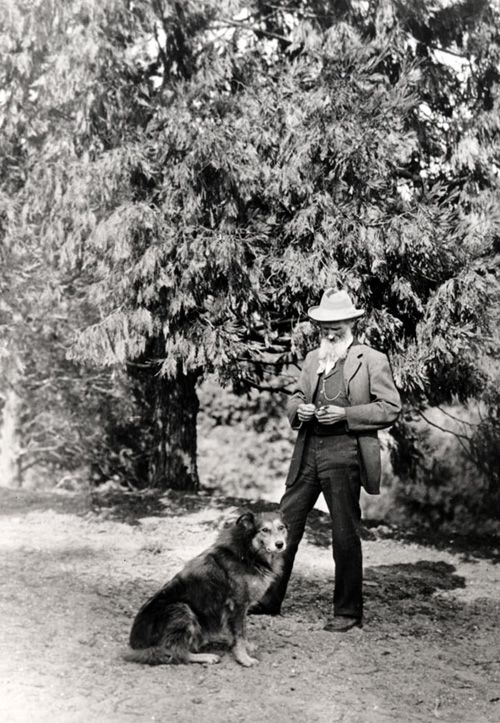
“I am losing precious days. I am degenerating into a machine for making money. I am learning nothing in this trivial world of men. I must break away and get out into the mountains to learn the news.”
— John Muir

