Rachele Dini discusses how the work of J.G. Ballard, Don DeLillo, and Samuel Beckett engages with one of the most pressing environmental issues of our time
Rachele Dini, Consumerism, Waste, and Re-Use in Twentieth-Century Fiction (Palgrave, 2016)

What motivated you to write Consumerism, Waste, and Re-Use in Twentieth-Century Fiction?

Well, I’ve been attracted to remnants of different kinds since I was very little, and was obsessed with cutting up magazines as a teenager—but intellectually, the turning point for me was during my MA at King’s College London. I noticed almost immediately that the texts on the modules I was taking were unusually concerned with fragments and fragmentation. Dickens, Zola, Eliot, Elizabeth Bowen, Fernando Pessoa, Virginia Woolf, Ballard, Calvino, and of course Walter Benjamin and Adorno: physical and metaphorical waste proliferates in all of these authors’ work. In hindsight, this was to be expected since the course focused on the seismic effects of capitalist modernity, and waste is certainly one of these. But that focus on residual matter reproaching you for throwing it away, or on things not working and stuff falling apart, especially compelled me at the time, since it was the opposite in every way from the focus of my day job in market research. Market research is an industry essentially devoted to promoting the very things that leftist theory denounces: its modus operandi is to find ways of selling more. So the first spark for the PhD project that ultimately turned into this book was the conflict between the rhetoric of ‘harder, better, faster, stronger’ (to quote Daft Punk) I was accustomed to in my working life, and all of the countercultural—or simply denunciatory—writing I discovered through my studies, which called that rhetoric into question. (more…)

Autobiography is always negotiating two or more voices, speaking from separate and distinct moments in time. We can see this in what is perhaps the earliest example of modern autobiography, St Augustine‘s Confessions, where a present-day narrator attempts to reconstruct a previous life. In this way, autobiographical writing attempts to collapse the distance between childhood and adulthood, innocence and experience, and past and present.  (more…)

Michael Richardson discusses how literature can help shed new light on our understanding of torture, trauma, and affect
Michael Richardson, Gestures of Testimony (Bloomsbury, 2016)

How did you come to write Gestures of Testimony?

One of Barack Obama’s first acts as President was to declassify the Torture Memos of the Bush Administration. Suddenly, the architecture of American torture was visible to an extent that it had never been before. At the time, I was working as a speechwriter in Canada for Jack Layton, who was then the leader of the New Democratic Party, and watching very closely what was happening across the border. I became obsessed with how torture was articulated and authorised, and even more so with the effect it had on both survivors and perpetrators. I’ve always understood the world through writing and literature, so I wanted to understand torture in that context too. That led me to a PhD on torture, literature and politics, and from there to writing Gestures of Testimony. (more…)

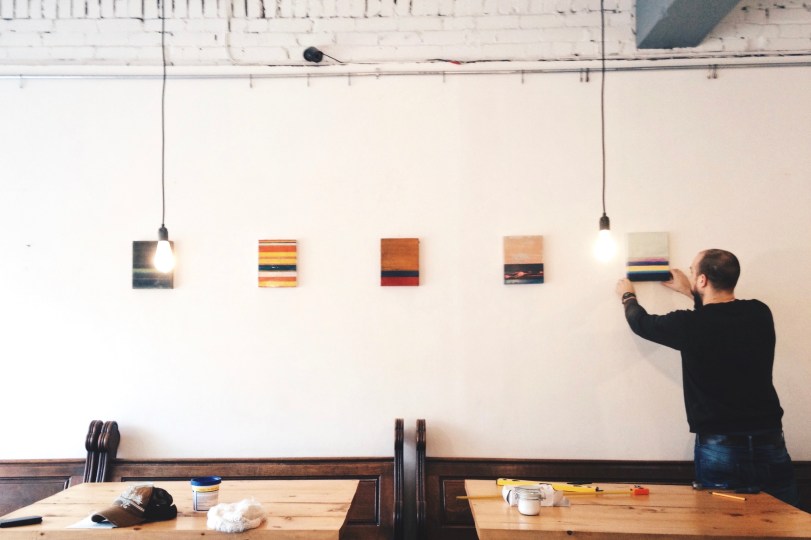
British artist Tom Harman discusses how critical theory led him to return to painting
Tom Harman installs abstract paintings at Little Man Coffee Co., Cardiff. Photograph: Rhys Tranter.

When did you start painting?

Drawing and painting, for me, was what I always did and was always good at. Throughout school I only ever wanted to paint and couldn’t wait to leave at 16 and begin a BTECH in Art and Design at my local FE college. This was a great experience, at last getting to create visual material all day, every day. I was particularly interested in painting that had some form of social commentary and was influenced by the New Glasgow Boys, painters from the Glasgow School of Art such as Steven Campbell, Peter Howson and Ken Currie, as well as the big names in British painting such as Frank Auerbach, Leon Kossoff, Francis Bacon and Lucian Freud. (more…)

Aimee Pozorski discusses the complex ways we engage with art and writing in the wake of the September 11th attacks

We are conducting this interview fifteen years after the September 11th terrorist attacks took place. What motivated you to write Falling After 9/11? How did the project begin?

Aime Pozorski, Falling After 9/11: Crisis in American Art and Literature (Bloomsbury, 2016)
Aimee Pozorski, Falling After 9/11: Crisis in American Art and Literature (Bloomsbury, 2016)

The project began with the installation of Graydon Parrish’s 9/11 mural, Cycle of Terror and Tragedy, which was commissioned in 2002 by the New Britain Museum of American Art in my hometown of New Britain, CT. It took Parrish four years to complete the work, and when it was finally revealed, some critics savaged it for its commitments to Classical Realism. After being outraged that reviewers could be so callous, my training in trauma theory kicked in. As a trauma theorist who studies literature, I frequently consider ways in which a text’s moments of so-called failure can actually succeed in telling us something not only about the nature of representation but also about traumatic history itself. What does it mean that so many representations of 9/11 seemed inadequate? I asked myself. And does that have more do to with the nature of trauma and our reception of art and literature than it does with the singular talents or contributions of individual artists themselves?  (more…)

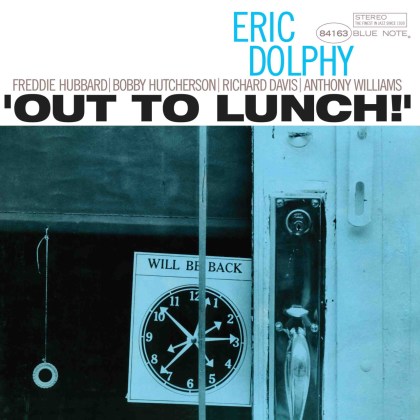
The avant-garde reedist’s iconic outing for Blue Note Records was recorded on this day in 1964
Eric Dolphy, Out to Lunch! (Blue Note, 1964)

On this day in 1964, Eric Dolphy entered Rudy Van Gelder’s studio in Englewood Cliffs, New Jersey, to record one of Blue Note Records’ most distinctive and iconic records. Joined by Freddie Hubbard (trumpet), Bobby Hutchinson (vibraphone), Richard Davis (bass) and an eighteen-year-old Anthony Williams (drums), Dolphy brought along his alto saxophone, bass clarinet, and flute for the date.

Out to Lunch! is the culmination of a sequence of recordings that explored the possibilities of avant-garde jazz in the early 1960s, from Dolphy’s first album as leader, Outward Bound (New Jazz, 1960), to Out There (New Jazz, 1960), to his 1961 recordings at the Five Spot and 1962’s Far Cry (New Jazz). Across these works we can hear the artistic development of Dolphy as a restless and inventive talent. Out to Lunch! nods a debt to bebop in its tribute to pianist Thelonious Monk (‘Hat and Beard’), and acknowledges the classical flautist Severino Gazzelloni (‘Gazzelloni’), but while the album negotiates the legacy of bebop and post-bop music it simultaneously reaches towards freer musical forms. (more…)

Lecture slide from Utopia: Suffrage to Cyberpunk.

I’m currently teaching a literature module at Cardiff University entitled Utopia: Suffrage to Cyberpunk, which traces the development of utopian/dystopian writing in the twentieth-century. Yesterday’s lecture included something of a surprise, when Margaret Atwood  took time to share a few words the group via Twitter. We spent a few minutes at the end of the lecture following her sage advice, collectively acquainting ourselves with the wonders of Thug Notes.