
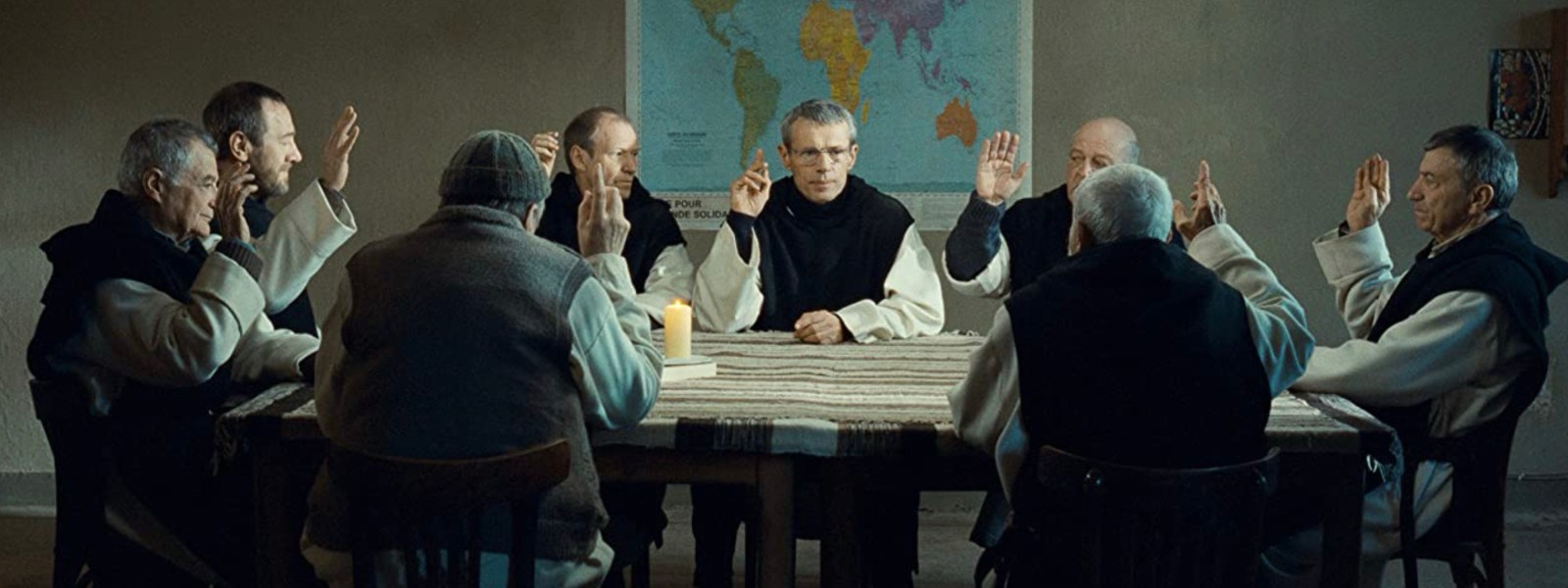

“You are gods, sons of the Most High, all of you; nevertheless, like men you shall die, and fall like any prince” (Ps 82:6-7)
Xavier Beauvois’s 2010 film, Of Gods and Men, begins with this ominous epitaph from the eighty-second psalm. It is to be a portent of the narrative’s themes of death and dignity, explored in conversation with the theological virtues of faith, hope, and love.
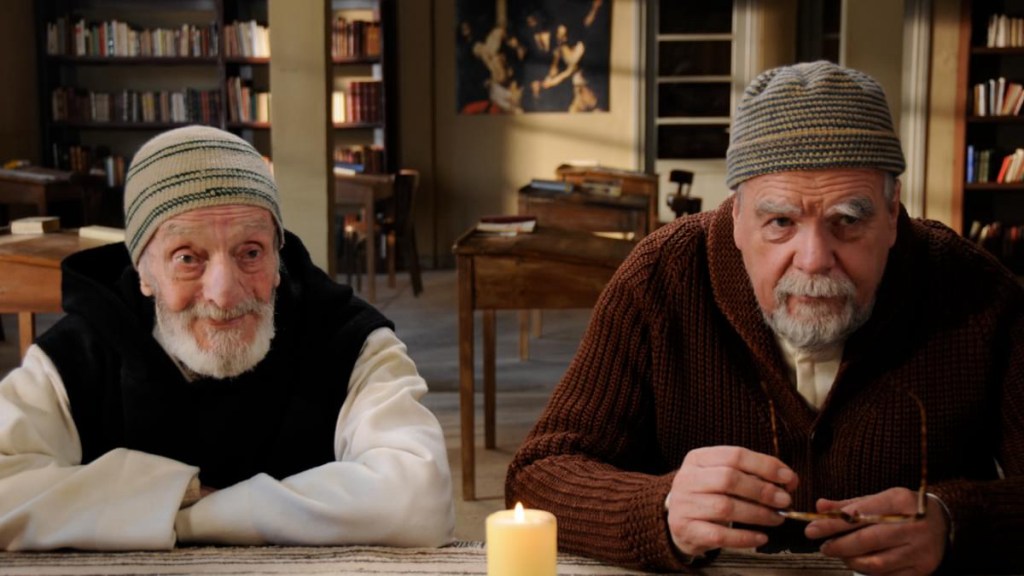
The film is based on the true story of a community of Cistercian monks at the Monastery Notre-Dame de l’Atlas (Abbey of Our Lady of Atlas) in Tibhirine, Algeria. As you might imagine, my remarks here will reveal key details of the plot and references to the real historical events.
Set in the early to mid-1990s, towards the beginning of the Algerian Civil War, the film juxtaposes the lives of the peaceable monks with the ideological tensions around them: specifically, between the governing political powers and the rising insurgency of the Armed Islamic Group (Groupe Islamique Armé, GIA). In this context, the monastery represents more than just a benign Christian presence in the region, but is acknowledged by government officials as an icon of France’s continuing colonial influence.
Lambert Wilson (The Matrix Reloaded and The Matrix Revolutions) plays the community leader, Dom Christian, with a quiet integrity and compassion. Michael Lonsdale is the humane and ambling asthmatic doctor, Br Luc, who brings a kindness and humour to many of his scenes. And Olivier Rabourdin plays the troubled Br Christophe, who is struggling with his vocation. (Br Christophe Lebreton’s diaries and spiritual writings from the period were later published as Born from the Gaze of God in 2014, and provide an expansive portrait of the real man behind Rabourdin’s performance.)
Beauvois brings the Étienne Comar’s screenplay to life with patience and deliberation, capturing the steady rhythms of a monastic life of prayer, manual labour, and service to the poor neighbouring village of Tibhirine. The monks sell homemade goods in the marketplace, and Br Luc provides medical assistance to all that seek him out.
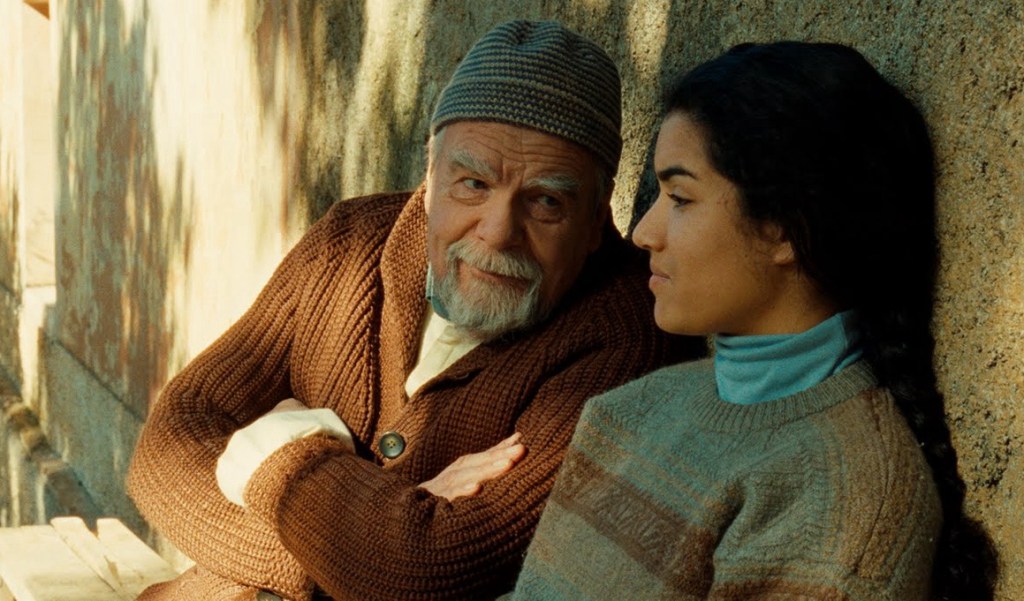
After several violent deaths in the area at the hands of the GIA, most notably the murder of 12 Croatians in 1993, the lives of the monks fall under threat; they are forced to question their place among the people of Tibhirine, and to make difficult decisions about their future. This growing sense of anxiety and doubt even extends to the meaning and purpose of their religious life.
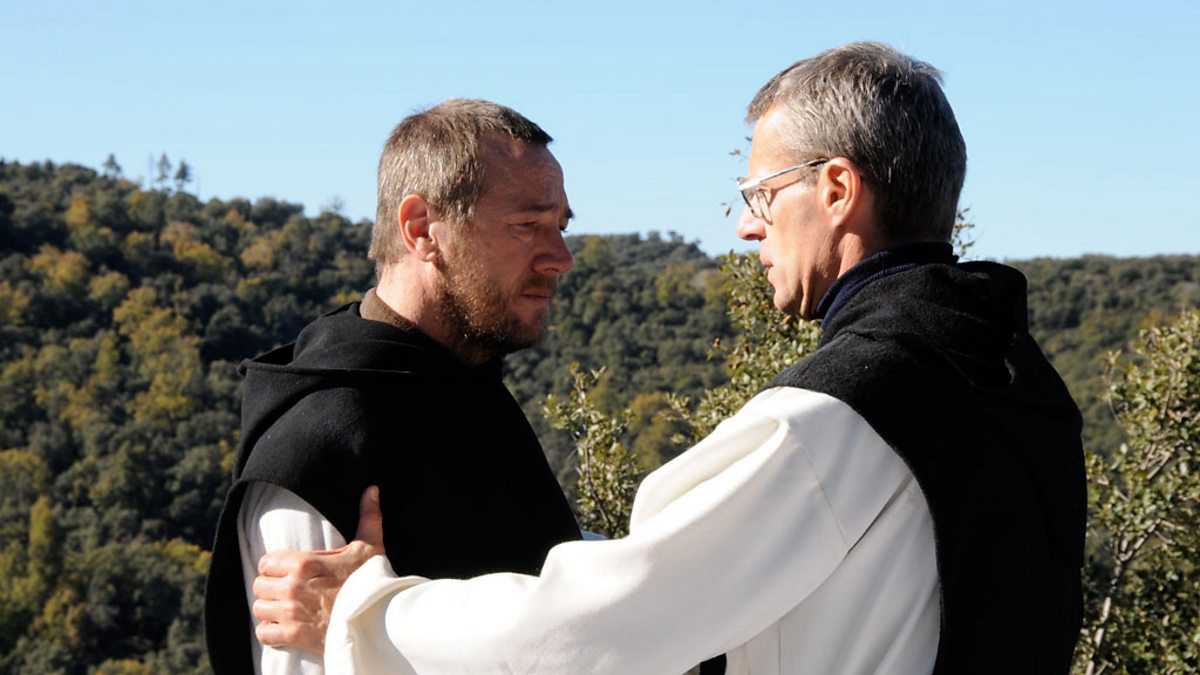
Encouraging Br Christophe at such a moment of crisis, Dom Christian’s calm and supportive words are a gentle reminder of the origin of the Christian term, ‘martyr’, derived from a Greek word for ‘witness’: “We are martyrs out of love, out of fidelity. If death overtake us, despite ourselves, because up to the end, up to the end we’ll try to avoid it. Our mission here is to be brothers to all. Remember that love is eternal hope. Love endures everything.” Br Christophe and Dom Christian embrace. “I’m sorry,” he tells him.
Tensions continue to escalate, but after careful and fraught consideration the monks decide that their vocation is to remain in the community that they serve, and that to do otherwise would be to abandon their calling.
The film’s final act dramatises a beautiful ‘last supper’ scene set to Tchaikovsky’s Swan Lake, which captures an almost sublime tension between the love that sustains the group and the sacrifice and suffering such love may demand.
After the supper, in the early hours of the next morning, seven of the monks are kidnapped from the Abbey by GIA forces (dramatising the real-life events of 26-7 March 1996). Two monks remained behind, overlooked by the kidnappers. A ransom is set, but on 21 May 1996 the seven monks are killed – the specific circumstances of which remain mysterious to this day. Beauvois’s film carefully retains the ambiguous nature of their deaths, which remain off-screen and out of sight.
What we are left with are many questions. The film is tacitly suggestive of the unintended and inherited legacies of colonialism; the untold consequences of political corruption; and the violent hypocrisy of misguided religious fundamentalism. But perhaps the most poignant and lingering question that remains with the viewer is this one: Why did the monks decide to stay?
Of Gods and Men answers this with several purposeful reasons, but its most convincing are given through music, images, and silent gestures. The meaning and purpose of their presence is love, something spiritual, immeasurable, and intangible.

The last words are a voiceover spoken by Dom Christian, taken from the Spiritual Testament of Christian de Chergé:
“My death, of course, will quickly vindicate those who call me naïve or idealistic, but they must know that I will be freed of a burning curiosity and, God willing, will immerse my gaze in the Father’s and contemplate with him his children of Islam as he sees them. This thank you which encompasses my entire life includes you, of course, friends of yesterday and today, and you too, friend of the last minute, who knew not what you were doing. Yes, to you as well I address this thank you and this farewell which you envisaged. May we meet again, happy thieves in Paradise, if it pleases God the Father of us both.”
Further Reading
- John W. Kiser, The Monks of Tibhirine: Faith, Love, and Terror in Algeria
- Br Christophe Bident, Born from the Gaze of God: The Tibhirine Journal of a Martyr Monk (1993-1996)
- Br Jean-Pierre Schumacher, survivor of the events of 1996, interviewed by Miguel Perez Pichel for Omnes.
 RhysTranter.com