Rachele Dini discusses how the work of J.G. Ballard, Don DeLillo, and Samuel Beckett engages with one of the most pressing environmental issues of our time
Rachele Dini, Consumerism, Waste, and Re-Use in Twentieth-Century Fiction (Palgrave, 2016)

What motivated you to write Consumerism, Waste, and Re-Use in Twentieth-Century Fiction?

Well, I’ve been attracted to remnants of different kinds since I was very little, and was obsessed with cutting up magazines as a teenager—but intellectually, the turning point for me was during my MA at King’s College London. I noticed almost immediately that the texts on the modules I was taking were unusually concerned with fragments and fragmentation. Dickens, Zola, Eliot, Elizabeth Bowen, Fernando Pessoa, Virginia Woolf, Ballard, Calvino, and of course Walter Benjamin and Adorno: physical and metaphorical waste proliferates in all of these authors’ work. In hindsight, this was to be expected since the course focused on the seismic effects of capitalist modernity, and waste is certainly one of these. But that focus on residual matter reproaching you for throwing it away, or on things not working and stuff falling apart, especially compelled me at the time, since it was the opposite in every way from the focus of my day job in market research. Market research is an industry essentially devoted to promoting the very things that leftist theory denounces: its modus operandi is to find ways of selling more. So the first spark for the PhD project that ultimately turned into this book was the conflict between the rhetoric of ‘harder, better, faster, stronger’ (to quote Daft Punk) I was accustomed to in my working life, and all of the countercultural—or simply denunciatory—writing I discovered through my studies, which called that rhetoric into question. (more…)
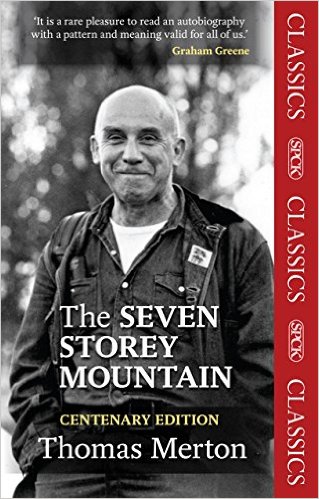
Thomas Merton, The Seven Storey Mountain

Spent yesterday evening reading Thomas Merton‘s autobiography, The Seven Storey Mountain. Still a young man, he has lost his mother and his father to illness. With no fixed home, he moved from his birthplace in France to America, then back to France, then to England, and now to America. His attention to detail is wonderful, whether describing middle-class English life or American cinemagoers enjoying Charlie Chaplin‘s Modern Times. He is becoming increasingly disillusioned with his literary career, and there are early signs that he will consider monastic life. I’m looking forward to returning to the book as soon as I can: rich in everyday details, it’s a remarkable document of early-twentieth-century life.

I am becoming increasingly fascinated with life writing for its potential to blend historical record, philosophical observation, and literary style. I’m thinking here not only of Merton, but figures like St AugustineHenri Amiel, and one of my all-time favourites, Jules Renard. Samuel Beckett‘s poignant and dryly humorous letters have a similar quality.

In a recent interview with Neil Badmington, I was reminded of the profound power and solace that that life writing can provide. Badmington reveals that ‘The Mourning Diary is the posthumous text by Barthes to which I return more than any other. Every time I revisit it, I’m struck by the desperate, impossible tension in its brief sighs of sorrow’.

Joseph Anderton’s compelling new study explores the role of creaturely life in Beckett’s post-war prose and drama

Joseph Anderton, Beckett's Creatures: Art of Failure After the Holocaust (Bloomsbury, 2016)
Joseph Anderton, Beckett’s Creatures: Art of Failure After the Holocaust (Bloomsbury, 2016)
In the immediate aftermath of the Second World War, Samuel Beckett volunteered with the Irish Red Cross on the European continent. With a strong grasp several languages, the writer was assigned the role of driver and translator in the devastated Normandy city of Saint-Lô. During this time, while still stationed in the city, Beckett submitted a record of his experiences to Ireland’s national broadcaster, Radio Telefis Éireann (RTÉ). It was entitled ‘The Capital of the Ruins’. This unaired report on a landscape of wounded civilian casualties and collapsed buildings is the starting point for Joseph Anderton’s compelling new study, Beckett’s Creatures: Art of Failure After the Holocaust. [Read More]

This is an excerpt from a review of Joseph Anderton’s Beckett’s Creatures: Art of Failure After the Holocaust (Bloomsbury, 2016), published in Studies in Theatre and Performance(October, 2016).

A new title refines and condenses more than a decade of Jean-Michel Rabaté’s thinking on Beckett

Jean-Michel Rabaté , Think, Pig! Beckett at the Limit of the Human (Fordham University Press, 2016)
Glancing at the title of Jean-Michel Rabaté’s excellent new book, you might be forgiven for thinking it was some kind of self-help manual from the shelf of tough love. The author clears up any confusion: “This is not a self-help book”, he writes; rather it undermines such projects of affirmation by “questioning the humanism that we take for granted”. Through the motif of the “animal”, Samuel Beckett’s prose and drama re-examines what it means to be human in the aftermath of the Second World War. Think, Pig! (Pozzo’s demoralizing order to Lucky in Waiting for Godot) refines and condenses more than a decade of Rabaté’s thinking on Beckett. The book’s focus is ethical and interrogative, but is peppered with a lively and inventive sense of humour. [Read More]

This extract is from my review of Jean-Michel Rabaté’s Think, Pig! Beckett at the Limit of the Human, published in the Times Literary Supplement, 14 October 2016.

An article for NYC’s Lincoln Center exploring the writer’s presence on social media
samuel-beckett
@SamuelBBeckett: An online resource for quotes, photographs, news, and events

Samuel Beckett is on Twitter, and perhaps we should not be surprised. As a playwright, he was what we would now call an “early adopter” of modern technology. His 1958 play Krapp’s Last Tape made revolutionary use of the reel-to-reel tape recorder the same year RCA manufactured full-size cassettes for home use. His works for radio and television—including All That Fall, which is being presented as part of the 2016 White Light Festival—stretched each medium to their technical limits, producing sights and sounds that had never before been broadcast. And it’s not just his engagement with technology that makes Beckett a natural candidate for Twitter: his compact observations and incisive remarks are perfectly trimmed for our social media age.

Beckett always had a talent for pithy observations about birth, death, and all the pesky stuff that happens in between. In 1984, when The Times (London) asked him about his New Year’s resolutions, he replied: “resolutions colon zero stop period hopes colon zero stop beckett.” His short, sharp telegram cuts to the quick, but also makes us smile at our own obsession with self-improvement. This is the kind of wit and economy that became his signature in plays like Waiting for Godot, Endgame, and Happy Days. (more…)

I talk to Jan Wilm about the Nobel winner. He shares his approach to Coetzee’s writing, and the first two novels that sparked his enthusiasm
J. M. Coetzee
J. M. Coetzee

When did you first encounter the works of J. M. Coetzee?

There seem to me to exist two very common encounters with the literary texts that change one’s life in one’s salad days. Encounter one is raw, perhaps pure, immediate and emotional, when one feels the literary text entering very deeply into what used to be called one’s soul. There, it seizes one, lifts one up and sets one on a course that will retrospectively seem like the right path. Encounter two is marked by bewilderment, lack of understanding, a sense of loss even, being shaken at the feeling that one has failed to taste from the greatness one was sure to find. (more…)

A 2011 review of the luxurious Sylph Edition
Archives: The writer Samuel Beckett in France in April, 1997.
Samuel Beckett

The title of George Craig’s recent book, Writing Beckett’s Letters, is both playful and paradoxical. And it prompts the question: how can Craig claim to be the author of someone else’s correspondence? The answer is both simple and complicated: Craig is a translator. He has spent the last fifteen years as part of a band of scholars, translating literally thousands of letters written by Samuel Beckett from French into English. It is a job that few are cut out for, involving long hours of arduous transcription and the seemingly endless search for that most elusive of things: the right word.

The work forms part of a hugely ambitious project, culminating in a four-volume edition of Samuel Beckett’s Letters. The first part, released in 2009, covered much of Beckett’s early period: intellectual development, his move to Paris, his encounters with James Joyce and the European literary scene. Its publication ushered a new period in the scholarly appreciation of Beckett’s work, whilst offering a rare glimpse into the personal and artistic life of this most private of writers. (more…)