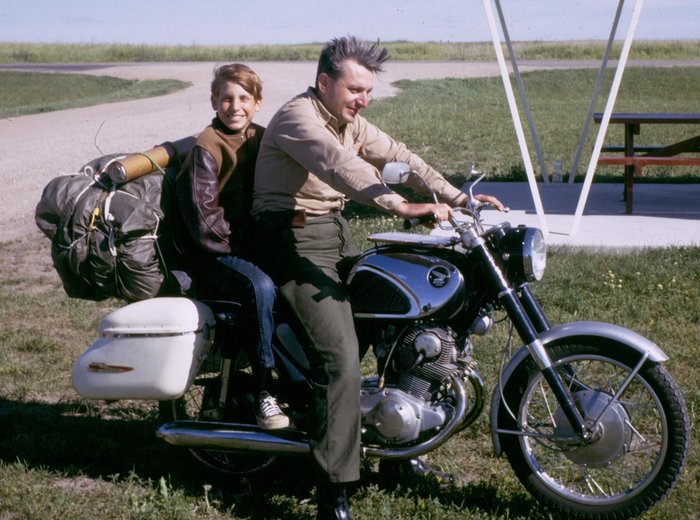
Author Robert Pirsig and his son Chris in 1968

While packing for a trip I pick up an old book I haven’t read for a long time. It’s a 1976 edition of Henri Nouwen’s The Genesee Diary: Report from a Trappist Monastery.

It documents a sabbatical year that the Dutch-born priest and teacher spent at the Cistercian Trappist Abbey of Genesee on New York State, immersing himself in a life of silence, prayer, and manual labour.

The book is enjoyable for its many humorous observations about Nouwen’s daily life, and also for its psychological clarity on the issues he struggles with in this environment.

(more…)

“You are gods, sons of the Most High, all of you; nevertheless, like men you shall die, and fall like any prince” (Ps 82:6-7)

Xavier Beauvois’s 2010 film, Of Gods and Men, begins with this ominous epitaph from the eighty-second psalm. It is to be a portent of the narrative’s themes of death and dignity, explored in conversation with the theological virtues of faith, hope, and love.

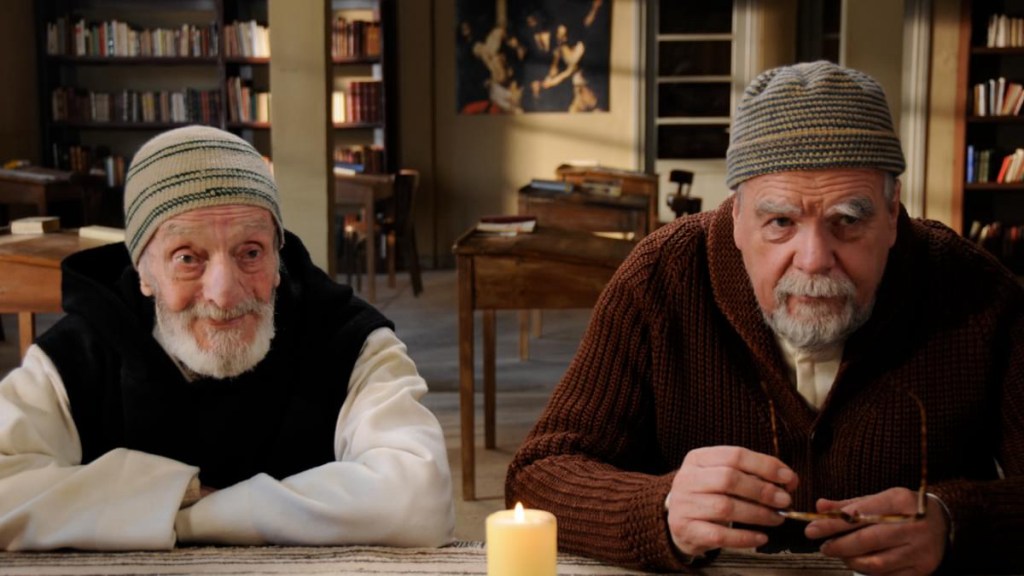
Br Amédée (Jacques Herlin) and Br Luc (Michael Lonsdale)

The film is based on the true story of a community of Cistercian monks at the Monastery Notre-Dame de l’Atlas (Abbey of Our Lady of Atlas) in Tibhirine, Algeria. As you might imagine, my remarks here will reveal key details of the plot and references to the real historical events.

(more…)

Reading Butler’s Lives of the Saints, I come across a passage on St Pambo, an Egyptian monk (c.390) thought to be a disciple of St Antony. I was struck by the following passage:

“His life was typical of the desert monks: hard manual labour, long fasts and physical penance, and sustained periods of prayer. Pambo was especially noted for his silence and a reluctance to speak any more than was necessary, seeing in control of the tongue a basic first step towards a deeper spirituality; he is said to have meditated on this verse from the Psalms for six months: ‘I will watch how I behave, and not let my tongue lead me into sin’ (Ps. 39:1). On the other hand, he had a broader outlook than many of his colleagues in the desert and did not believe their way of life was necessarily the best; he settled an argument between to monks as to which was more perfect, becoming a monk or staying in the world and doing works of mercy, by saying: ‘Before God both are perfect. There are other roads to perfection besides being a monk.'” (18 July, Butler’s Lives of the Saints)

The Decisive Years

From Reiner Stach, Kafka: The Decisive Years (translated by Shelley Frisch):

Asceticism was a magic word for Kafka, an intricate complex of images, cultural paradigms, idiosyncrasies, fears, and psychological techniques that he incorporated into his thought that feelings and gradually made a focal point of his identity. He was entirely justified in asserting that he had ‘a fabulous innate capacity for asceticism’. It is remarkable how tenaciously he clung to the rule of self-abjuration once his period of dawdling came to an end. The way he steadfastly denied himself warmth, meat, drugs, and medicine clearly refutes his alleged weakness of will. He reduced his good intake, toughened his body, and simplified his habits. […]

Asceticism is not austerity for its own sake; it is a process of self-regulation and self-formation based on the utopian notion of attaining complete control over one’s body, self, and life. All Kafka’s interests, habits, and penchants were modified accordingly. A diet of nuts and fruits, a flawless method of chewing, devotion to calisthenics, and long walks. He cultivated and shaped his body. He gained awareness of his body as well. He felt a growing aversion to and even loathing for everything that threatened to undermine his new sense of autonomy, especially doctors who treated his body as though they were plumbers, and medicines that had unanticipated side effects. He contended that it was degrading to battle insomnia with valerian: his insomnia was not caused by a lack of valerian.
(more…)