
As The Story Was Told (1996), a two-part documentary featuring interviews with authorised biographer James Knowlson, publishers John Calder and Barney Rosset, actress Billie Whitelaw, nephew Edward Beckett, and others. The documentary is notable, in part, for its glimpses of Beckett’s home in Paris and his country retreat in Ussy-sur-Marne.
Tag: Modernism
Modernist Women’s Literature and Photography
Lorraine Sim discusses how the women of modernism allow us to reimagine the ordinary and the everyday

What inspired you to write Ordinary Matters?
The idea developed from my first book, Virginia Woolf: the Patterns of Ordinary Experience. Towards the end of that project I realised there was much more that I wanted to explore, both in terms of the concept of the everyday and its applications to modernism and cultural histories of early twentieth-century modernity. I remember reading H.D.’s fascinating wartime memoir, The Gift, while I was working on my book on Woolf, and seeing some of Lee Miller’s photographs of London during the Blitz around the same time, and I felt I needed to extend my exploration of the ordinary to a broader range of women writers, artists and contexts. The final chapter of Virginia Woolf looked at what I termed the ‘ethics of the ordinary’ in her oeuvre. This idea, of the ways in which the ordinary functions as a site of value (be it personal, social, moral or political), really fascinated me, and I wanted to explore it in a more comprehensive way. Also, many canonical and contemporary theories on the topic view the everyday negatively, or as requiring radical transformation, and I felt that this was a critical habit or commonplace that itself required interrogation. (more…)
Virginia Woolf: A Guide for the Perplexed
Kathryn Simpson discusses the life and work of one of literary modernism’s most distinguished innovators
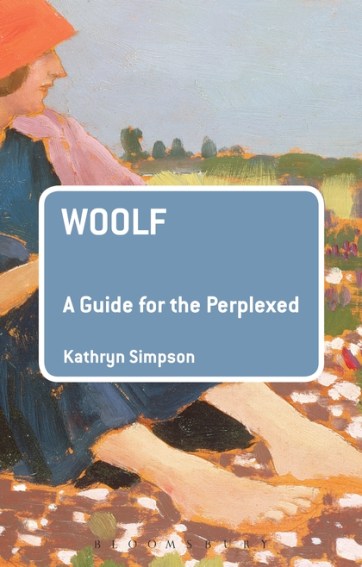
What motivated you to write Woolf: A Guide for the Perplexed?
I feel very passionate about the work of Virginia Woolf because of the ways it engages with some of the ‘big’ questions about self and identity, experience and relationships, politics, cultural pressures and the impact of a changing world. She, like other modernist writers and artists, attempted to convey what it meant and felt like to live through a period of dramatic change (politically, socially, economically and in terms of technological developments) and to find new forms and techniques to represent a new sense of modernity.
How did you discover Virginia Woolf’s writing?
I discovered her writing as part of my undergraduate degree at the University of Birmingham and then chose to write on her work for my PhD alongside other early twentieth-century women writers (Gertrude Stein, H.D, Radclyffe Hall and Djuna Barnes). (more…)
Walking, Thinking, and Improvisation
 “As a literary structure, the recounted walk encourages digression and association, in contrast to the stricter form of a discourse or the chronological progression of a biographical or historical narrative. A century and a half later, James Joyce and Virginia Woolf would, in trying to descrive the workings of the mind, develop the style called stream of consciousness. In their novels Ulysses and Mrs. Dalloway, the jumble of thoughts and recollections of their protagonists unfolds best during walks. This kind of unstructured, associative thinking is the kind most often connected to walking, and it suggests walking as not an analytical but an improvisational act. Rousseau’s Reveries [of the Solitary Walker] are one of the first portraits of this relationship between thinking and walking.”
— From Rebecca Solnit, Wanderlust: A History of Walking
Is Modernism Boring?
Should we bother with modernism? Is it suited to our bedside table, or should it be exiled to obscurity on some distant library shelf?
While looking for something interesting to read online recently I stumbled across something boring. Namely, Robert McCrum’s Guardian piece on ‘The best boring books’: it listed big, grey bricks of supposedly anaesthetic prose. McCrum selected novels based on their ability to relieve anxiety and dull the senses, singling out two modernist novels among his favourites: James Joyce’s notorious Finnegans Wake and Virginia Woolf’s The Waves. I looked again. Is there something intrinsic to modernism that lends itself to these kinds of associations? Of dullness and tedium in the mind’s eye of the public?
Gabriel Josipovici asked What Ever Happened to Modernism? As part of an in-depth literary study, he charted the recent decline of modernist literature in opposition to other, more traditional forms of storytelling. But what is it about Modernism that turns so many readers away? Why are Joyce, Eliot and Kafka missing from our holiday reading lists? And if by some miracle they are on our bookshelves, why do we never pick them up? (more…)
Samuel Beckett and Barbara Bray: A New Documentary
Through exclusive interviews and previously unseen photographs, a new documentary offers an intimate portrait of the relationship between translator Barbara Bray and Nobel Prize winner Samuel Beckett
The Prose of Thomas Bernhard: A Graphic Essay
Espen Terjesen’s beautifully drawn essay on Bernhard’s writing

I’m very excited to share a beautiful and concise ‘graphic essay’ on the work of Austrian writer Thomas Bernhard. The essay was written, drawn, and designed by Espen Terjesen, an illustrator, cartoonist, pixel artist, teacher/lecturer, and writer working in Bergen, Norway. In addition to the original essay, Terjesen has also been kind enough to provide me with an English translation.
Terjesen’s work not only presents themes from Bernhard’s writing with striking, icy accompaniments, but offers a playful approach to the traditional academic essay. By combining elements of literary criticism with the graphic novel, Terjesen’s reading of Bernhard becomes, in itself, a creative act. What we are left with is something both thought-provoking and accessible.
To see the strip in its original format, please find links to Terjesen’s essay at the bottom of this post. In its complete form, the essay includes a number of footnotes and recommended reading. You can click any of the images to enlarge them. Enjoy! (more…)
 RhysTranter.com