“Most of my early music was non-vocal. In fact, I only started writing intensively for choirs after I met the Hilliards. Hearing them for the first time changed my life totally. The tears fell over my face and I was not able to say where I was – in heaven or here on Earth. It was a shock.”
On pursuing a vocation in art, writing, and simple living
The reasons for my decision
Back in June, I attended a cardiology appointment that had a profound impact on me. My meeting with the cardiologist was routine and I did not receive any alarming news, but I became aware of the fragility of my own body in a new way. As an infant I was diagnosed with a congenital heart condition, and my life had been saved by the UK’s National Health Service and the surgeons at Great Ormond Street Hospital in London. I have always felt grateful for the life-saving help that I received, and could talk superficially about my condition with friends and loved ones, but now I see that I was also prone to a form of denial. Throughout my adolescence and early adulthood I placed my heart condition to one side as I tried to establish an identity for myself. My routine appointments continued from year to year, but in my conscious mind and my behaviour I aimed to suppress what they represented with denial and distraction. This year marks the first time that I am fully and consciously aware that I have a congenital heart condition. And while there is no reason why I cannot live a full and happy life, I am now awake to the fact that I nearly didn’t survive infancy.
John Corbett on a new pocket-sized field guide to free and spontaneous music
What led you to write A Listener’s Guide to Free Improvisation?
I’ve been involved with improvised music from several different standpoints over the last 35 years, as a listener, as a critic, as a teacher, as a presenter, and as a producer. In the process of moving around in the music’s netherworlds, I noticed that many potential listeners were curious about it but just had no way to enter, no accessible points of reference. It’s sometimes seen as “difficult” or “complex,” and it can be both, but approaching free music is very different from listening to music composed using mathematical algorithms or with elaborate preconceived harmonic inventions. To listen to it you basically need to be attentive. That’s it. But that’s also not easy. Having some historical framework can help, and the more experience you have as a listener the better. But it’s really open to new listeners, and I wanted to find a way, in as down to earth a way as possible, to suggest that openness. To invite new listeners from other walks of music and to give a few tips on listening, things that might help get over the initial hump. (more…)
I have been revisiting the music of Estonian composer Arvo Pärt recently, which I find very consoling. Back in 2014, Tom Huizenga (NPR) managed to secure an interview with Pärt, where he reflected on the use of space and silence in his work:
“[W]hen we speak about silence, we must keep in mind that it has two different wings, so to speak. Silence can be both that which is outside of us and that which is inside a person. The silence of our soul, which isn’t even affected by external distractions, is actually more crucial but more difficult to achieve.”
Grachan Moncur III recorded Some Other Stuff for Blue Note Records on 6 July 1964. When he entered Rudy Van Gelder‘s studio in Englewood Cliffs, he was already an experienced leader and an established trombonist on the avant-garde jazz scene. Before his debut album, Evolution (Blue Note, 1963), which was recorded the day before President John F. Kennedy was shot, he was an established sideman on records by Art Blakey, Herbie Hancock and Jackie McLean.
Moncur is known for a “clear-cut style of playing” (Richard Cook) that blends the hard bop of the late 1950s and early 1960s with the emerging free jazz movement. While the standout virtuosity of Evolution has led to a general critical reflect of Some Other Stuff, do not be fooled by the latter’s dismissive title. Moncur assembles a strong lineup that includes saxophonist WayneShorter, pianist Herbie Hancock (between the recording of Empyrean Isles and Maiden Voyage), and drummer Anthony Williams.Among the highlights: ‘Gnostic’ is ominous and meditative in a way that recalls the high points of Evolution; ‘Thandiwa’ is an upbeat piece written and performed in a hardbop style; and ‘The Twins’ steals the show with sustained performances from Moncur, Hancock, and Shorter.
The avant-garde reedist’s iconic outing for Blue Note Records was recorded on this day in 1964
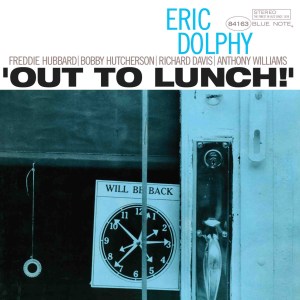
Eric Dolphy, Out to Lunch! (Blue Note, 1964)
On this day in 1964, Eric Dolphy entered Rudy Van Gelder’s studio in Englewood Cliffs, New Jersey, to record one of Blue Note Records’ most distinctive and iconic records. Joined by Freddie Hubbard (trumpet), Bobby Hutchinson (vibraphone), Richard Davis (bass) and an eighteen-year-old Anthony Williams (drums), Dolphy brought along his alto saxophone, bass clarinet, and flute for the date.
Out to Lunch! is the culmination of asequence of recordings that explored the possibilities of avant-garde jazz in the early 1960s, from Dolphy’s first album as leader, Outward Bound (New Jazz, 1960), to Out There (New Jazz, 1960), to his 1961 recordings at the Five Spot and 1962’s Far Cry (New Jazz). Across these works we can hear the artistic development of Dolphy as a restless and inventive talent. Out to Lunch! nods a debt to bebop in its tribute to pianist Thelonious Monk (‘Hat and Beard’), and acknowledges the classical flautist Severino Gazzelloni (‘Gazzelloni’), but while the album negotiates the legacy of bebop and post-bop music it simultaneously reaches towards freer musical forms. (more…)
Why critics of the Nobel Committee’s nomination are missing the point
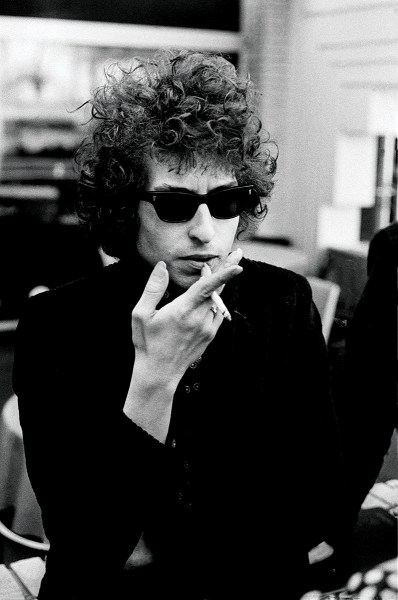
Bob Dylan in the 1960s.
On 13 October, I was surprised and delighted to hear that Bob Dylan was awarded the Nobel Prize for Literature. The Nobel Committee selected Dylan ‘for having created new poetic expressions within the great American song tradition’. Few would question the songwriter’s contribution to the cultural landscape of the twentieth-century. His albums for Columbia Records in the 1960s document a deep knowledge and respect for American folk music, blues music, and poetry; Dylan adapted and reworked these forms to forge a compelling picaresque of the post-war American landscape.
“[…] literature, when traced back to its earliest forms, began as a poetic oral tradition frequently linked to rhythm, music, and song.”
There have been some who have responded to Dylan’s Nobel nomination with dismay, even anger. Some cite that his status as a songwriter might justify a place in the Rock and Roll Hall of Fame, but is not a ticket into the literary canon. Such detractors often fail to acknowledge that in addition to his music, Bob Dylan has also published poetry, experimental prose, and even a memoir. That’s to say nothing of his influence on countless more traditional literary figures. But this kind of categorization seems to miss the point. Those who reject Dylan’s candidacy for the Nobel forget that literature, when traced back to its earliest forms, began as a poetic oral tradition frequently linked to rhythm, music, and song. (more…)

 RhysTranter.com