
How the practice of criticism can offer a way to rethink our assumptions about truth, history, and human nature

What exactly do we mean by the term ‘criticism’?
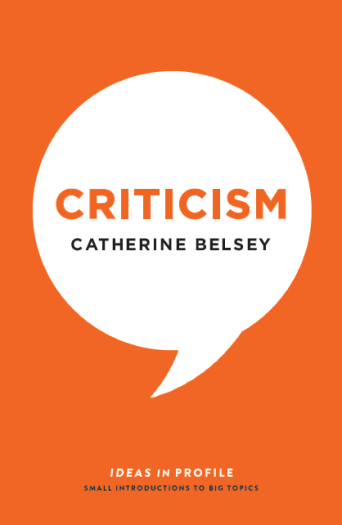
Catherine Belsey, Criticism (Profile Books, 2016)

The publishers asked me that and I didn’t give them an answer! It’s a fair question but I’m uneasy about definitions. They’re a bit like written constitutions: they tie you down and exclude new possibilities. Definitions demarcate a legitimate area of activity – and close off other options.

In a general way, criticism is reflection on the stories, plays and poems we read (or see, or listen to). But in detail, it varies. For some people, it’s effectively a source of consumer advice: this film is worth going to; that novel is worth buying. Others might prefer to think about what differentiates genres, or the effects of different media. Does a play tell a story in the same way as a novel? Do novels tend to works as films, say?

Then there’s fiction as a record of the way we think about the world, or our ancestors once thought about it. Criticism offers access to cultural analysis and cultural history.

My own current preoccupation is pleasure. Why is fiction so enjoyable, even when the stories it tells are unhappy ones? Why does tragedy attract audiences? Other people have other concerns: it can all be criticism. (more…)

Francis O’Gorman describes how his tendency to worry led him to investigate its cultural and literary origins. We talk about Shakespeare, Sherlock Holmes stories, and the prominence of ‘worry’ in everyday life
Francis O'Gorman, Worrying: A Literary and Cultural History
Francis O’Gorman, Worrying: A Literary and Cultural History

What motivated you to write the book?

There’s a very short answer to that: I’m a worrier and I wanted to think about what that meant. Several people have asked me why a literary critic would write such a book, and whether I am merely using literature as a kind of case study, as representation. But for me being a literary critic means reading as intently and alertly as possible. And that includes, where necessary, reading the patterns of one’s own mind.

What exactly is ‘worry’, and why is it so difficult to pin down?

I don’t think that there is an ‘exactly’ in relation to worry. In the book, my topic is being fearful about the turn of ordinary things. Worry—those questions in the mind that mostly start with ‘what if …’—is a way of trying to take some control over a future that we don’t know but would like to. Worrying isn’t a ‘mental health’ book in that it doesn’t concern conditions of mind that would even vaguely interest a clinician. And I don’t write about grave worries—including worries about the grave. I’m interested, rather, in the mundane, in the meaning of low level bothers about what might happen next. (more…)

Why critics of the Nobel Committee’s nomination are missing the point
Bob Dylan in the 1960s.

On 13 October, I was surprised and delighted to hear that Bob Dylan was awarded the Nobel Prize for Literature. The Nobel Committee selected Dylan ‘for having created new poetic expressions within the great American song tradition’. Few would question the songwriter’s contribution to the cultural landscape of the twentieth-century. His albums for Columbia Records in the 1960s document a deep knowledge and respect for American folk music, blues music, and poetry; Dylan adapted and reworked these forms to forge a compelling picaresque of the post-war American landscape.

“[…] literature, when traced back to its earliest forms, began as a poetic oral tradition frequently linked to rhythm, music, and song.”

There have been some who have responded to Dylan’s Nobel nomination with dismay, even anger. Some cite that his status as a songwriter might justify a place in the Rock and Roll Hall of Fame, but is not a ticket into the literary canon. Such detractors often fail to acknowledge that in addition to his music, Bob Dylan has also published poetry, experimental prose, and even a memoir. That’s to say nothing of his influence on countless more traditional literary figures. But this kind of categorization seems to miss the point. Those who reject Dylan’s candidacy for the Nobel forget that literature, when traced back to its earliest forms, began as a poetic oral tradition frequently linked to rhythm, music, and song. (more…)

A new title refines and condenses more than a decade of Jean-Michel Rabaté’s thinking on Beckett

Jean-Michel Rabaté , Think, Pig! Beckett at the Limit of the Human (Fordham University Press, 2016)
Glancing at the title of Jean-Michel Rabaté’s excellent new book, you might be forgiven for thinking it was some kind of self-help manual from the shelf of tough love. The author clears up any confusion: “This is not a self-help book”, he writes; rather it undermines such projects of affirmation by “questioning the humanism that we take for granted”. Through the motif of the “animal”, Samuel Beckett’s prose and drama re-examines what it means to be human in the aftermath of the Second World War. Think, Pig! (Pozzo’s demoralizing order to Lucky in Waiting for Godot) refines and condenses more than a decade of Rabaté’s thinking on Beckett. The book’s focus is ethical and interrogative, but is peppered with a lively and inventive sense of humour. [Read More]

This extract is from my review of Jean-Michel Rabaté’s Think, Pig! Beckett at the Limit of the Human, published in the Times Literary Supplement, 14 October 2016.

An article for NYC’s Lincoln Center exploring the writer’s presence on social media
samuel-beckett
@SamuelBBeckett: An online resource for quotes, photographs, news, and events

Samuel Beckett is on Twitter, and perhaps we should not be surprised. As a playwright, he was what we would now call an “early adopter” of modern technology. His 1958 play Krapp’s Last Tape made revolutionary use of the reel-to-reel tape recorder the same year RCA manufactured full-size cassettes for home use. His works for radio and television—including All That Fall, which is being presented as part of the 2016 White Light Festival—stretched each medium to their technical limits, producing sights and sounds that had never before been broadcast. And it’s not just his engagement with technology that makes Beckett a natural candidate for Twitter: his compact observations and incisive remarks are perfectly trimmed for our social media age.

Beckett always had a talent for pithy observations about birth, death, and all the pesky stuff that happens in between. In 1984, when The Times (London) asked him about his New Year’s resolutions, he replied: “resolutions colon zero stop period hopes colon zero stop beckett.” His short, sharp telegram cuts to the quick, but also makes us smile at our own obsession with self-improvement. This is the kind of wit and economy that became his signature in plays like Waiting for Godot, Endgame, and Happy Days. (more…)

I caught up with Katie Gramich to talk about a conference she is co-organizing to celebrate the life and work of poet Edward Thomas

In April 2017, Cardiff University will be hosting a conference to celebrate the Welsh writer Edward Thomas. Can you say a little bit about the timing of the conference? Do you think it’s time for a revaluation of Thomas’ life and work?

Edward Thomas died in the Battle of Arras at Easter 1917, so the conference at Cardiff University in April 2017 is a centenary conference to commemorate a distinctive and unusual writer whose life was cut short in the First World War. Thomas wrote all of his poetry in the last two years of his life – between December 1914 and December 1916 – prompted to do so partly by his friendship with the American poet, Robert Frost, whom he met in the summer of 1913,  and partly by the new and pressing circumstances of the war. It is so sad to think that only six of his poems were published in his lifetime – a small pamphlet under the pseudonym ‘Edward Eastaway’ in 1916. (more…)

Lisa Stead discusses the influence of cinema on a generation of interwar women writers
Lisa Stead, Off to the Pictures: Cinema-going, Women's Writing and Movie Culture in Interwar Britain (EUP, 2016)
Lisa Stead, Off to the Pictures: Cinema-going, Women’s Writing and Movie Culture in Interwar Britain (EUP, 2016)

A new book by Lisa Stead uncovers the vital role cinema played in the work of interwar women writers. Entitled Off to the Pictures: Cinemagoing, Women’s Writing and Movie Culture in Interwar Britain, the study explores a range of important but often overlooked figures, from Jean Rhys to Elinor Glyn and C. A. Lejeune. Stead delves into archives and unearths hidden treasures from newspapers and magazines of the time, not to mention a range of literary texts from popular middlebrow fiction to experimental modernism. I caught up with Lisa Stead to discuss her interest in this crucial period for women’s writing, and to ask how cinemagoing still influences the way women construct their own identities.

What led you to write Off to the Pictures?

It all started with magazines. As a postgrad, I got to be fascinated with early film magazines and their address to women. I started looking through hundreds of old issues of 1910s and 1920s fan papers – designed to promote stars and review the latest films and generally keep the cinema alive for their readership by offering gossip and glamour beyond the auditorium. Whilst these papers are crammed full of fascinating period details – fashion tips, advertising etc.— it was the ‘unofficial’ writing inside that hooked me. Fan magazines at this time published letters and poetry from self-professed ‘ordinary’ women, who talk not just about their love for screen stars, but also offer their critical commentary on the cinema, considering its relation to their everyday lives and the distinctly British experience of cinemagoing. (more…)