
Lisa Stead discusses the influence of cinema on a generation of interwar women writers
Lisa Stead, Off to the Pictures: Cinema-going, Women's Writing and Movie Culture in Interwar Britain (EUP, 2016)
Lisa Stead, Off to the Pictures: Cinema-going, Women’s Writing and Movie Culture in Interwar Britain (EUP, 2016)

A new book by Lisa Stead uncovers the vital role cinema played in the work of interwar women writers. Entitled Off to the Pictures: Cinemagoing, Women’s Writing and Movie Culture in Interwar Britain, the study explores a range of important but often overlooked figures, from Jean Rhys to Elinor Glyn and C. A. Lejeune. Stead delves into archives and unearths hidden treasures from newspapers and magazines of the time, not to mention a range of literary texts from popular middlebrow fiction to experimental modernism. I caught up with Lisa Stead to discuss her interest in this crucial period for women’s writing, and to ask how cinemagoing still influences the way women construct their own identities.

What led you to write Off to the Pictures?

It all started with magazines. As a postgrad, I got to be fascinated with early film magazines and their address to women. I started looking through hundreds of old issues of 1910s and 1920s fan papers – designed to promote stars and review the latest films and generally keep the cinema alive for their readership by offering gossip and glamour beyond the auditorium. Whilst these papers are crammed full of fascinating period details – fashion tips, advertising etc.— it was the ‘unofficial’ writing inside that hooked me. Fan magazines at this time published letters and poetry from self-professed ‘ordinary’ women, who talk not just about their love for screen stars, but also offer their critical commentary on the cinema, considering its relation to their everyday lives and the distinctly British experience of cinemagoing. (more…)

Innovative arts journal promotes the work of Welsh-born writer, critic, and librettist
music-and-literature-paul-griffiths
Music & Literature (No.7): Paul Griffiths, Ann Quin, Lera Auerbach

Today’s artistic landscape can often feel like a busy marketplace, where voices compete for attention and creative validation. And, as a result, some voices do not get heard. Since its launch in 2012, Music & Literature has been a torchbearer for writers and artists that are often neglected by the mainstream: its first issue was notable for its discussion of avant-garde composer Arvo Pärt, offering an unprecedented glimpse into his life, work, and motivations. Scott Esposito points out that the journal offers ‘the kind of thing that’s unavailable anywhere else’, and he’s right. Music & Literature is a fascinating read for enthusiasts, and a valuable cultural resource for scholars.

Now publishing its seventh volume, Music & Literature is celebrating the work of Welsh-born writer, critic, and accomplished librettist Paul Griffiths. His first novel, Myself and Marco Polo: A Novel of Changes (1989), is a work of speculative fiction that reimagines the life of the world traveller through his memoirs. More recently, Griffiths translated eleven Japanese noh plays, published as The Tilted Cup: Noh Stories (2014) in a beautifully illustrated volume. Paul Griffiths has written five librettos, and is an insightful commentator on modern classic music; he is the author of a number of critical works on topics ranging from electronic music to the history of the string quartet, and was a music critic for both The New Yorker (1992-96) and The New York Times (1997-2005). As if that wasn’t enough, Griffiths is also the biographer of a number of modern composers, from György Ligeti and Bela Bartók to John Cage and Igor Stravinsky. (more…)

The writer and journalist talks about This Is the Place to Be, and the influences that motivate her
This month brings the release of Lara Pawson’s new memoir, This Is the Place to Be, published by CB editions. Written in a fragmentary form, the book deals with Pawson’s experiences as a witness of war in Angola and Ivory Coast. The writer Joanna Walsh praises it for the way it ‘unpicks the spirals of memory, politics, violence, to trace the boundaries and crossing points of gender and race identity.’ I caught up with Pawson to ask her about This Is the Place to Be, and to find out more about her motivations and influences.

(more…)

samuelbeckett-walking“As a literary structure, the recounted walk encourages digression and association, in contrast to the stricter form of a discourse or the chronological progression of a biographical or historical narrative. A century and a half later, James Joyce and Virginia Woolf would, in trying to descrive the workings of the mind, develop the style called stream of consciousness. In their novels Ulysses and Mrs. Dalloway, the jumble of thoughts and recollections of their protagonists unfolds best during walks. This kind of unstructured, associative thinking is the kind most often connected to walking, and it suggests walking as not an analytical but an improvisational act. Rousseau’s Reveries [of the Solitary Walker] are one of the first portraits of this relationship between thinking and walking.”
— From Rebecca Solnit, Wanderlust: A History of Walking

Simon Critchley’s philosophical antidote to the self-help manual

Since when did happiness, wisdom and contentment become the cornerstones of a fulfilling life? Whatever happened to doubt? Instability? Melancholia? In 2010, Polity Press published How to Stop Living and Start Worrying, a collection of interviews with Simon Critchley which playfully parodies the conventional self-help manual. Through a series of conversations with Carl Cedeström, Critchley sketches an alternative view of the role philosophy plays in our lives today, covering an ambitious range of topics: from science and religion, to poetry and politics, love and humour, life and death.

Critchley, a philosophy professor who teaches in New York, takes us step-by-step through the major themes of his work in an entertaining and accessible way. Each interview takes the form of an informal, improvised chat on a theoretical topic, elucidating terms and concepts with helpful metaphors and memorable anecdotes. Jokes also play a key role in the overall tone of the book, illuminating central ideas with a lightness of touch. (more…)

Should we bother with modernism? Is it suited to our bedside table, or should it be exiled to obscurity on some distant library shelf?

While looking for something interesting to read online recently I stumbled across something boring. Namely, Robert McCrum’s Guardian piece on ‘The best boring books’: it listed big, grey bricks of supposedly anaesthetic prose. McCrum selected novels based on their ability to relieve anxiety and dull the senses, singling out two modernist novels among his favourites: James Joyce’s notorious Finnegans Wake and Virginia Woolf’s The Waves. I looked again. Is there something intrinsic to modernism that lends itself to these kinds of associations? Of dullness and tedium in the mind’s eye of the public?

Gabriel Josipovici asked What Ever Happened to Modernism? As part of an in-depth literary study, he charted the recent decline of modernist literature in opposition to other, more traditional forms of storytelling. But what is it about Modernism that turns so many readers away? Why are Joyce, Eliot and Kafka missing from our holiday reading lists? And if by some miracle they are on our bookshelves, why do we never pick them up? (more…)

A 2011 review of the luxurious Sylph Edition
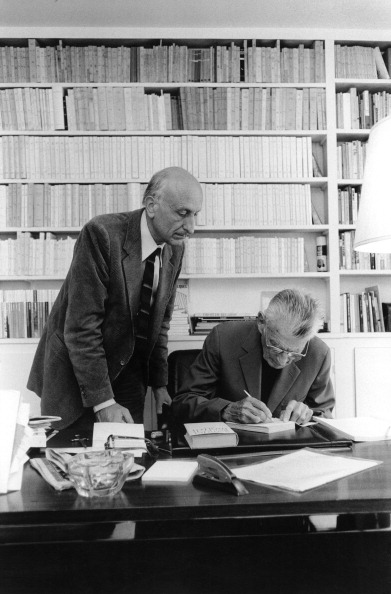
Archives: The writer Samuel Beckett in France in April, 1997.
Samuel Beckett

The title of George Craig’s recent book, Writing Beckett’s Letters, is both playful and paradoxical. And it prompts the question: how can Craig claim to be the author of someone else’s correspondence? The answer is both simple and complicated: Craig is a translator. He has spent the last fifteen years as part of a band of scholars, translating literally thousands of letters written by Samuel Beckett from French into English. It is a job that few are cut out for, involving long hours of arduous transcription and the seemingly endless search for that most elusive of things: the right word.

The work forms part of a hugely ambitious project, culminating in a four-volume edition of Samuel Beckett’s Letters. The first part, released in 2009, covered much of Beckett’s early period: intellectual development, his move to Paris, his encounters with James Joyce and the European literary scene. Its publication ushered a new period in the scholarly appreciation of Beckett’s work, whilst offering a rare glimpse into the personal and artistic life of this most private of writers. (more…)