Stacey Abbott discusses the role that vampires and zombies play in 21st century culture
stacey-abbott-undead-apocalypse-vampires-zombies-21st-century
Stacey Abbott, Undead Apocalypse: Vampires and Zombies in the 21st century (EUP, 2016)

Recent decades have brought an increasing preoccupation with the gothic figure of the vampire and the apocalyptic zombie. Rather than reading them in opposition to each other, Stacey Abbott traces the similar places they hold our collective imagination. Through a series of engaging and incisive readings encompassing film, television, literature, and pop culture of the 20th and early 21st century, Abbott examines our fascination with these monstrous creatures and the cultural anxieties that they reveal. Undead Apocalypse delineates a contemporary canon of vampire and zombie texts to shed new light on our present historical moment, and the ‘culture of apocalypse’ that surrounds us.

I caught up with Stacey Abbott to discuss her book, published by Edinburgh University Press in September 2016. She shares her personal interest in vampire and zombie texts; what she considers the classics of the genre; and her thoughts on the proliferation of apocalyptic narratives across graphic novels, video games, and cosplay. With critical precision and a fan’s enthusiasm for the subject, Abbott offers a guide to navigating the impending undead apocalypse. (more…)

I talk to Jan Wilm about the Nobel winner. He shares his approach to Coetzee’s writing, and the first two novels that sparked his enthusiasm
J. M. Coetzee
J. M. Coetzee

When did you first encounter the works of J. M. Coetzee?

There seem to me to exist two very common encounters with the literary texts that change one’s life in one’s salad days. Encounter one is raw, perhaps pure, immediate and emotional, when one feels the literary text entering very deeply into what used to be called one’s soul. There, it seizes one, lifts one up and sets one on a course that will retrospectively seem like the right path. Encounter two is marked by bewilderment, lack of understanding, a sense of loss even, being shaken at the feeling that one has failed to taste from the greatness one was sure to find. (more…)

I speak to author and academic Lauren Elkin about women walking in the city, and the pioneering writers who influenced her
Lauren Elkin, Flâneuse (Penguin Books, 2016)

I wonder if you could say a little bit about your title. What exactly is a “Flâneuse”? And what motivated you to write the book?

A flâneuse is quite basically the female conjugation of a “flâneur,” or a kind of idly curious stroller in the city, a man-about-town. As Baudelaire wrote: “The crowd is his domain, just as the air is the bird’s, and water that of the fish. His passion and his profession is to merge with the crowd.”

The flâneur is this really resonant archetype in our culture; you come across it really frequently when magazines or other brands (most recently Hermès) want to lend a kind of worldly, nonchalant, urban intellectualism to their enterprise, or to whatever it is they’re selling. However – and this is going to answer your second question as well – this figure is usually male, or male-identified; only men have historically (and this is arguably still true today) had that kind of access to the city, where they could walk around observing and “merge with the crowd”; women have been, or are, generally too conspicuous in the city, we’re viewed either as a threat or as someone who needs protection; we’re told to smile, our appearances are commented on. Or, for women who don’t conform to some idea of youth or beauty, made to feel functionally invisible. In neither case do we have the kind of neutrality the flâneur needs to have. So the “flâneuse” is a figure who’s kind of impossible to conjugate. (more…)

I caught up with Katie Gramich to talk about a conference she is co-organizing to celebrate the life and work of poet Edward Thomas

In April 2017, Cardiff University will be hosting a conference to celebrate the Welsh writer Edward Thomas. Can you say a little bit about the timing of the conference? Do you think it’s time for a revaluation of Thomas’ life and work?

Edward Thomas died in the Battle of Arras at Easter 1917, so the conference at Cardiff University in April 2017 is a centenary conference to commemorate a distinctive and unusual writer whose life was cut short in the First World War. Thomas wrote all of his poetry in the last two years of his life – between December 1914 and December 1916 – prompted to do so partly by his friendship with the American poet, Robert Frost, whom he met in the summer of 1913,  and partly by the new and pressing circumstances of the war. It is so sad to think that only six of his poems were published in his lifetime – a small pamphlet under the pseudonym ‘Edward Eastaway’ in 1916. (more…)

Lisa Stead discusses the influence of cinema on a generation of interwar women writers
Lisa Stead, Off to the Pictures: Cinema-going, Women's Writing and Movie Culture in Interwar Britain (EUP, 2016)
Lisa Stead, Off to the Pictures: Cinema-going, Women’s Writing and Movie Culture in Interwar Britain (EUP, 2016)

A new book by Lisa Stead uncovers the vital role cinema played in the work of interwar women writers. Entitled Off to the Pictures: Cinemagoing, Women’s Writing and Movie Culture in Interwar Britain, the study explores a range of important but often overlooked figures, from Jean Rhys to Elinor Glyn and C. A. Lejeune. Stead delves into archives and unearths hidden treasures from newspapers and magazines of the time, not to mention a range of literary texts from popular middlebrow fiction to experimental modernism. I caught up with Lisa Stead to discuss her interest in this crucial period for women’s writing, and to ask how cinemagoing still influences the way women construct their own identities.

What led you to write Off to the Pictures?

It all started with magazines. As a postgrad, I got to be fascinated with early film magazines and their address to women. I started looking through hundreds of old issues of 1910s and 1920s fan papers – designed to promote stars and review the latest films and generally keep the cinema alive for their readership by offering gossip and glamour beyond the auditorium. Whilst these papers are crammed full of fascinating period details – fashion tips, advertising etc.— it was the ‘unofficial’ writing inside that hooked me. Fan magazines at this time published letters and poetry from self-professed ‘ordinary’ women, who talk not just about their love for screen stars, but also offer their critical commentary on the cinema, considering its relation to their everyday lives and the distinctly British experience of cinemagoing. (more…)

The writer and journalist talks about This Is the Place to Be, and the influences that motivate her
This month brings the release of Lara Pawson’s new memoir, This Is the Place to Be, published by CB editions. Written in a fragmentary form, the book deals with Pawson’s experiences as a witness of war in Angola and Ivory Coast. The writer Joanna Walsh praises it for the way it ‘unpicks the spirals of memory, politics, violence, to trace the boundaries and crossing points of gender and race identity.’ I caught up with Pawson to ask her about This Is the Place to Be, and to find out more about her motivations and influences.

(more…)

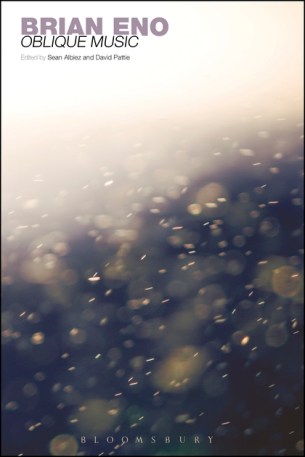
To mark the release of Brian Eno: Oblique Music, a new collection of essays celebrating the musician’s life and work, I talk to the editors about their shared obsession

You previously collaborated on a book of essays about the German electronic group Kraftwerk. What made you decide to put together a book about Eno?

brian-eno-oblique-music-sean-albiez-david-pattie
Brian Eno: Oblique Music, eds. Sean Albiez & David Pattie (Bloomsbury, 2016)

Sean Albiez: In the final stages of the editing and writing process of Kraftwerk: Music Non Stop we started to discuss further book projects as, though we had never met before starting the book, we found that we enjoyed our collaborative process and had many similar musical interests. It think it was David who initially suggested looking at Brian Eno. Eno has been a major figure in music since the 1970s and yet little academic attention had been paid to his work. Any attention that had been given seemed to repeat and replay the same ideas and stories. So we felt that undertaking detailed research on Eno’s diverse activities over several decades from a range of academic perspectives would produce new ways of thinking about his work.

“As Eno says, he’s very interested in the idea of music as landscape; and it’s a landscape that I’m quite happy to inhabit.”

David: As Sean said, we’d enjoyed working together on the Kraftwerk book; and when we were discussing other projects Eno seemed to be the obvious next option. He’s amassed quite a reputation as popular music’s resident intellectual, but, aside from one book in the 1990s, his work hadn’t been given the kind of in-depth analysis it deserves. On a more personal level, I’ve been listening to Eno’s solo work for over three decades, and I find it endlessly fascinating. As Eno says, he’s very interested in the idea of music as landscape; and it’s a landscape that I’m quite happy to inhabit.  (more…)