David Lloyd talks about Beckett’s friendships with twentieth-century painters and his enduring interest in the visual arts
David Lloyd, Beckett's Thing: Painting and Theatre (Edinburgh University Press, 2016)
David Lloyd, Beckett’s Thing: Painting and Theatre (Edinburgh University Press, 2016)

What draws you to the work of Samuel Beckett?

I’ve been reading Beckett’s work since I was a teenager and writing on him since my undergraduate days at Cambridge in the 70s. I dare say part of my initial attraction to Beckett lay in the kinds of philosophical conundra his work posed, in its hilarious comedy and in its ascetic reductionism. In a letter to Georges Duthuit, in which he comments on his desire for “a theatre reduced to its own means”, he goes on: “That is Protestantism if you like, we are what we are.” It may be that there was also something about the South Dublin Protestant background that I shared with Beckett that felt like grounds for affinity: certainly there was something familiar as much in the ethos as in the local landscapes secreted in the works. But above all, it was the uncompromising aesthetic ethic, the commitment to a work determined to “reduce itself to its own means”, that corresponded to the refusal of extraneous resources like the resonances of identity or signifiers of cultural belonging. That offered a quite different set of possibilities, intellectually and aesthetically, than Irish culture at the time generally made available. (more…)

Rachele Dini discusses how the work of J.G. Ballard, Don DeLillo, and Samuel Beckett engages with one of the most pressing environmental issues of our time
Rachele Dini, Consumerism, Waste, and Re-Use in Twentieth-Century Fiction (Palgrave, 2016)

What motivated you to write Consumerism, Waste, and Re-Use in Twentieth-Century Fiction?

Well, I’ve been attracted to remnants of different kinds since I was very little, and was obsessed with cutting up magazines as a teenager—but intellectually, the turning point for me was during my MA at King’s College London. I noticed almost immediately that the texts on the modules I was taking were unusually concerned with fragments and fragmentation. Dickens, Zola, Eliot, Elizabeth Bowen, Fernando Pessoa, Virginia Woolf, Ballard, Calvino, and of course Walter Benjamin and Adorno: physical and metaphorical waste proliferates in all of these authors’ work. In hindsight, this was to be expected since the course focused on the seismic effects of capitalist modernity, and waste is certainly one of these. But that focus on residual matter reproaching you for throwing it away, or on things not working and stuff falling apart, especially compelled me at the time, since it was the opposite in every way from the focus of my day job in market research. Market research is an industry essentially devoted to promoting the very things that leftist theory denounces: its modus operandi is to find ways of selling more. So the first spark for the PhD project that ultimately turned into this book was the conflict between the rhetoric of ‘harder, better, faster, stronger’ (to quote Daft Punk) I was accustomed to in my working life, and all of the countercultural—or simply denunciatory—writing I discovered through my studies, which called that rhetoric into question. (more…)

Michael Richardson discusses how literature can help shed new light on our understanding of torture, trauma, and affect
Michael Richardson, Gestures of Testimony (Bloomsbury, 2016)

How did you come to write Gestures of Testimony?

One of Barack Obama’s first acts as President was to declassify the Torture Memos of the Bush Administration. Suddenly, the architecture of American torture was visible to an extent that it had never been before. At the time, I was working as a speechwriter in Canada for Jack Layton, who was then the leader of the New Democratic Party, and watching very closely what was happening across the border. I became obsessed with how torture was articulated and authorised, and even more so with the effect it had on both survivors and perpetrators. I’ve always understood the world through writing and literature, so I wanted to understand torture in that context too. That led me to a PhD on torture, literature and politics, and from there to writing Gestures of Testimony. (more…)

British artist Tom Harman discusses how critical theory led him to return to painting
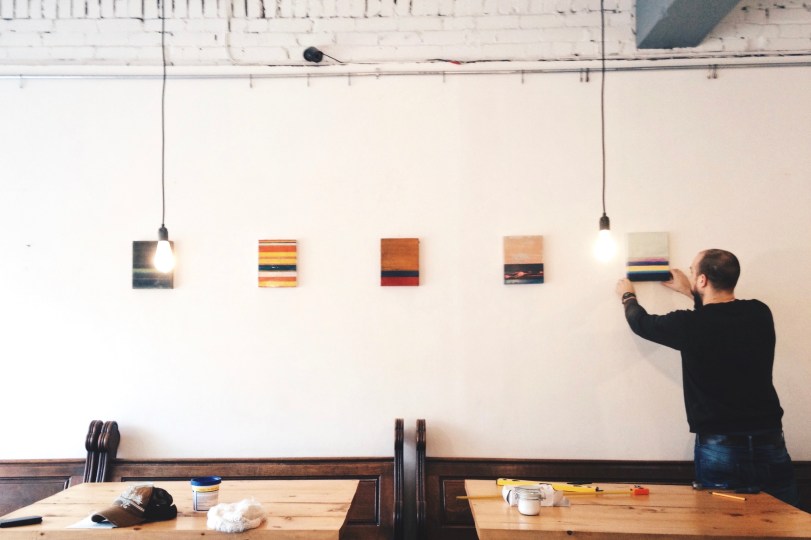
Tom Harman installs abstract paintings at Little Man Coffee Co., Cardiff. Photograph: Rhys Tranter.

When did you start painting?

Drawing and painting, for me, was what I always did and was always good at. Throughout school I only ever wanted to paint and couldn’t wait to leave at 16 and begin a BTECH in Art and Design at my local FE college. This was a great experience, at last getting to create visual material all day, every day. I was particularly interested in painting that had some form of social commentary and was influenced by the New Glasgow Boys, painters from the Glasgow School of Art such as Steven Campbell, Peter Howson and Ken Currie, as well as the big names in British painting such as Frank Auerbach, Leon Kossoff, Francis Bacon and Lucian Freud. (more…)

Aimee Pozorski discusses the complex ways we engage with art and writing in the wake of the September 11th attacks

We are conducting this interview fifteen years after the September 11th terrorist attacks took place. What motivated you to write Falling After 9/11? How did the project begin?

Aime Pozorski, Falling After 9/11: Crisis in American Art and Literature (Bloomsbury, 2016)
Aimee Pozorski, Falling After 9/11: Crisis in American Art and Literature (Bloomsbury, 2016)

The project began with the installation of Graydon Parrish’s 9/11 mural, Cycle of Terror and Tragedy, which was commissioned in 2002 by the New Britain Museum of American Art in my hometown of New Britain, CT. It took Parrish four years to complete the work, and when it was finally revealed, some critics savaged it for its commitments to Classical Realism. After being outraged that reviewers could be so callous, my training in trauma theory kicked in. As a trauma theorist who studies literature, I frequently consider ways in which a text’s moments of so-called failure can actually succeed in telling us something not only about the nature of representation but also about traumatic history itself. What does it mean that so many representations of 9/11 seemed inadequate? I asked myself. And does that have more do to with the nature of trauma and our reception of art and literature than it does with the singular talents or contributions of individual artists themselves?  (more…)

Neil Badmington discusses his fascination with the work of Barthes, the continuing relevance of critical theory, and his own approach to academic style
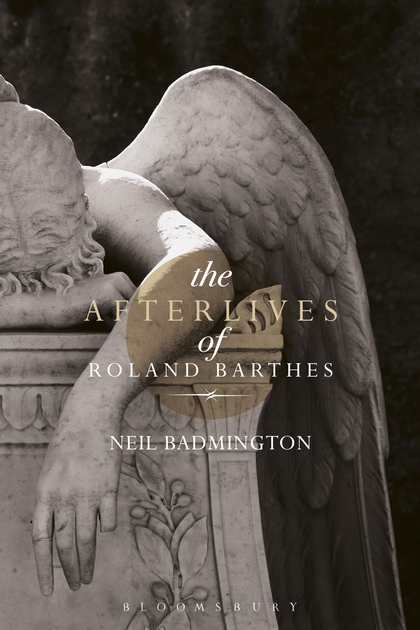
Neil Badmington, The Afterlives of Roland Barthes (Bloomsbury, 2016)

What led you to write The Afterlives of Roland Barthes?

‘Who’ rather than ‘What’, really. It’s all the fault of my good friend Jürgen Pieters, who has repeatedly led me, with our conversations over the years, in new directions. In 2006 Jürgen and Kris Pint (who was Jürgen’s PhD student at the time) organised a conference at their home institution of Ghent University on Barthes’s lecture courses at the Collège de France, which had recently appeared in print for the first time. I’m not sure why I was invited to participate: the other speakers were people with formidable reputations in the field of Barthes studies (Andy Stafford and Claude Coste, for instance), while I’d never written extensively about Barthes. His work had often informed mine up until that point — he’s there in Alien Chic and even the Posthumanism anthology, for instance — but he’d not been the primary object of analysis: I’d written with Barthes, not on Barthes. And the Barthes with whom I’d written had been the familiar Barthes, the ‘classic’ Barthes — the Barthes of S/Z and Mythologies, for example. But the unexpected invitation from Jürgen and Kris led me to look closely at the various volumes bearing Barthes’s name which had been published long after his death, and I was struck by how a different Barthes, another Barthes, was emerging gradually into print — not just the Barthes of the Collège years, but the Barthes of Travels in China, the Barthes of the seminars at the École pratique des hautes études, and the Barthes of Journal de deuil (or Mourning Diary, to give it its English title). It was the appearance of the latter in French in 2009 which really convinced me that The Afterlives of Roland Barthes needed to be written, in fact. I remember reading it at the time and realising as I turned the pages that it was altering my established perspective on Camera Lucida. This ‘new’ Barthes was reshaping the ‘old’ Barthes. In short, then, I wrote Afterlives to take stock of some of the posthumous publications which have appeared in recent years, and to ask how they might lead us to reconsider our understanding of the well-known publications which appeared during Barthes’s lifetime. (more…)

Ann Basu discusses how Philip Roth reveals the contradictions at the heart of American identity
Ann Basu, States of Trial: Manhood in Philip Roth's Post-War America (Bloomsbury, 2016)
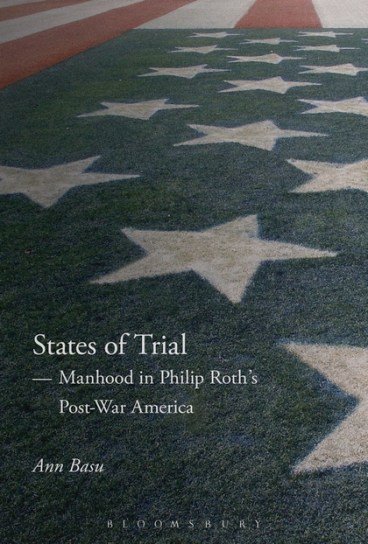
Ann Basu, States of Trial: Manhood in Philip Roth’s Post-War America (Bloomsbury, 2016)

What motivated you to write States of Trial?

My imagination was lit, in particular, by the historical perspectives of Roth’s American Trilogy: American Pastoral, (1997) I Married a Communist (1998) and The Human Stain (2000) as well as its forerunner, Operation Shylock (1993) and a slightly later novel, The Plot Against America (2004). I became fascinated by how Roth tests narratives about both national and male identity to the point of destruction, uncovering the contradictions within concepts of American identity. Roth displays a powerful sense of conflicting historical forces impacting on personal identity, combining this with portraits of individuals tormented by contradictions in their own lives; contradictions that may both stretch and limit them. I found these major late-career novels compelling and wanted to write about them. The trial, a resonant concept in terms of American history and personal identity with its connotations of testing, suffering and also experimentation, was a good lens, I thought. It was productive for me, anyway. (more…)