Carolyn Cocca discusses how women superheroes are changing the we way think about contemporary femininity

What motivated you to write Superwomen?

carolyn-cocca-superwomen-gender-power-representation
Carolyn Cocca, Superwomen: Gender, Power, and Representation (Bloomsbury, 2016)

As a kid, my three male neighbors and I would play “superheroes.” I was always “the girl,” whether that was Wonder Woman, or Princess Leia, or whoever, while the guys got to choose from among many characters. As I got older it still seemed that female characters were much less numerous than the male characters and were more sexualized than the male characters, and usually have weaker powers and less interesting stories. So I decided to formally apply my political science and gender studies training to this issue and found that what I felt growing up is true not only about superheroes but also about the way women are portrayed across fiction–they are portrayed much less often, with much less nuance, and with much less power. There has been some change over time, but not very much. So Superwomen investigates how and why this is the case. (more…)

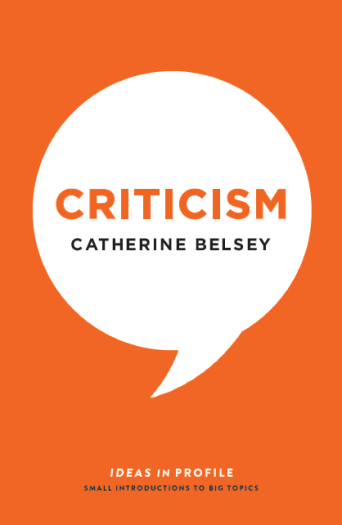
How the practice of criticism can offer a way to rethink our assumptions about truth, history, and human nature

What exactly do we mean by the term ‘criticism’?

Catherine Belsey, Criticism (Profile Books, 2016)

The publishers asked me that and I didn’t give them an answer! It’s a fair question but I’m uneasy about definitions. They’re a bit like written constitutions: they tie you down and exclude new possibilities. Definitions demarcate a legitimate area of activity – and close off other options.

In a general way, criticism is reflection on the stories, plays and poems we read (or see, or listen to). But in detail, it varies. For some people, it’s effectively a source of consumer advice: this film is worth going to; that novel is worth buying. Others might prefer to think about what differentiates genres, or the effects of different media. Does a play tell a story in the same way as a novel? Do novels tend to works as films, say?

Then there’s fiction as a record of the way we think about the world, or our ancestors once thought about it. Criticism offers access to cultural analysis and cultural history.

My own current preoccupation is pleasure. Why is fiction so enjoyable, even when the stories it tells are unhappy ones? Why does tragedy attract audiences? Other people have other concerns: it can all be criticism. (more…)

A secret charity auction with contributions from major artists and emerging talent

Art on a Postcard raises money for The Hepatitis C Trust through an annual secret postcard auction and ‘postcard lotteries’ which occur throughout the year. In recent years, work has been donated from established artists such as Peter Blake, Damien Hirst, Harland Miller, Gavin Turk, Rachel Howard, Gilbert and George, Polly Morgan, John Wragg RA, Stephen Chambers RA, Micheal Craig-Martin and Cecily Brown and emerging talent such as David Shillinglaw, Hayden Kays and Daisy Cook as well as urban artists, Ben Eine, Pure Evil and Inkie and photographers Dougie Wallace and Rankin. The project was founded by Gemma Peppé.

“I’m delighted to be part of this year’s The Hepatitis C Trust’s Art on a Postcard Secret Auction. While the secret auction democratises art, funds raised will help The Trust in its work towards ridding the county of hepatitis C, a killer disease which disproportionally affects an underprivileged community.”

— Grayson Perry

I caught up with some of this year’s artists to ask them about their involvement with the cause, and how they met the challenge set by the project. (more…)

The author talks about his new book, his influences, and his fascination with modern urban spaces

What made you choose the title “Imaginary Cities”?

Darran Anderson, Imaginary Cities

I had more romantic or esoteric titles in mind but it had to be something simple to give, what is a fairly sprawling and extremely rambling text, a sense of coherence. I’ve always liked books with minimalist titles; The Castle, The Plague, Notes from Underground, The Tin Drum, The Lottery. They seem far more evocative to me than The Lighthouse-Keeper’s Daughter-type titles you see a lot. At the same time, my intention was to write something that isn’t self-contained; a book that somehow spills out of its pages and into the world. Reading Susan Sontag’s On Photography, I was initially frustrated that she hadn’t included the photographs she was writing about. Later I came to realise this was a godsend as it sends you out searching and you end up finding entire worlds you didn’t know about – Diane Arbus, Roman Vishniac, Weegee, Vivian Maier. I tried to do the same with Imaginary Cities. I wanted to send people out looking for Sant’Elia or Chernikhov or whoever. It would be as much a map as a book.   (more…)

Joseph Anderton’s compelling new study explores the role of creaturely life in Beckett’s post-war prose and drama

Joseph Anderton, Beckett's Creatures: Art of Failure After the Holocaust (Bloomsbury, 2016)
Joseph Anderton, Beckett’s Creatures: Art of Failure After the Holocaust (Bloomsbury, 2016)
In the immediate aftermath of the Second World War, Samuel Beckett volunteered with the Irish Red Cross on the European continent. With a strong grasp several languages, the writer was assigned the role of driver and translator in the devastated Normandy city of Saint-Lô. During this time, while still stationed in the city, Beckett submitted a record of his experiences to Ireland’s national broadcaster, Radio Telefis Éireann (RTÉ). It was entitled ‘The Capital of the Ruins’. This unaired report on a landscape of wounded civilian casualties and collapsed buildings is the starting point for Joseph Anderton’s compelling new study, Beckett’s Creatures: Art of Failure After the Holocaust. [Read More]

This is an excerpt from a review of Joseph Anderton’s Beckett’s Creatures: Art of Failure After the Holocaust (Bloomsbury, 2016), published in Studies in Theatre and Performance(October, 2016).

Why critics of the Nobel Committee’s nomination are missing the point
Bob Dylan in the 1960s.

On 13 October, I was surprised and delighted to hear that Bob Dylan was awarded the Nobel Prize for Literature. The Nobel Committee selected Dylan ‘for having created new poetic expressions within the great American song tradition’. Few would question the songwriter’s contribution to the cultural landscape of the twentieth-century. His albums for Columbia Records in the 1960s document a deep knowledge and respect for American folk music, blues music, and poetry; Dylan adapted and reworked these forms to forge a compelling picaresque of the post-war American landscape.

“[…] literature, when traced back to its earliest forms, began as a poetic oral tradition frequently linked to rhythm, music, and song.”

There have been some who have responded to Dylan’s Nobel nomination with dismay, even anger. Some cite that his status as a songwriter might justify a place in the Rock and Roll Hall of Fame, but is not a ticket into the literary canon. Such detractors often fail to acknowledge that in addition to his music, Bob Dylan has also published poetry, experimental prose, and even a memoir. That’s to say nothing of his influence on countless more traditional literary figures. But this kind of categorization seems to miss the point. Those who reject Dylan’s candidacy for the Nobel forget that literature, when traced back to its earliest forms, began as a poetic oral tradition frequently linked to rhythm, music, and song. (more…)

A new title refines and condenses more than a decade of Jean-Michel Rabaté’s thinking on Beckett

Jean-Michel Rabaté , Think, Pig! Beckett at the Limit of the Human (Fordham University Press, 2016)
Glancing at the title of Jean-Michel Rabaté’s excellent new book, you might be forgiven for thinking it was some kind of self-help manual from the shelf of tough love. The author clears up any confusion: “This is not a self-help book”, he writes; rather it undermines such projects of affirmation by “questioning the humanism that we take for granted”. Through the motif of the “animal”, Samuel Beckett’s prose and drama re-examines what it means to be human in the aftermath of the Second World War. Think, Pig! (Pozzo’s demoralizing order to Lucky in Waiting for Godot) refines and condenses more than a decade of Rabaté’s thinking on Beckett. The book’s focus is ethical and interrogative, but is peppered with a lively and inventive sense of humour. [Read More]

This extract is from my review of Jean-Michel Rabaté’s Think, Pig! Beckett at the Limit of the Human, published in the Times Literary Supplement, 14 October 2016.