On pursuing a vocation in art, writing, and simple living

The reasons for my decision

Back in June, I attended a cardiology appointment that had a profound impact on me. My meeting with the cardiologist was routine and I did not receive any alarming news, but I became aware of the fragility of my own body in a new way. As an infant I was diagnosed with a congenital heart condition, and my life had been saved by the UK’s National Health Service and the surgeons at Great Ormond Street Hospital in London. I have always felt grateful for the life-saving help that I received, and could talk superficially about my condition with friends and loved ones, but now I see that I was also prone to a form of denial. Throughout my adolescence and early adulthood I placed my heart condition to one side as I tried to establish an identity for myself. My routine appointments continued from year to year, but in my conscious mind and my behaviour I aimed to suppress what they represented with denial and distraction. This year marks the first time that I am fully and consciously aware that I have a congenital heart condition. And while there is no reason why I cannot live a full and happy life, I am now awake to the fact that I nearly didn’t survive infancy.

(more…)
“Well, some of these old films I feel now that I was too impressed with movies I had seen and I only learned later on in my career that it was better not to refer to other movies but to refer to experiences you had on your own. The new films that were not really quoting other movies, I think I was happy with now in hindsight.”

— Wim Wenders, Collider

I recently had an opportunity to see David Lynch: The Art Life, a wonderful documentary about the American filmmaker David Lynch, directed by Jon Nguyen. The film offers unparalleled access to Lynch, and cobbles together a series of telling anecdotes about Lynch’s childhood in the suburbs, and his early days as a painter. ‘The Art Life’ refers to a lifestyle choice that Lynch adopted after reading Robert Henri’s book about painting, The Art Spirit: “The art spirit sort of became the art life, and I had this idea that you drink coffee, you smoke cigarettes, and you paint, and that’s it.” (more…)

Angela Moorjani on co-editing a new collection which recounts Samuel Beckett’s meetings with scholars, translators, and theatre practitioners

To begin, could you say a little bit about Samuel Beckett Today/Aujourd’hui?

SBT/A is a refereed academic journal that publishes essays in English and French on Samuel Beckett’s oeuvre.

When first launched in 1992 by the late Marius Buning and the present coeditor in chief Sjef Houppermans, it took the form of a bilingual annual review publishing selections from international meetings or solicited essays on special topics, but also featuring a section of submitted articles. By 2016, the year SBT/A morphed into a semiannual journal under a different academic publisher (Brill), twenty-seven handsome hardcover volumes had appeared under the Rodopi imprint. My association with SBT/A goes back twenty years with an essay in the “Crossroads and Borderlines” volume of 1997, further intensifying with my coediting the volume based on the “Beckett in Berlin 2000” symposium, after which I was invited to join the editorial board. I served as coeditor in chief from 2008 to 2016. (more…)

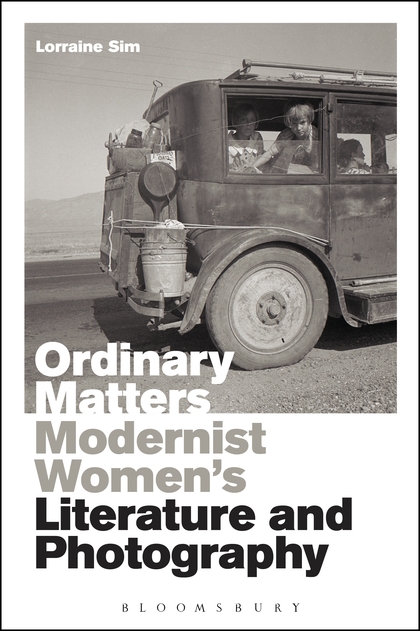
Lorraine Sim discusses how the women of modernism allow us to reimagine the ordinary and the everyday

Lorraine Sim, Ordinary Matters: Modernist Women's Literature and Photography (Bloomsbury, 2016)
Lorraine Sim, Ordinary Matters: Modernist Women’s Literature and Photography (Bloomsbury, 2016)

What inspired you to write Ordinary Matters?

The idea developed from my first book, Virginia Woolf: the Patterns of Ordinary Experience. Towards the end of that project I realised there was much more that I wanted to explore, both in terms of the concept of the everyday and its applications to modernism and cultural histories of early twentieth-century modernity. I remember reading H.D.’s fascinating wartime memoir, The Gift, while I was working on my book on Woolf, and seeing some of Lee Miller’s photographs of London during the Blitz around the same time, and I felt I needed to extend my exploration of the ordinary to a broader range of women writers, artists and contexts. The final chapter of Virginia Woolf looked at what I termed the ‘ethics of the ordinary’ in her oeuvre. This idea, of the ways in which the ordinary functions as a site of value (be it personal, social, moral or political), really fascinated me, and I wanted to explore it in a more comprehensive way. Also, many canonical and contemporary theories on the topic view the everyday negatively, or as requiring radical transformation, and I felt that this was a critical habit or commonplace that itself required interrogation. (more…)

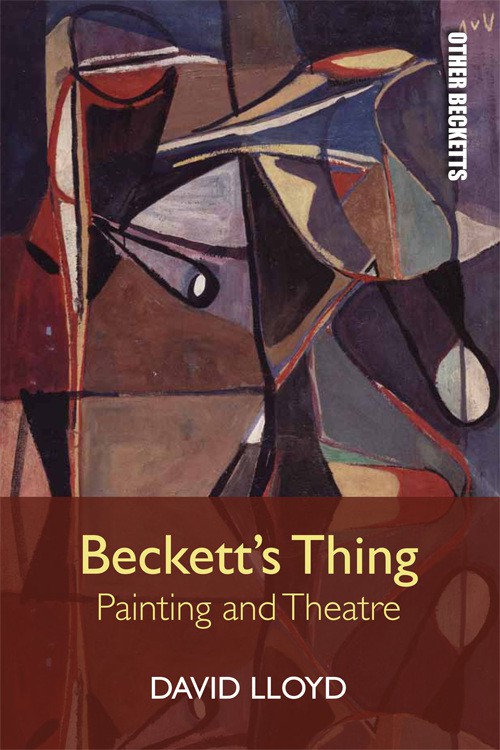
David Lloyd talks about Beckett’s friendships with twentieth-century painters and his enduring interest in the visual arts

David Lloyd, Beckett's Thing: Painting and Theatre (Edinburgh University Press, 2016)
David Lloyd, Beckett’s Thing: Painting and Theatre (Edinburgh University Press, 2016)

What draws you to the work of Samuel Beckett?

I’ve been reading Beckett’s work since I was a teenager and writing on him since my undergraduate days at Cambridge in the 70s. I dare say part of my initial attraction to Beckett lay in the kinds of philosophical conundra his work posed, in its hilarious comedy and in its ascetic reductionism. In a letter to Georges Duthuit, in which he comments on his desire for “a theatre reduced to its own means”, he goes on: “That is Protestantism if you like, we are what we are.” It may be that there was also something about the South Dublin Protestant background that I shared with Beckett that felt like grounds for affinity: certainly there was something familiar as much in the ethos as in the local landscapes secreted in the works. But above all, it was the uncompromising aesthetic ethic, the commitment to a work determined to “reduce itself to its own means”, that corresponded to the refusal of extraneous resources like the resonances of identity or signifiers of cultural belonging. That offered a quite different set of possibilities, intellectually and aesthetically, than Irish culture at the time generally made available. (more…)

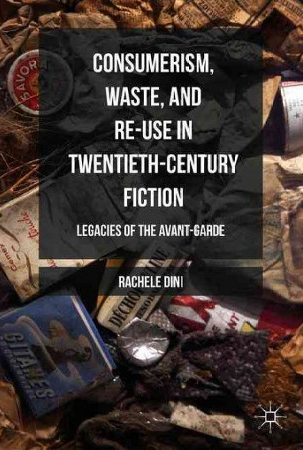
Rachele Dini discusses how the work of J.G. Ballard, Don DeLillo, and Samuel Beckett engages with one of the most pressing environmental issues of our time

Rachele Dini, Consumerism, Waste, and Re-Use in Twentieth-Century Fiction (Palgrave, 2016)

What motivated you to write Consumerism, Waste, and Re-Use in Twentieth-Century Fiction?

Well, I’ve been attracted to remnants of different kinds since I was very little, and was obsessed with cutting up magazines as a teenager—but intellectually, the turning point for me was during my MA at King’s College London. I noticed almost immediately that the texts on the modules I was taking were unusually concerned with fragments and fragmentation. Dickens, Zola, Eliot, Elizabeth Bowen, Fernando Pessoa, Virginia Woolf, Ballard, Calvino, and of course Walter Benjamin and Adorno: physical and metaphorical waste proliferates in all of these authors’ work. In hindsight, this was to be expected since the course focused on the seismic effects of capitalist modernity, and waste is certainly one of these. But that focus on residual matter reproaching you for throwing it away, or on things not working and stuff falling apart, especially compelled me at the time, since it was the opposite in every way from the focus of my day job in market research. Market research is an industry essentially devoted to promoting the very things that leftist theory denounces: its modus operandi is to find ways of selling more. So the first spark for the PhD project that ultimately turned into this book was the conflict between the rhetoric of ‘harder, better, faster, stronger’ (to quote Daft Punk) I was accustomed to in my working life, and all of the countercultural—or simply denunciatory—writing I discovered through my studies, which called that rhetoric into question. (more…)