
The most important sound engineer in jazz history has died, aged 91
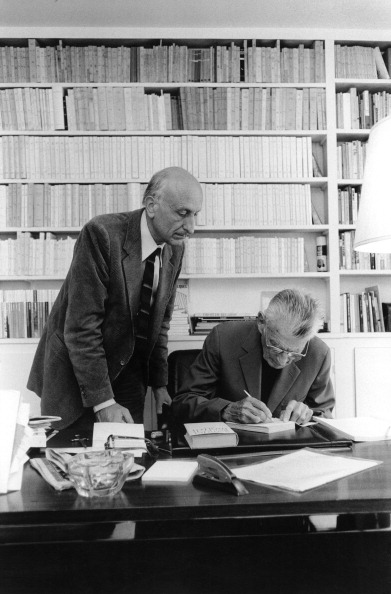
If you’ve ever heard a jazz record, chances are you’ve heard the work of Rudy Van Gelder. But you wouldn’t have heard him playing the drums, the piano, the saxophone, or the trumpet (although he had lessons in his youth) – and you wouldn’t have heard him singing into the microphone. That’s because he was the microphone. In a manner of speaking. Born in New Jersey on 2 November 1924, Rudolph (Rudy) Van Gelder became the most prominent sound engineer in American jazz history. He recorded just about every major figure in the canon, including Miles Davis, John Coltrane, Thelonious Monk, and Sonny Rollins.

(more…)

What the hit Netflix show can tell us about our fascination with ’80s nostalgia and American suburban gothic

stranger-things-poster.png

The word ‘stranger’ can suggest many things. One antiquated definition, used in the 18th and 19th century, refers to ‘things which are popularly imagined to forebode the coming of an unexpected visitor’ (OED). These ‘things’ might refer to tea leaves floating in a cup, a moth appearing suddenly out of the dark, or candlewax that causes the light of a flame to flicker and die. For viewers of Netflix’s thrilling new drama, Stranger Things, this superstition holds a unique significance.

(more…)

Simon Critchley’s philosophical antidote to the self-help manual

Since when did happiness, wisdom and contentment become the cornerstones of a fulfilling life? Whatever happened to doubt? Instability? Melancholia? In 2010, Polity Press published How to Stop Living and Start Worrying, a collection of interviews with Simon Critchley which playfully parodies the conventional self-help manual. Through a series of conversations with Carl Cedeström, Critchley sketches an alternative view of the role philosophy plays in our lives today, covering an ambitious range of topics: from science and religion, to poetry and politics, love and humour, life and death.

Critchley, a philosophy professor who teaches in New York, takes us step-by-step through the major themes of his work in an entertaining and accessible way. Each interview takes the form of an informal, improvised chat on a theoretical topic, elucidating terms and concepts with helpful metaphors and memorable anecdotes. Jokes also play a key role in the overall tone of the book, illuminating central ideas with a lightness of touch. (more…)

A 2011 review of the luxurious Sylph Edition
Archives: The writer Samuel Beckett in France in April, 1997.
Samuel Beckett

The title of George Craig’s recent book, Writing Beckett’s Letters, is both playful and paradoxical. And it prompts the question: how can Craig claim to be the author of someone else’s correspondence? The answer is both simple and complicated: Craig is a translator. He has spent the last fifteen years as part of a band of scholars, translating literally thousands of letters written by Samuel Beckett from French into English. It is a job that few are cut out for, involving long hours of arduous transcription and the seemingly endless search for that most elusive of things: the right word.

The work forms part of a hugely ambitious project, culminating in a four-volume edition of Samuel Beckett’s Letters. The first part, released in 2009, covered much of Beckett’s early period: intellectual development, his move to Paris, his encounters with James Joyce and the European literary scene. Its publication ushered a new period in the scholarly appreciation of Beckett’s work, whilst offering a rare glimpse into the personal and artistic life of this most private of writers. (more…)

A notable precursor to the contemporary zombie movie
IMG_6848
Richard Matheson, I Am Legend
Recently, I picked up a copy of Richard Matheson’s I Am Legend at a second-hand bookstore. Matheson—whose high-concept man vs. truck short story Duel was to launch the career of Steven Spielberg—made a name for himself in the genres of science-fiction, horror and fantasy. His writing spans novels and short stories, alongside work in television and film. I Am Legend, itself no stranger to the silver screen, has been adapted no less than three times, and is, in some ways, a reflective document of post-war American culture. First published in 1954, it laid an early foundation for zombie movies such as George Romero’s Night of the Living Dead (1968) series, and critiques many of the same social and cultural concerns associated with these later films.

“a reflective document of post-war American culture”

The plot revolves around Robert Neville, the ‘last living man on earth’. He navigates a post-apocalyptic landscape where every other man, woman, and child has been converted into zombie-like nocturnal vampires. It is a cautionary tale, negotiating the long-term impact of violence and exploitation in the atomic age.   (more…)

Does Fyodor Dostoyevsky’s Poor Folk and Other Stories speak to our troubled economic era?
Portrait of Fyodor Dostoyevsky by Vasily Perov (1872).

In November 1844, Dostoyevsky finished writing his first story. He confides in Diary of a Writer that he had ‘written nothing before that time’. This was 22 years before the publication of Crime and Punishment, and 36 years before The Brothers Karamazov. Having recently finished translating Balzac’s Eugénie Grandet, he suddenly felt inspired to write a tale ‘of the same dimensions’. But he was not only prompted by artistic aspirations. Poverty also played a part. In a letter to his brother, Mikhail, just a few months earlier, he mentions being satisfied with a work-in-progress, and his hopes for greater financial stability: ‘I may get 400 rubles for it,’ he wrote, ‘and therein lie all my hopes.’

First published in 1846, Poor Folk was both a critical and financial success, with one prominent critic hailing Dostoyevsky as the next Gogol. It is a short epistolary novel that traces a five-month love affair. And while it certainly owes something to Balzac’s masterpiece, the role that money plays in determining people’s fates has a distinctly Dostoyevskyan bite. Financial difficulties plagued the Russian novelist’s career, and are a recurrent theme throughout his work, from the destitute student of Crime and Punishment to The Gambler, written to pay off gambling debts. The writer confessed having money troubles in letters to his brother, and hoped Poor Folk could offer some kind of reprieve. It is through his pen, he says, that he hopes ‘to save the whole situation’, considering suicide as perhaps his only other alternative. Money, then, was one of the novelist’s chief motivations, and one of his signature themes. (more…)

On Raul Hilberg’s The Politics of Memory: The Journey of a Holocaust Historian

raulhilberg-thepoliticsofmemory-thejourneyofaholocausthistorian

As a child refugee from Europe at the outset of the Second World War, Raul Hilberg escaped with his parents to Paris, then Cuba, before settling permanently in the United States. This traumatic exile formed the basis of a lifelong preoccupation, by turns both emotional and intellectual, which culminated in the publication of his most noted work: The Destruction of the European Jews. His short 1996 memoir, The Politics of Memory: The Journey of a Holocaust Historian, tells the story of his life.

(more…)