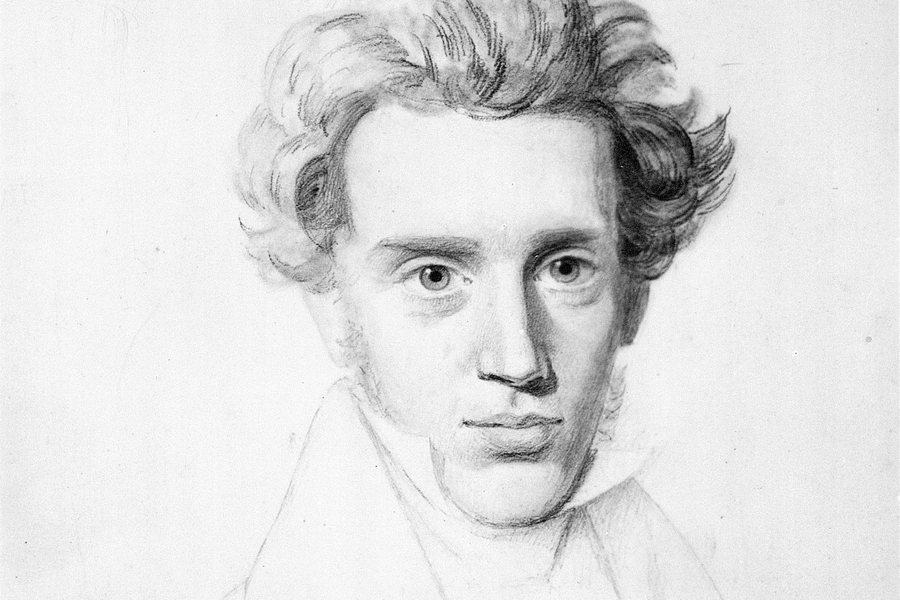
“What I really need is to get clear about what I must do, not what I must know, except insofar as knowledge must precede every act. What matters is to find a purpose, to see what it really is that God wills that I shall do; the crucial thing is to find a truth which is truth for me, to find the idea for which I am willing to live and die.”
A selection of quotations from Georges Bernanos’ 1937 novel
On alienation
Georges Bernanos, The Diary of a Country Priest
“Every day I become more aware of my own ignorance in the most elementary details of everyday life, which everybody seems to know without having learnt them, but a sort of instinct. Yet I don’t suppose I’m really more of a fool than most people, and if I stick to easily remembered rules of thumb, I can look as though I really understand what was going on. But all those words which seem to have such precise meaning for some folk, and pretty nigh indistinguishable to me, like a bad card-player to whom one lead seems as good as another. Whilst they were discussing the savings-banks I felt like a child strayed into a room full of gabbling grown-ups. […] I fear I shall never be practical, and I don’t improve with experience.”
“I left the Château late—far too late. I am also very bad at taking my leave. Each time the clock goes round I make a tentative move, calling forth much polite protestation which I have not the courage to resist. It might go on for hours!”
“My nervousness has lately become a real obsession. It is hard to conquer that childish unreasonable terror, which makes me turn with a jump whenever I feel the eyes of a passer-by. My heart comes into my mouth, and I can’t breathe freely again until I’ve heard his ‘good morning’ in answer to mine. When at last it comes I’ve ceased to hope for it.” (more…)
Autobiography is always negotiating two or more voices, speaking from separate and distinct moments in time. We can see this in what is perhaps the earliest example of modern autobiography, St Augustine‘s Confessions, where a present-day narrator attempts to reconstruct a previous life. In this way, autobiographical writing attempts to collapse the distance between childhood and adulthood, innocence and experience, and past and present. (more…)
Sarah Hammerschlag discusses how the work of Levinas and Derrida can help us to rethink the relationship between religion, literature, and philosophy
What motivated you to write the book?
Sarah Hammerschlag, Broken Tablets: Levinas, Derrida, and the Literary Afterlife of Religion (Columbia University Press, 2016)
This project developed organically out of my first book The Figural Jew, which focuses on the revalorization of the figure of the Jew in post-World War II French literature and philosophy. At the center of that project there was already a nascent argument for introducing literary modes of speech into the political sphere to capitalize on the ways in which irony and plurivocity complicate the politics of identity. The last couple of chapters of that book argue that Blanchot and Derrida develop a literary concept of the Jew and Judaism through a reading of Levinas. But I was still concerned to represent the differences between Derrida and Levinas on the question of how to think about the cultural relevance of Judaism in the post-WWII context and to consider the very important political implications of their respective choices. Broken Tablets gave me the opportunity to track the implications of those differences and to conceive of them in terms of how each philosopher negotiated his relationship to religion and literature as competing discourses to philosophy. (more…)
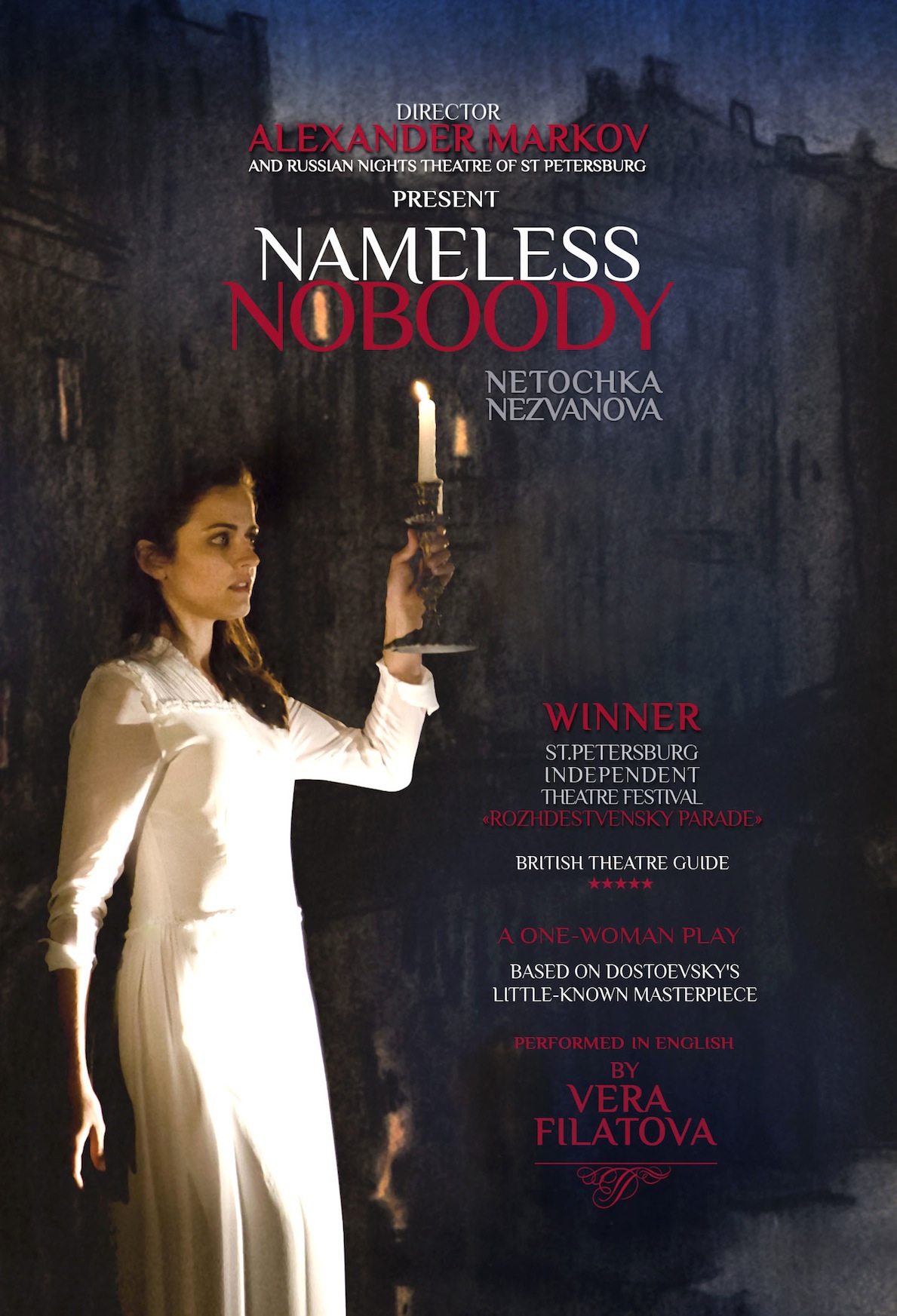
To celebrate the birthday of Fyodor Dostoevsky, I speak to film and television actress Vera Graziadei about her acclaimed one-woman performance of one of his most overlooked works
What first attracted you to Dostoevsky’s work?
Promotional image for Alexander Markov’s production of Nameless Nobody, starring Vera Graziadei
Nietzsche once said that Dostoevsky was “the only person who has ever taught me anything about psychology.” I became obsessed with Dostoevsky’s work during my early twenties when I read The Idiot, a masterpiece which became for me not only a source of psychological insight, but also of philosophical thought and spirituality – my other passions, aside from theatre and literature. He is one of those rare writers whose influence extends far beyond his immediate discipline.
It was fascinating for me as a student of Empiricist philosophy, who was dissatisfied with the rational positivist approach taught to me at LSE [London School of Economics and Political Science], to dwell on the “Shakespeare of the lunatic asylum”, and have a chance to explore the darker and more irrational sides of human nature. It was a revelation to realise that Dostoevsky’s philosophical thought is at the root of Existentialism, a branch of philosophy that resonates with me very strongly. And to find out that most existentialist thinkers, including Sarte and Camus, have at some stage addressed the issues raised by Fyodor Mihailovich. (more…)
“I want to be a force for real good. In other words. I know that there are bad forces, forces that bring suffering to others and misery to the world, but I want to be the opposite force. I want to be the force which is truly for good”
An exclusive glimpse inside a new online archive, cataloguing the Nobel laureate’s personal reading habits and artistic influences
Dirk Van Hulle and Mark Nixon, Samuel Beckett’s Library
The Beckett Digital Library (BDL) is a digital reconstruction of Samuel Beckett’s personal library, based on the volumes preserved at his apartment in Paris, in archives (Beckett International Foundation) and private collections (James and Elizabeth Knowlson Collection, Anne Atik, Noga Arikha, Terrence Killeen,…). It currently houses 757 extant volumes, as well as 248 virtual entries for which no physical copy has been retrieved.
The BDL module is a part of the Beckett Digital Manuscript Project and contains scans of book covers, title pages, all pages with reading traces, flyleaves, colophons, tables of contents, indexes and inserts of various kinds. In addition to facsimiles, the BDL also offers transcriptions of readings traces and links to Beckett’s manuscripts.
The BDL is accompanied by a monograph (Dirk Van Hulle and Mark Nixon, Samuel Beckett’s Library, Cambridge UP, 2013)
What follows is an exclusive preview of the Beckett Digital Library (BDL), with quotations excerpted from Van Hulle’s and Nixon’s companion book. Each image presents an actual edition owned by the writer himself. (more…)