Strayed’s memoir is a testament to the restorative power of art

In recent months I have become increasingly interested in writers who discuss nature and the wilderness in their work. I have been keeping a mental note of several writers to consider, and was trying to decide between J.A. Baker‘s landmark work The Peregrine, Robert MacFarlane‘s The Old Ways, or a selection of John Muir‘s writing about his time in the Sierra Nevada. Then I was reminded of a book that my wife had read the previous year, and decided to read the opening couple of pages to get a sense of the prose. The book was Cheryl Strayed‘s memoir, Wild, and I was hooked. (more…)

On pursuing a vocation in art, writing, and simple living

The reasons for my decision

Back in June, I attended a cardiology appointment that had a profound impact on me. My meeting with the cardiologist was routine and I did not receive any alarming news, but I became aware of the fragility of my own body in a new way. As an infant I was diagnosed with a congenital heart condition, and my life had been saved by the UK’s National Health Service and the surgeons at Great Ormond Street Hospital in London. I have always felt grateful for the life-saving help that I received, and could talk superficially about my condition with friends and loved ones, but now I see that I was also prone to a form of denial. Throughout my adolescence and early adulthood I placed my heart condition to one side as I tried to establish an identity for myself. My routine appointments continued from year to year, but in my conscious mind and my behaviour I aimed to suppress what they represented with denial and distraction. This year marks the first time that I am fully and consciously aware that I have a congenital heart condition. And while there is no reason why I cannot live a full and happy life, I am now awake to the fact that I nearly didn’t survive infancy.

(more…)

I recently rediscovered a copy of Marguerite Duras‘ fiction that had been packed away in a spare room for several years. It is a 1977 edition of “three novels” from publisher John Calder, short pieces offering English-speaking readers an introduction to the French post-war writer. The first novel within, entitled The Square (Le Square, 1955), presents a conversation between a servant girl and a commercial traveller as they sit in a city square. Duras renders the two strangers’ conversation with beautiful economy of expression; her prose style simply conveys their words, with occasional observations of their surroundings. As their exchange develops, the two share reflections on living a meaningful life.

What follows are a few choice quotations from Duras’ novel, translated into English by Sonia Pitt-Rivers and Irina Morduch. (more…)

The letters allow readers to glimpse over the shoulder of one of twentieth-century drama’s most distinguished playwrights as he corresponds with actors, directors, and loved ones

A philosopher in the ancient Greek city of Miletus posed a question. If somebody adds one grain of sand to another, and repeats the process, at what point do the grains of sand become a heap? The conundrum, known as the Sorites paradox, opens Samuel Beckett’s Endgame as part of Clov’s speech to the auditorium: ‘Finished, it’s finished, nearly finished, it must be nearly finished. [Pause] Grain upon grain, one by one, and one day suddenly, there’s a heap, a little heap, the impossible heap’. The paradox asks us to confront the ambiguities of rational thinking and empirical observation, and in Endgame it frames the ‘impossible’ problem of being in the world, of what constitutes a life lived.

I was reminded of the Sorites paradox in 2016, when Cambridge University Press published the fourth and final volume of Samuel Beckett’s correspondence. On the instruction of Beckett himself, Martha Dow Fehsenfeld led an editorial team to assemble, transcribe and translate thousands of letters, telegrams, and postcards held in archives and private collections around the world. These traces of Beckett’s personal and artistic life have been ordered chronologically, and fully annotated with cultural and historical notes that are accessible to the scholar and layman alike. Surmounting this seemingly impossible task, The Letters of Samuel Beckett brings these documents together in one place for the first time to form a masterwork of academic scholarship and rigour — allowing readers to glimpse over the shoulder of one of twentieth-century drama’s most distinguished playwrights as he corresponds with actors, directors, and loved ones.

This is an excerpt from a review of The Letters of Samuel Beckett: Volume 4, 1966-1989, edited by George Craig et al.,  (Cambridge University Press, 2016), published in Studies in Theatre and Performance (July, 2017).

Angela Moorjani on co-editing a new collection which recounts Samuel Beckett’s meetings with scholars, translators, and theatre practitioners

To begin, could you say a little bit about Samuel Beckett Today/Aujourd’hui?

SBT/A is a refereed academic journal that publishes essays in English and French on Samuel Beckett’s oeuvre.

When first launched in 1992 by the late Marius Buning and the present coeditor in chief Sjef Houppermans, it took the form of a bilingual annual review publishing selections from international meetings or solicited essays on special topics, but also featuring a section of submitted articles. By 2016, the year SBT/A morphed into a semiannual journal under a different academic publisher (Brill), twenty-seven handsome hardcover volumes had appeared under the Rodopi imprint. My association with SBT/A goes back twenty years with an essay in the “Crossroads and Borderlines” volume of 1997, further intensifying with my coediting the volume based on the “Beckett in Berlin 2000” symposium, after which I was invited to join the editorial board. I served as coeditor in chief from 2008 to 2016. (more…)

Anthony Uhlmann on co-editing a new essay collection exploring Coetzee’s recent novel, The Childhood of Jesus

How did you first encounter J.M. Coetzee’s writing?

In 2002 I was working on the preparation for a major conference on Samuel Beckett that was to take place in Sydney in 2003 and I was looking for keynotes. There was a major public lecture at the Sydney Town Hall which is a reasonably grand space. We invited a number of people including Herbert Blau and Luce Irigaray (via videolink). Someone suggested I ask J. M. Coetzee who was on the board of one of the research groups related to Samuel Beckett. I then went and read a few of his novels, including Disgrace, Waiting for the Barbarians, and The Master of Petersburg and was blown away by the quality of the works. I told him when I finally met him that he had renewed my faith in contemporary fiction. He agreed to act as a keynote and read the ‘At The Gate’ Lesson from Elizabeth Costello which had not yet been published when he read it January 2003. He spoke briefly of having mostly gained an understanding of rhythm, and the structure of sentences, from reading and studying Beckett. After that I read all of his novels and have been working towards writing about him. (more…)

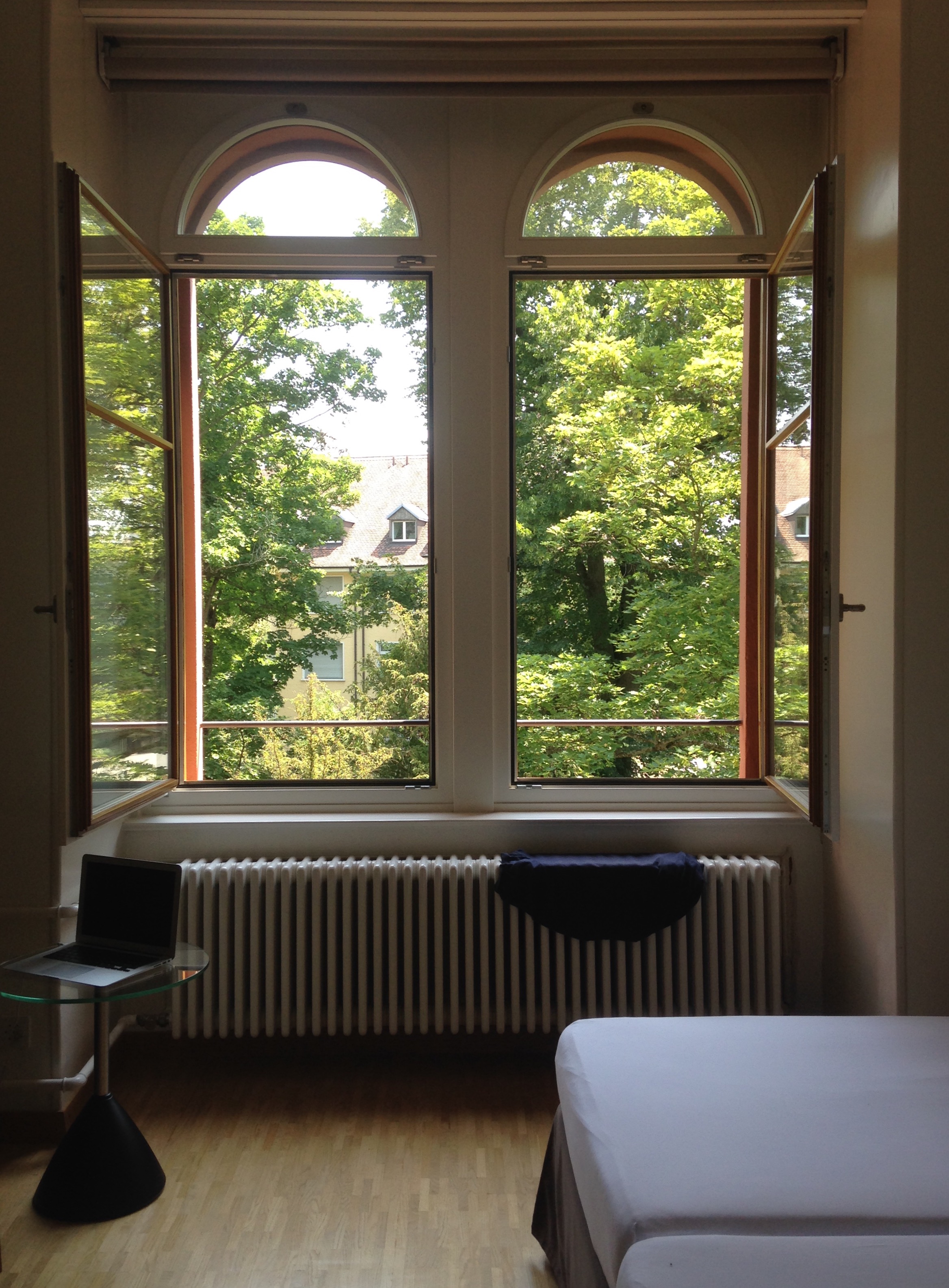
fullsizeoutput_5eavsco-rhystranter
Hotel BildungsZentrum, Basel, Switzerland.

I am staying at the Hotel BildungsZentrum in Basel, Switzerland. It is thirty-four degrees centigrade. I’m sustaining myself with delicious fresh fruit and cold green tea. Having finished my work late this morning I picked up Tolstoy’s Anna Karenina, and it would appear that Levin is beginning his transformation. (more…)