
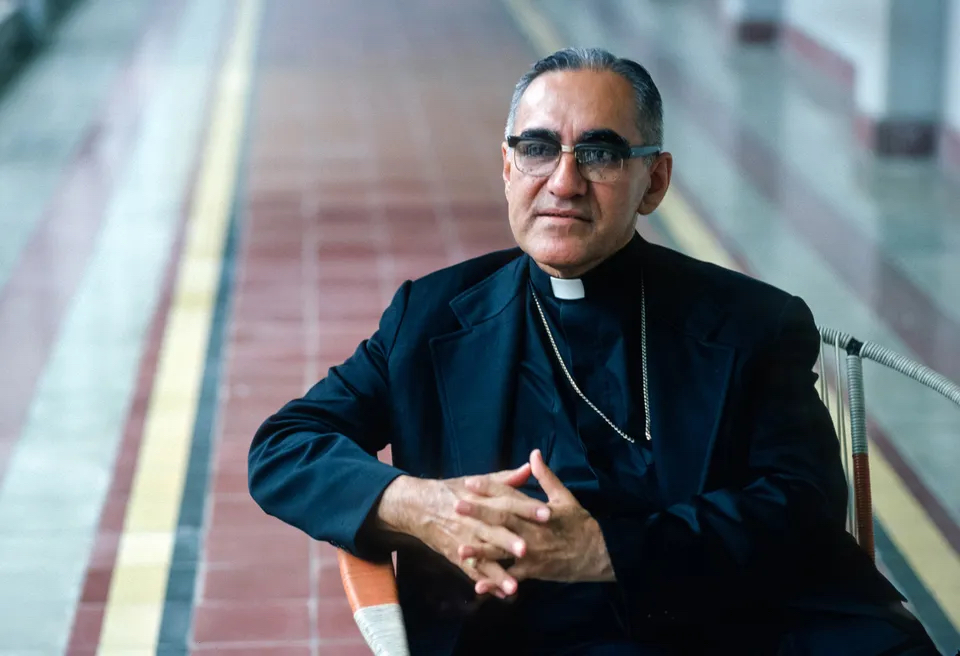
A beautiful prayer about vocation by Bishop Ken Untener of Saginaw, often attributed to St Óscar Romero:
(more…)A beautiful prayer about vocation by Bishop Ken Untener of Saginaw, often attributed to St Óscar Romero:
(more…)In the years leading up to my conversion, I gradually became fascinated by Thomas á Kempis’s devotional text, The Imitation of Christ. I encountered it first in the letters of the young Samuel Beckett, and next in the interviews of Estonian composer Arvo Pärt, and then in all kinds of other unexpected places. Among them, this 1877 letter from Vincent Van Gogh to his beloved brother, Theo:
(more…)
Corresponding from distant Paris, Fr Huvelin offers spiritual advice to St Charles de Foucauld as he works as a gardener in Nazareth:
“Nourish yourself on the Psalms, which give such vivid expression to the feelings that feed the soul united to God or in search of him.”
— 13 May 1897, qtd. in Jean-Jacques Antier, Charles de Foucauld

On Holy Thursday, we visit St Peter’s Square and enter St Peter’s Basilica in Vatican City. We spend time in prayer at the Altar of the Crucifixion of Saint Peter; at the Chapel of the Sacrament; and at the Tomb of Saint Peter the Apostle underneath the Main Altar (Saint Peter’s Baldachin).


Saturday afternoon. Revisiting Merton, Newman, and this from Madeleine Delbrêl:
“We are not lacking silence. We already have it. / If we lack silence, it is because we have not learned how to keep it. / All the noises that surround us make much less din than we ourselves do. / The real noise is the echo that things have in us. / It is not speaking that necessarily breaks the silence. / Silence is the place of the word of God, and if we confine ourselves to repeating this word, then we can speak without ceasing to be silent.”
— The Dazzling Light of God, trans. Mary Dudro Gordon
“Mary arose and went with haste” — Luke 7:39
In July and August, I accompanied the Archdiocese of Cardiff and the Diocese of Menevia on a two-week pilgrimage to World Youth Day in Lisbon, Portugal. I acted as one of the Team Leaders joining over fifty other pilgrims on the journey, including Archbishop Mark O’Toole and five young pilgrims from St David’s Catholic Sixth Form College in Cardiff.
The first week was spent in the Diocese of Porto, exploring the rich cultural history and life of the Church from our local accommodation in the town of Aguda. Our second week was spent in Fàtima, where we visited key historical sites and welcomed Pope Francis to a public prayer service before the Shrine. The trip culminated in World Youth Day itself, a major event that hosted around 1.5 million pilgrims to a communal all-night vigil and Mass.
The pilgrimage was one of the most personally and professionally satisfying events of my life and career. I moderated a Q&A between pilgrims and the Archbishop where a range of challenging topics were discussed with patience, openness and nuance; and it was a privilege to lead an Examen in a Chapel of Reconciliation in Fátima itself. The places and people we encountered helped to broaden and deepen my understanding of the universal Church; the happy and excited atmosphere of some of the events was like nothing I have experienced before; and it was a joy and a reward to spend time building so many meaningful relationships with my fellow pilgrims. I will be forever grateful for this opportunity, and the many graces it has afforded.
Here are a few images from the trip.
(more…)“All important things in life are simple.” — Arvo Pärt
In July, Jenn and I travelled to Estonia to visit the Arvo Pärt Centre in Laulasmaa. Pärt is the most-performed living composer in the world, and his life and work played a key role in the development of my faith. We even saw Arvo Pärt and his wife Nora shopping at their local village supermarket! Included here are some images from our day, although we did not take any photographs of or approach the Pärts out of respect for their privacy.
(more…)
